
When a new student joins DGMI, I do not start with SEO or ads. I start with one question: “Who exactly are you trying to reach?” Almost everyone answers “everyone” or “people who need my product.” Both answers are why their marketing later fails. Twelve years of running campaigns has taught me one thing above all others: audience research is the skill underneath every other skill. Get it right and SEO, ads, content and social all become easier, cheaper and more effective. Get it wrong and no amount of tactics can save you. This guide is exactly how I teach it: what a target audience really is, the four layers that make it useful, and a repeatable seven-step process to research one for every marketing channel. Written for beginners, with free tools and real examples.
A target audience is the specific group of people most likely to want what you offer, defined precisely enough that you know what they need, where they spend attention, and what words they use for their problem. It is not “everyone who might buy,” it is the narrow group you can reach efficiently and convince honestly. A useful target audience has four layers: demographics (who they are), psychographics (why they choose), behaviour (what they do and search), and pain and intent (the problem they need solved now). Most beginners describe only the first layer. The money, and the marketing that works, lives in the last two.
• Marketers who use audience segmentation report significantly higher campaign ROI than those who blast one message to everyone
• Facebook’s 2026 delivery system (Andromeda) now reads your creative to find your audience, so knowing who you are talking to matters more than manual targeting sliders
• Google rewards content with genuine first-hand relevance to a specific audience (E-E-A-T); generic “for everyone” content is exactly what AI now summarizes and buries
• The cost of getting it wrong: wasted ad spend, content nobody shares, and SEO that ranks for words your buyers never type
1. What a Target Audience Actually Is (and Is Not)
A target audience is the group of people most likely to buy from you, defined clearly enough to guide every marketing decision. That last part is what separates a useful definition from a useless one. “Adults in India” is a description; it guides nothing. “Women aged 28 to 40 in Jaipur who just moved into a new flat and feel overwhelmed decorating it” is a target audience; it tells you what to write, where to advertise, and which words to rank for.
Here is the distinction that trips up every beginner. Your target audience is not everyone who could use your product. A gym could technically serve anyone with a body. But a gym that markets to “everyone” competes with every other gym on price and reaches no one deeply. The same gym that targets “busy professionals aged 30 to 45 who feel unfit and guilty but have no time” can write ads, posts and pages that make that specific person feel understood, and that person converts. Narrowing your audience does not shrink your business; it sharpens your marketing so the right people actually notice.
A related idea you will hear is the buyer persona: a semi-fictional character that represents your target audience, given a name, a photo, a story and specific traits. A target audience is the group; a persona is the face you give it so your whole team pictures the same person. We will build one together in the process section.
2. The 4 Layers of a Useful Target Audience
A target audience becomes useful as you add depth. Think of it as four layers, each one making your marketing sharper. Most beginners stop at layer one, which is exactly why their marketing feels generic.
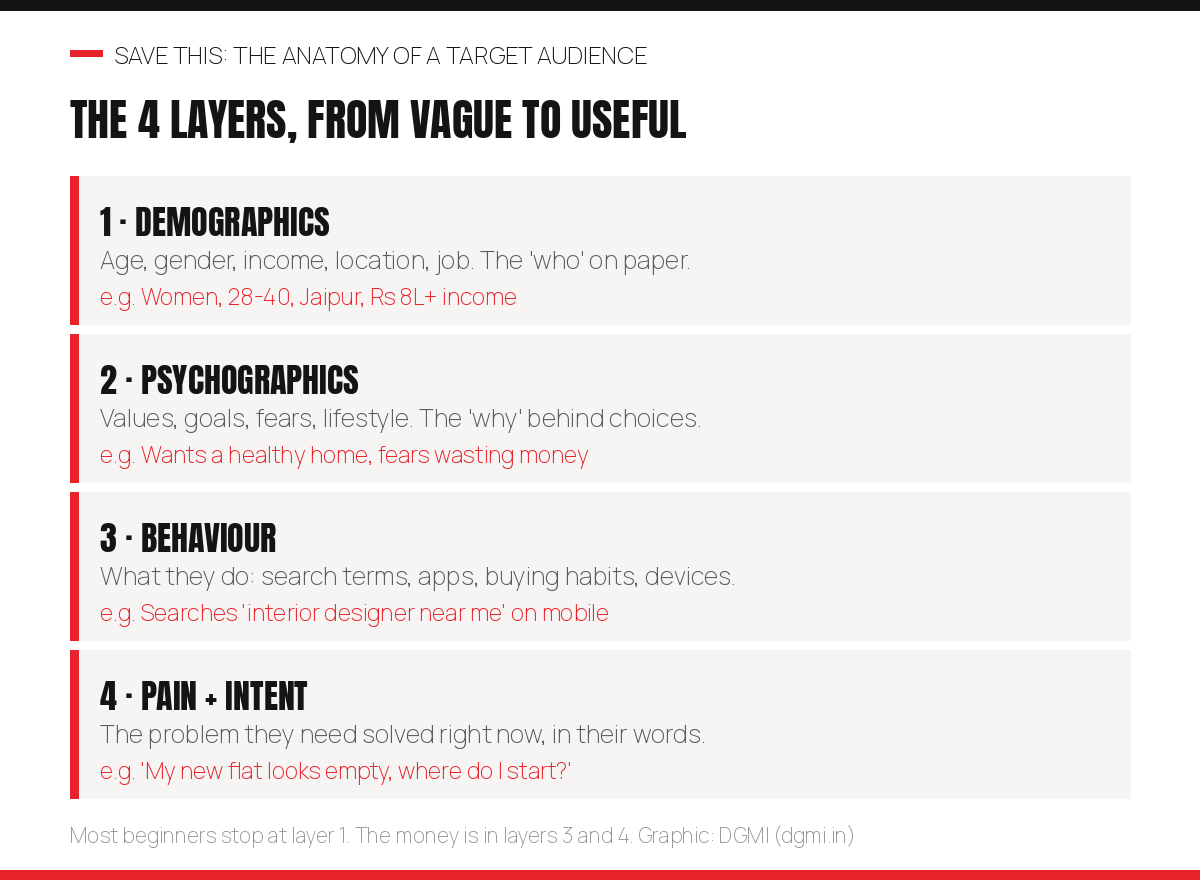
Layer 1, demographics, is the “who on paper”: age, gender, income, location, education, job. Necessary but shallow. Two people with identical demographics can want completely opposite things. Layer 2, psychographics, is the “why”: their values, goals, fears and lifestyle. This is where marketing starts to work, because people buy for emotional reasons and justify with logic. Layer 3, behaviour, is what they actually do: the terms they search, the apps they open, the devices they use, how they buy. This layer is pure gold because it is observable and it tells you exactly where to show up. Layer 4, pain and intent, is the problem they need solved right now, ideally in their own words. Nail this layer and your headline can quote the sentence already running through their head. That is the moment marketing stops feeling like marketing and starts feeling like help.
3. Why “Everyone” Is the Most Expensive Answer
When I push back on “my audience is everyone,” students think targeting narrowly will cost them customers. The opposite is true, and here is the practical proof from running real budgets. Say you have ₹10,000 for ads. Aimed at “everyone,” it buys a thin, generic impression across a huge crowd, most of whom will never care, and your cost per result is high because your message fits no one perfectly. Aimed at one sharp audience, the same ₹10,000 concentrates on people primed to respond, your message hits home, and your cost per result drops. Same money, very different outcome.
It compounds beyond ads. Generic content ranks for nothing because it competes with the whole internet and, in 2026, gets summarized away by AI Overviews (we cover this in our algorithm updates guide). Specific content ranks because it answers a specific person completely. Even Facebook’s 2026 ad system rewards specificity: its Andromeda delivery reads your creative to find your buyers, so the clearer you signal who your product is for, the better the machine performs. Vague targeting is not a safe middle ground. It is the one choice that fails on every channel at once.
4. The 7-Step Audience Research Process (Exact Steps)
This is the exact sequence I walk students through, now with the precise actions inside each step. It works for a business owner defining customers or a freelancer researching a client’s market. Budget roughly 4 to 6 focused hours across a week. Use a real example as you read: I will define the audience for a fictional Jaipur interior designer named Priya, so each step produces something concrete you can copy.
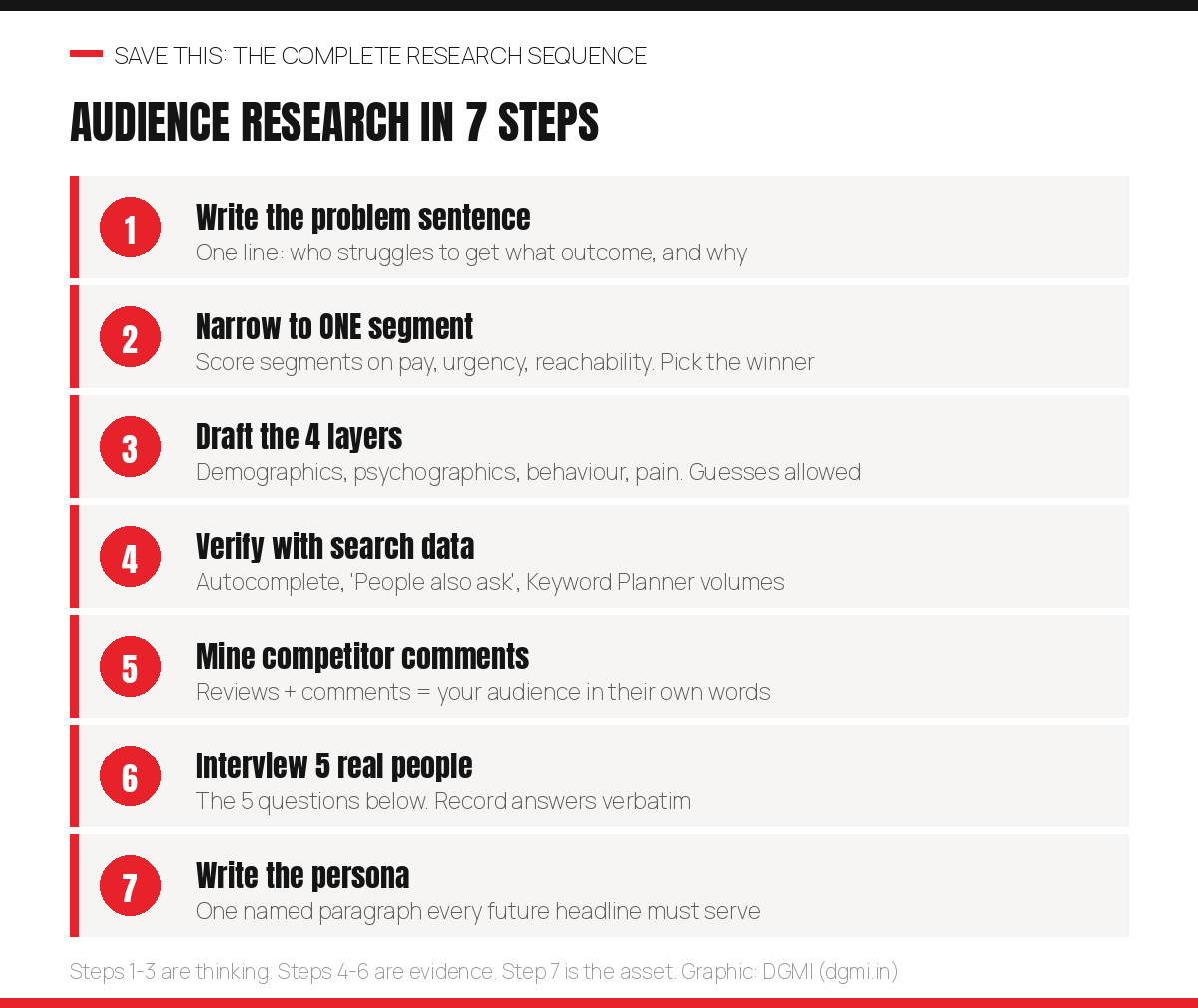
Step 1 · Write the problem sentence (15 minutes)
Open a blank document and write this formula three times, each version sharper: “[Person] struggles to [get outcome] because [obstacle].” Do not mention your product at all; people search for their problem, not your service name. Then pick the version that feels most specific and slightly uncomfortable to read, because specific and uncomfortable is what real problems feel like. 👀 What you should have at the end: one sentence. Priya’s: “New homeowners in Jaipur struggle to turn an empty flat into a home they love because design feels expensive, confusing and full of pushy salespeople.”
Step 2 · Narrow to ONE segment (20 minutes)
List every group that has your problem, then make a small scoring table with four columns: segment, ability to pay (1 to 5), urgency (1 to 5), reachability (1 to 5). Score honestly and total each row. Reachability means: can you actually get in front of them affordably (they search on Google, they are on Instagram, you can meet them locally)? Pick the highest total, and resist the urge to keep two. 👀 What you should have: one winning segment. Priya’s table has new homeowners (13), renters (9), offices (10), restaurants (8); new homeowners aged 28 to 45 win.
Step 3 · Draft the 4 layers (30 minutes)
Using the layer card from section 2, answer these prompts in writing for your winning segment. Demographics: age range, gender split, income band, exact locations, typical jobs. Psychographics: what do they want their life to look like, what do they fear wasting, whose opinion do they care about, what do they believe about your category? Behaviour: what would they type into Google at 11 pm, which apps eat their evenings, do they research heavily or buy on impulse, mobile or desktop? Pain and intent: finish this sentence in their voice: “I just want ______ but ______.” Guessing is allowed and expected here; steps 4 to 6 exist to correct you. 👀 What you should have: a one-page draft profile with question marks next to your shakiest guesses.
Step 4 · Verify with real search data (45 minutes)
Now replace guesses with evidence, in this order:
- 4a. Autocomplete mining: open an incognito window (so your history does not distort results), go to Google, and type the first 3 to 4 words of your problem slowly: “interior designer ja…”, “interior design cost…”. Write down every autocomplete suggestion that appears; each one is a real, frequently-typed search.
- 4b. “People also ask” mining: run the search, scroll to the PAA box, and click 2 or 3 questions open (clicking loads more). Copy every relevant question into your document; these are content ideas AND the audience’s actual vocabulary.
- 4c. Keyword Planner volumes: in Google Ads go to Tools → Keyword Planner → Discover new keywords, enter 3 seed terms from 4a, set the location to your target city or country, and sort by average monthly searches. Record the top 10 terms with their volumes. Numbers turn opinions into decisions.
- 4d. If you already have a website: open Search Console → Performance → Queries (last 3 months) and note the queries with high impressions. That is your real audience describing itself; our SEO checklist shows the setup if you have not connected it yet.
👀 What you should have: a list of 15 to 25 real phrases with volumes. Priya discovers “how much does interior design cost in Jaipur” outsearches “interior designer Jaipur”, so cost transparency becomes her lead message, a money-changing insight she would never have guessed.
Step 5 · Mine competitor comments and reviews (45 minutes)
Your audience is already talking, publicly, under your competitors’ content. Pick your 3 nearest competitors, then create a “voice file” spreadsheet with three columns: exact phrase, where you found it, what it reveals (a fear, a desire, an objection, a trigger). Fill it from four places: their Google reviews (read 5-star reviews for the outcomes people celebrate, and 1 to 3-star reviews for the fears and objections nobody tells you directly), the comments on their most popular Instagram posts, the questions under YouTube videos in your niche, and Reddit or Quora threads about the problem. Copy phrases verbatim; do not paraphrase. 👀 What you should have: at least 15 verbatim phrases. Priya’s file fills with variations of “they kept pushing expensive things I never asked for”, which is an objection her marketing can now answer head-on.
Step 6 · Interview 5 real people (the highest-value hour you will spend)
One real conversation beats a hundred assumptions. Finding five people is easier than it sounds: past customers if you have them; otherwise friends-of-friends who fit the segment, members of relevant local or Facebook groups, or people who commented on competitor content. Send this exact message: “Hi! I am researching how people choose [category] and your experience would genuinely help. Could I ask you 5 quick questions on a 10-minute call or right here on chat? No selling, I promise.” Then ask the five questions on this card, and obey its golden rule:
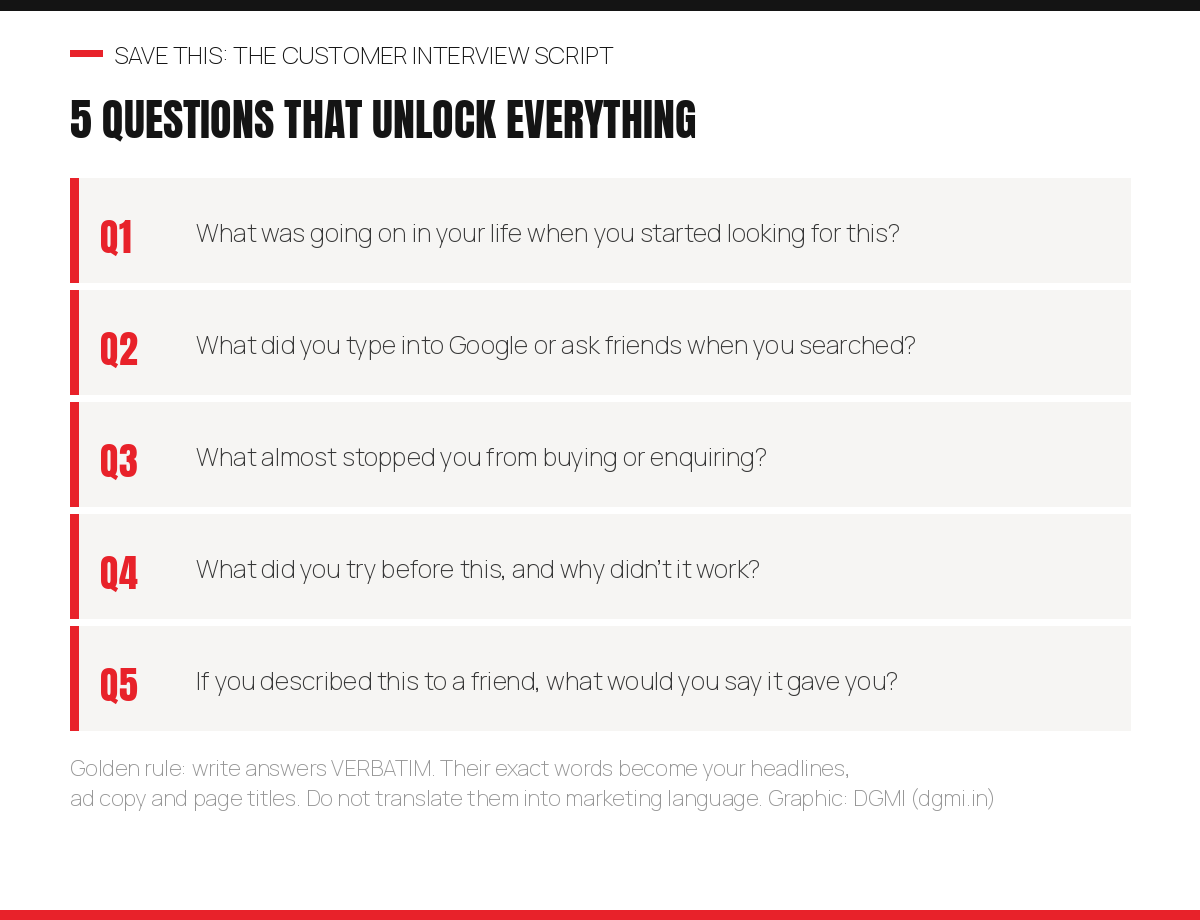
👀 What you should have: pages of verbatim notes with recurring patterns highlighted. Priya hears the same fear from three of five people: “I was scared it would get too expensive and I would be pushed into things I did not want.” That sentence, almost word for word, becomes her homepage headline.
Step 7 · Write the one-paragraph persona (20 minutes)
Compress everything into a short, named story using this fill-in-the-blanks template. Every blank should be filled from evidence you collected in steps 4 to 6, not imagination:
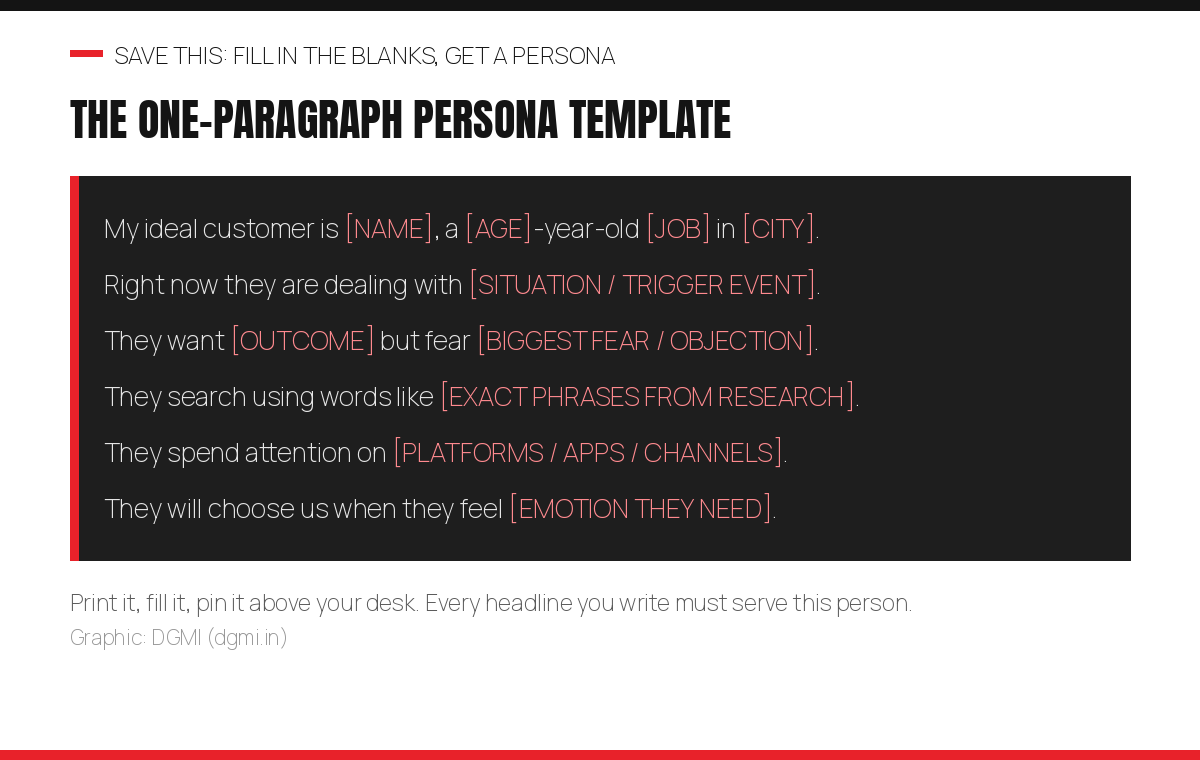
Priya’s finished persona: “My ideal customer is Neha, a 32-year-old software professional in Jaipur. Right now she is moving into her first owned 2BHK. She wants a home that finally feels like hers but fears overspending and being upsold. She searches ‘affordable interior designer Jaipur’ and ‘interior design cost Jaipur’. She spends attention on Instagram Reels and Google. She will choose us when she feels safe and in control of the budget.” 👀 The final test: pin this paragraph where you work. From now on, every headline, ad, Reel and page either speaks to Neha or does not get published. That single discipline is worth more than most paid courses.
🎯 Audience Research Is Step One. We Teach All of It.
At DGMI, every student practices this exact process on a real business before touching a single tactic, because targeting is what makes SEO, ads and content actually work. Learn the full skill set, live and 1:1 on real projects. Start with a 100% practical crash course class, FREE this week.
5. How to Research Your Audience for Each Technique
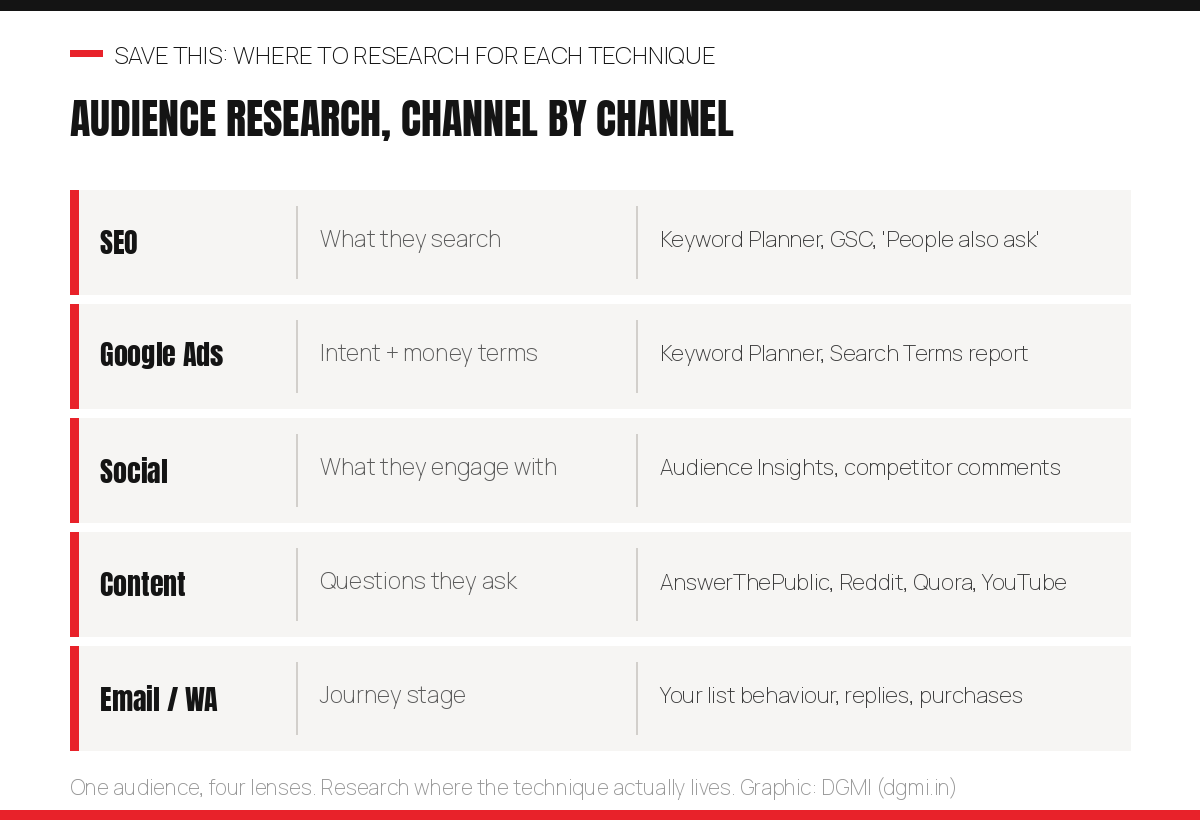
Here is the part most guides skip. The same audience shows up differently on each channel, so you research each one where the technique actually lives. One audience, four lenses.
For SEO: research what they search
SEO is about matching the words your audience types. Use Google Keyword Planner and Search Console to find the exact terms and their volume, mine “People also ask” and autocomplete for real questions, and note the difference between how you describe your service and how they search for it. Priya optimizes for “affordable interior designer Jaipur” and “interior design cost Jaipur,” not the industry jargon she would have guessed. Our SEO checklist and keyword research guide go deep on this.
For Google Ads: research intent and money terms
Ads add a money dimension: which searches signal someone ready to pay, not just browse. “Interior design ideas” is a browser; “hire interior designer Jaipur” is a buyer. Use Keyword Planner for commercial-intent terms and, once running, the Search Terms report to see the actual phrases triggering your ads, then cut the wasteful ones. This is core to not lighting budget on fire, covered fully in our Google Ads guide.
For social media: research what they engage with
On social, your audience reveals itself through what it stops to watch, like and share. Use Meta Audience Insights for interests and demographics, but spend more time reading the comments on competitors’ popular posts: the questions, objections and phrases there are your content brief. In 2026, the strongest signal is what people privately share (sends per reach on Instagram), so study what content in your niche gets forwarded, not just liked. Our platform algorithm guide breaks down each network’s signals.
For content marketing: research the questions they ask
Content is about answering real questions better than anyone else. Use free tools like AnswerThePublic for question clusters, and read Reddit threads, Quora questions and YouTube search suggestions in your niche. Each real question is a content idea with built-in demand. Priya notices repeated questions about “how to decorate a small 2BHK on a budget” and builds her most-viewed blog and Reel series around exactly that.
6. Free Tools to Research Your Audience
You do not need paid software to start. These free tools cover the whole process:
- ✓ Google Keyword Planner (free with a Google Ads account): search volumes and the real terms people use.
- ✓ Google Search Console (free): once you have a site, the exact queries bringing people to you, straight from your real audience.
- ✓ AnswerThePublic and “People also ask”: the questions your audience is actually asking, ready to answer.
- ✓ Meta Audience Insights and competitor comment sections: interests, language and objections in your audience’s own words.
- ✓ Reddit, Quora and YouTube search: unfiltered questions and the exact phrasing to mirror in your marketing.
Modern AI tools speed this up too: you can paste your competitor reviews or survey answers into an AI assistant and ask it to cluster the recurring themes and pains. Just verify what it finds against real sources; the human judgment is the point, as we explain in our AI tools guide.
7. Five Common Mistakes Beginners Make
- ✗ 1. Targeting “everyone.” The single most expensive mistake, for all the reasons above. Narrow to sharpen.
- ✗ 2. Stopping at demographics. “Women 25 to 40” tells you almost nothing about what to say. Push to psychographics, behaviour, and pain.
- ✗ 3. Guessing instead of researching. Your assumptions about your audience are hypotheses, not facts. Verify with search data and real conversations.
- ✗ 4. Describing your audience in your words, not theirs. Marketing works when you use the audience’s exact language. Collect their phrases; do not translate them into jargon.
- ✗ 5. Defining it once and forgetting it. Audiences shift. Revisit your research every few months and after any major result, good or bad.
8. FAQ
What is the difference between a target audience and a target market?
A target market is the broad group your business serves (for example, “homeowners in Jaipur”). A target audience is narrower and marketing-specific: the exact people a particular campaign or piece of content speaks to (for example, “new 2BHK owners aged 28 to 40 worried about overspending on decor”). One business can have one target market and several target audiences for different campaigns. In practice, the more specific your target audience, the better your marketing performs.
Can I have more than one target audience?
Yes, most businesses do, but start with one. Master researching and marketing to a single sharp audience first, get results, then add a second. Trying to serve several audiences before you can serve one usually produces marketing that is vague for all of them. When you do add audiences, research each one separately with this same seven-step process; do not assume they think alike.
How do I research an audience if I have no customers yet?
You borrow other people’s audiences. Study competitors: their reviews, comments and the questions under their content reveal exactly who buys and why. Read Reddit and Quora threads where people discuss your problem area. Use Keyword Planner to see what and how much people search. And talk to five people who fit your intended segment even if they are not customers yet. You will have a solid, evidence-based audience before you make a single sale.
Do I need paid tools to research my target audience?
No. Everything in the process section can be done with free tools: Google Keyword Planner, Search Console, AnswerThePublic, “People also ask,” Meta Audience Insights, and simply reading competitor comments, Reddit and Quora. Paid tools speed up and deepen the work once you are established, but a beginner can build an excellent audience profile for zero rupees. The limiting factor is effort and honesty, not budget.
How often should I update my target audience research?
Revisit it every three to six months, and immediately after any significant change: a new product, a big campaign result, a market shift, or a run of feedback that surprises you. Audiences evolve as their circumstances, platforms and language change. A target audience defined in 2023 and never revisited is almost certainly out of date in 2026, especially given how fast search and social behaviour have shifted with AI. Treat it as a living document, not a one-time exercise.
🚀 Turn Audience Research Into Real Results
DGMI’s 3-month Digital Marketing + AI Course (₹29,999) starts where this guide does, with understanding your audience, then builds every skill on top: SEO, GEO, ads, content, social, analytics and AI, practiced live and 1:1 on real projects with worldwide-recognized certification. Start with a free practical crash course class.
Questions? Contact us · hello@dgmi.in · +91 96940 03464

Helpful external references: Google Keyword Planner (official help) · Google Search Console · Meta Audience Insights · AnswerThePublic · Google: creating helpful, people-first content
Put it into practice: the SEO checklist · the Google Ads and keyword research guide · the platform algorithm guide · the AI tools stack · the GEO playbook · start your career roadmap · discuss in the DGMI Community.
[…] Performance is where you will spend 80% of your time. It shows four numbers: impressions (how often you appeared), clicks (how often someone chose you), CTR (clicks divided by impressions) and average position. Switch to the Queries tab to see the actual words people typed. This is gold for content ideas, because it shows real demand rather than guesses, which is exactly the research method in our audience research guide. […]
[…] 100 prompts library are built for exactly this, including a full GBP posts calendar prompt, and our audience research guide shows you how to find the questions your tip posts should […]