
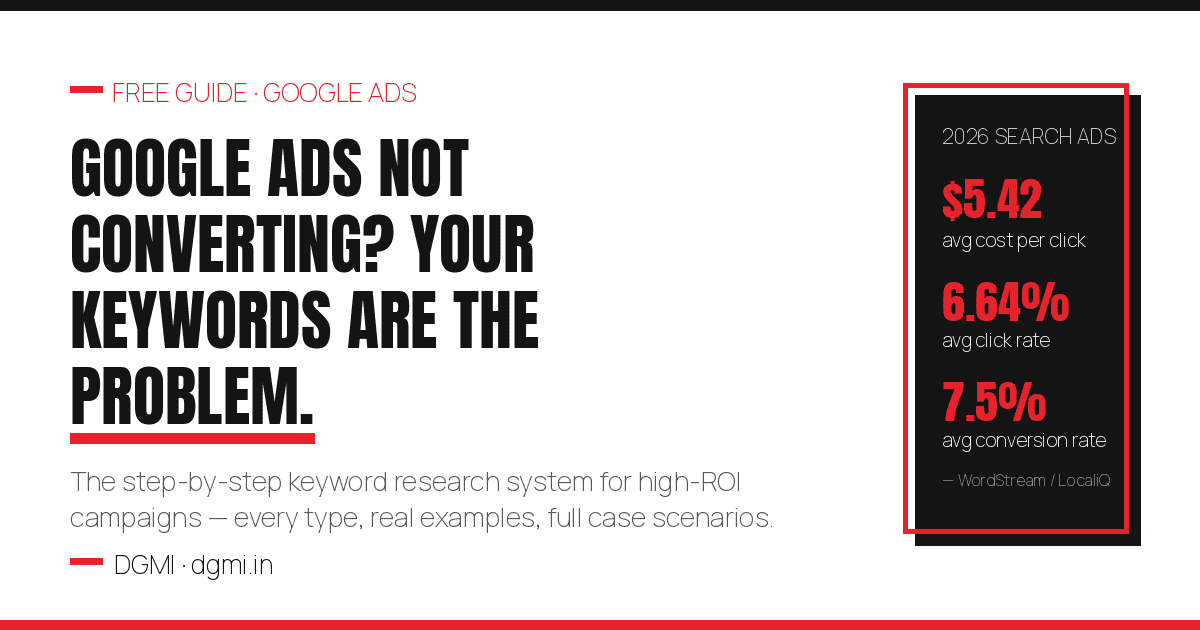
Here’s what 12 years of auditing Google Ads accounts has taught me: when a business owner tells me “Google Ads doesn’t work for us,” I don’t open their ad copy, their landing page or their bids first. I open one report — Search Terms — and within ten minutes, the same story appears almost every time: the account is paying for searches it should never touch, while the searches that print money are barely covered. The campaign isn’t broken. The keyword research was never done. This guide is the complete fix — every keyword type with examples, the exact research process click by click, the ROI math, and two full case scenarios you can copy.
In Google Ads, keywords are the only targeting layer that captures intent — they decide which searches trigger your ads, what you pay per click, and whether the clicker was ever going to buy. With the average search CPC at $5.42 in 2026, every wrong-intent click is money burned before your ad copy or landing page even gets a chance. Research done right routes your entire budget to people actively looking to purchase.
• Average search-ads CPC across industries: $5.42; average CTR 6.64% (WordStream/LocaliQ, 13,474 campaigns, Apr 2025–Mar 2026)
• Average conversion rate: ~7.5% — meaning ~92 of every 100 clicks don’t convert; wrong keywords make it far worse
• Education & Instruction saw the biggest CTR jump of any industry: +31.71% year over year
• Expert consensus from the 2026 report: platforms now reward “tighter alignment between keywords, ads, and landing pages”
1. The 10-Minute Diagnosis: Is This Your Account?
Before researching anything new, see where your current money actually goes. The Search Terms report shows the real searches that triggered your ads — not the keywords you bid on, but what people actually typed.
How to open it: Google Ads → select your campaign → left menu Insights & reports → Search terms. Sort by Cost, highest first. Now scan the top 30 rows for the four classic failure patterns:
- ✗ 1. Wrong-intent leaks: you sell interior design services, and you’re paying for “interior design course,” “interior designer salary,” “interior design ideas DIY.” Researchers and job-seekers, not clients.
- ✗ 2. Broad match drift: your keyword was “running shoes” and you’re matched to “shoe repair near me” and “barefoot running injuries.” Broad match without conversion data behaves like this.
- ✗ 3. Zero negatives: search the report for the words free, jobs, salary, meaning. If they appear with cost against them, nobody built a negative list.
- ✗ 4. One-bucket structure: 60 unrelated keywords in a single ad group, all seeing the same generic ad. Google’s own 2026 benchmark experts flagged the fix: platforms reward tight keyword→ad→landing page alignment.
Found two or more? Good news: nothing below requires more budget — it requires redirecting the budget you’re already burning.
2. The 8 Keyword Types — With Examples of Every One
Keyword research starts with vocabulary. These eight types cover every search that can ever trigger your ads — and each one gets different treatment:
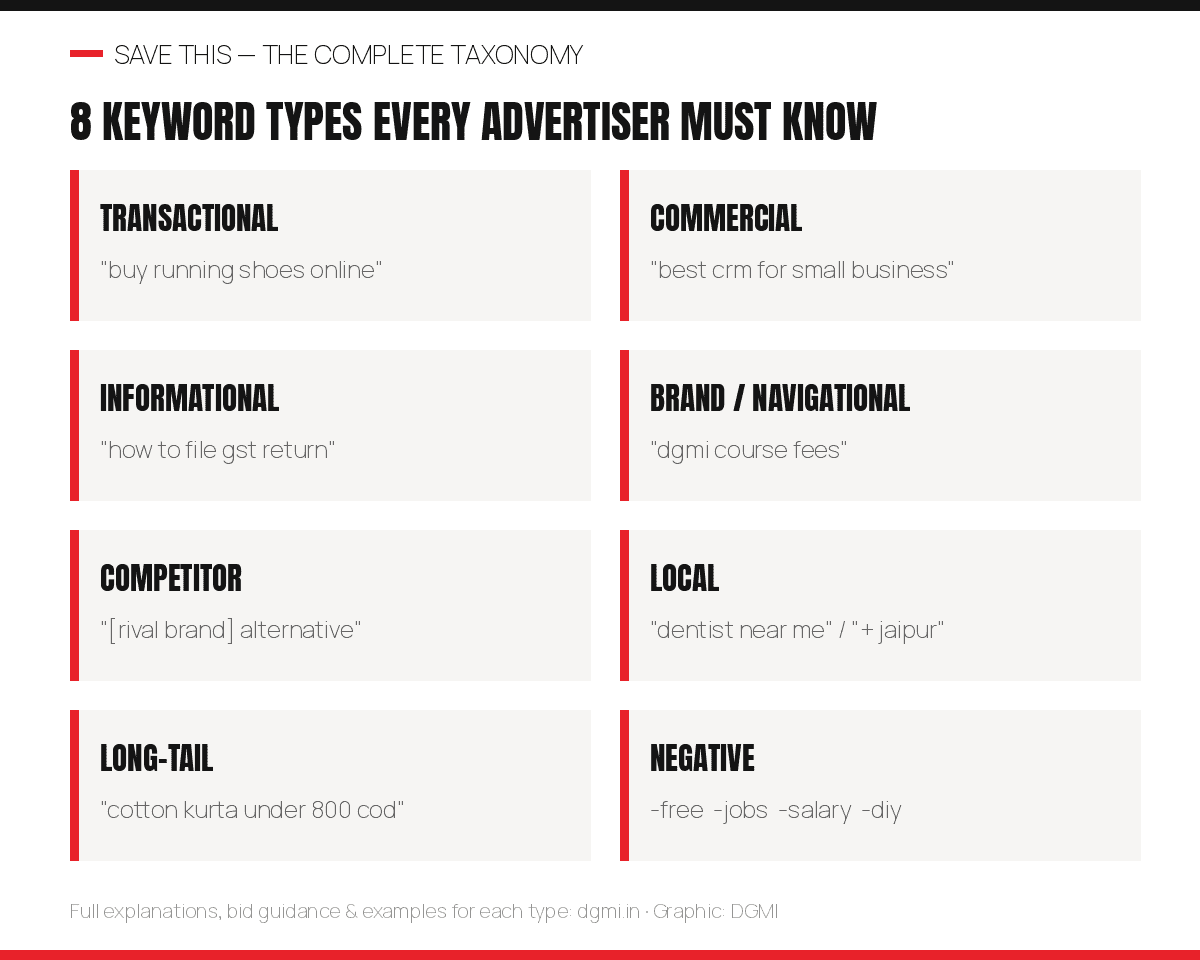
| Type | Examples | Searcher’s mindset | Should you bid? |
|---|---|---|---|
| Transactional | “buy running shoes online”, “digital marketing course fees”, “interior designer jaipur contact number” | Wallet out — comparing where to act | YES — your core budget |
| Commercial investigation | “best CRM for small business”, “asian paints vs berger”, “top interior designers in jaipur reviews” | Shortlisting; buys in days–weeks | Selectively — proof-heavy landing pages |
| Informational | “how to file GST return”, “what is performance marketing”, “kitchen design ideas” | Learning, not buying (yet) | NO — answer with SEO/GEO content |
| Brand / navigational | “dgmi course fees”, “zomato customer care”, “your business name + city” | Looking specifically for you | YES — cheapest clicks you’ll ever buy; blocks rivals from your name |
| Competitor | “[rival brand] alternative”, “[rival] reviews”, “[rival] price” | Considering your rival — poachable | Advanced play: expensive, low Quality Score; never use their name in your ad text |
| Local | “dentist near me”, “cake shop in malviya nagar jaipur”, “AC repair jaipur” | Wants it nearby, usually soon | YES for local businesses — highest converting type there is |
| Long-tail | “cotton kurta under 800 cash on delivery”, “3 month digital marketing course with certificate” | Knows exactly what they want | YES — lower volume, lower CPC, higher conversion; the small-budget advertiser’s best friend |
| Negative | -free, -jobs, -salary, -diy, -meaning, -download | People you’re paying to repel | The type everyone forgets — full list in step 7 below |
Two of these deserve a second look. Long-tail keywords are how small budgets beat big ones: “running shoes” is a bidding war against giants; “women’s trail running shoes size 5 jaipur” is nearly free and converts like a handshake. Negative keywords are the invisible half of research — a keyword list without a negative list is a bucket without a bottom.
3. Match Types in 2026: Broad, Phrase, Exact
The same keyword behaves completely differently depending on how you enter it. Match type is the leash length you give Google:
| Match type | How you type it | Can trigger on | Use it when |
|---|---|---|---|
| Exact | [interior designer jaipur] | That search + very close variants (“interior designers in jaipur”) | Your proven money terms — maximum control, best Quality Scores |
| Phrase | "interior designer jaipur" | Searches including that meaning (“best interior designer jaipur for flats”) | The workhorse — control plus discovery; where most new campaigns should live |
| Broad | interior designer jaipur (no symbols) | Anything Google’s AI deems related (“home renovation cost”, “furniture shops jaipur”) | Only with Smart Bidding + solid conversion tracking + 30+ conversions of history — never on day one |
The 2026 reality about broad match: it’s genuinely smarter than it used to be — Google’s AI reads intent, your landing page and your conversion data to decide relevance. But that last part is the catch: it learns from conversion data you don’t have yet. On a fresh account, broad match is a leash with no dog trainer. Our standing recommendation for beginners: launch on phrase + exact, graduate winners to exact, and test broad only after conversion tracking has real history.
4. The Intent Ladder & the 70/20/10 Budget Rule
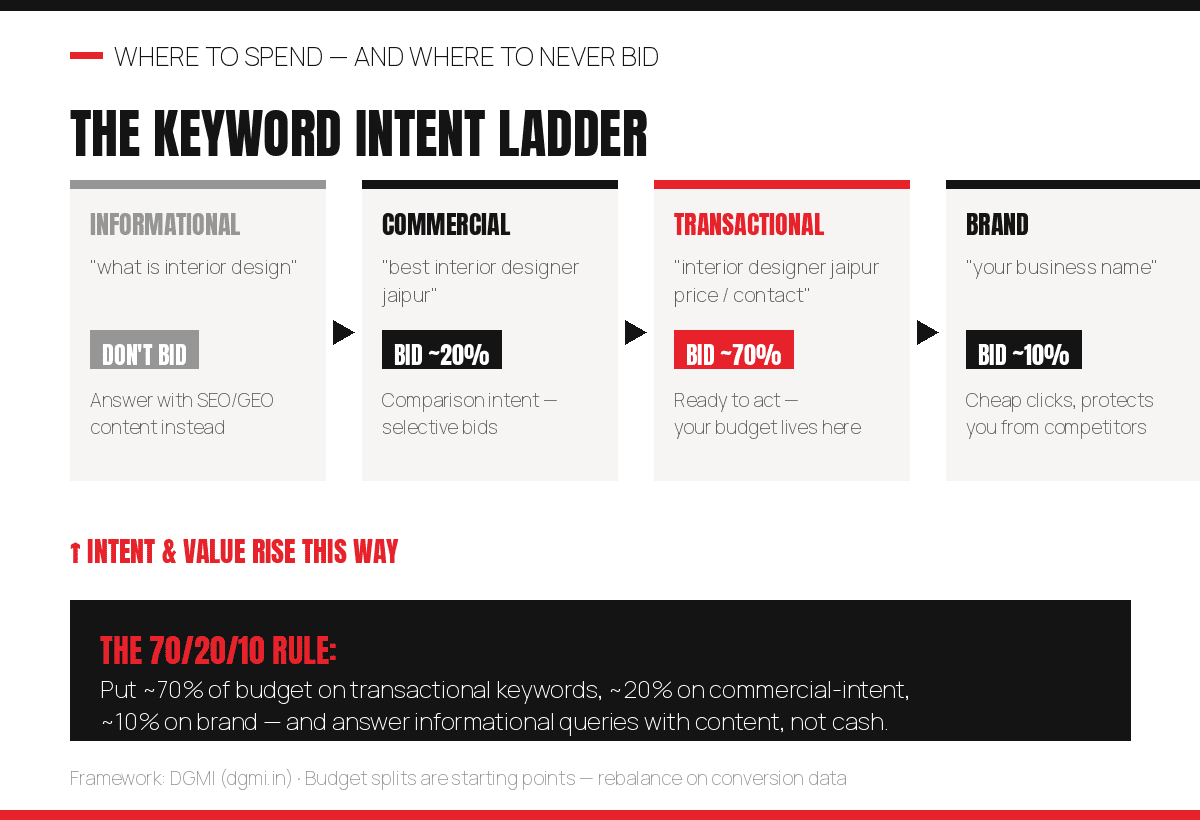
This one image prevents the most expensive mistake in Google Ads: paying transactional prices for informational traffic. The searcher typing “what is interior design” and the one typing “interior designer jaipur price” might become the same customer eventually — but only the second one deserves your ₹5-a-click budget today. The first one deserves a helpful article that costs you nothing per reader (that’s the SEO/GEO half of your marketing, and it’s a whole playbook of its own). Advertising and content aren’t rivals; they’re the two halves of intent coverage.
5. The 7-Step Keyword Research Process
Step 1 — Build Your Seed List From Customer Language (⏱ ~45 min)
Why: tools expand keywords; they can’t invent the words your customers actually use. Those come from your business.
- 1. Open a sheet with three columns: What we sell · What customers call it · Problems they describe.
- 2. Mine your last 30 WhatsApp enquiries, call notes and Google reviews for the exact phrases people used (“2BHK interior budget”, “false ceiling cost”). Customer words beat industry jargon — you say “modular kitchen solutions”, they type “kitchen design price jaipur”.
- 3. Add every service + city combination you serve. Target: 15–30 seed terms. Don’t judge them yet.
Step 2 — Expand and Price Them in Google Keyword Planner (⏱ ~60 min)
Why: Keyword Planner is free, pulls from Google’s own data, and — critically — shows you what clicks cost before you spend a rupee.
- 1. In Google Ads: top menu Tools → Planning → Keyword Planner → “Discover new keywords.” (Any Google Ads account gets access free — you don’t need a running campaign.)
- 2. Paste 5–10 seeds at a time. Set Location to your real service area (the city, not all of India — pricing changes completely) and Language to English + Hindi if your customers search in both.
- 3. Read four columns: Avg. monthly searches (demand), Competition (advertiser density), and Top of page bid — low & high range (your realistic CPC window). A keyword showing ₹28–₹65 tells you to budget ~₹45/click.
- 4. Download everything to a sheet (top right → download). You’ll typically leave with 150–400 candidates. Culling comes next — collection first.
Step 3 — Expand Beyond the Planner (⏱ ~30 min)
- 1. Google autocomplete: type each core seed and note the suggestions — these are real, frequent searches, including long-tails the Planner buries.
- 2. Spy on competitors legally: open the Google Ads Transparency Center, search your rivals, and read their ad headlines — the phrases they repeat are the keywords they’ve validated with money.
- 3. Google Trends (trends.google.com, set to India/your state): check seasonality on your money terms — “interior designer” spikes pre-Diwali; a course business spikes post-results season. Timing budget to demand is free ROI.
Step 4 — The Intent Cull (⏱ ~40 min)
Why: this is where ROI is actually made. Go down your sheet and tag every keyword T (transactional), C (commercial), I (informational), B (brand) — then delete every I from the bidding list and move it to a “content ideas” tab. Apply the tie-breaker question: “If someone types this, could they pay us this week?” If the honest answer is no, it doesn’t get ad money. Expect to cut 40–60% of your list here. That’s not loss — that’s the wasted spend you just refused to pre-order.
Step 5 — The Money Math: Know Your Break-Even CPC (⏱ ~20 min, once)
Why: a keyword isn’t “expensive” or “cheap” in the abstract — only relative to what a customer is worth to you. Two formulas end all guesswork:
Break-even CPC = Profit per customer × Lead-to-customer rate × Click-to-lead rate
Target CPA (cost per lead) = Profit per customer × Lead-to-customer rate × (1 − desired margin)
Worked example (₹): an interior designer earns ₹80,000 profit per project. Historically, 1 in 8 leads becomes a client (12.5%), and a decent landing page converts ~5% of clicks to leads. Break-even CPC = 80,000 × 0.125 × 0.05 = ₹500 per click. If the Planner shows “interior designer jaipur” at ₹40–₹90, every click is wildly profitable as long as intent is right — which is why step 4 matters more than bid haggling. Run this math once and Keyword Planner’s bid column transforms from scary to shopping list.
Step 6 — Group Into Tight, Themed Ad Groups (⏱ ~45 min)
- 1. Cluster survivors by theme, not alphabet: all “kitchen” terms together, all “full home” terms together, all “office” terms together — 5–15 keywords per ad group.
- 2. Message match is the whole point: the “modular kitchen jaipur” ad group gets ads with “kitchen” in the headline, landing on your kitchen page — not the homepage. This alignment is exactly what the 2026 benchmark experts say platforms now reward, and it’s what earns the Quality Scores that cut your CPC.
- 3. Keep brand keywords in their own campaign so their cheap, high-CTR clicks don’t disguise the performance of everything else.
Step 7 — Build the Negative Keyword List Before Launch (⏱ ~25 min)
Why: negatives are pre-paid refunds. Every term below blocks a class of clicker who was never going to pay you. Create it once as a shared list (Tools → Shared library → Exclusion lists → Negative keyword lists) and attach it to every search campaign:
UNIVERSAL STARTER NEGATIVES (service businesses)
free            jobs            salary          vacancy
career          hiring          internship      course*
training*       classes*        diy             how to
what is         meaning         wikipedia       images
photos          download        pdf             sample
second hand     olx             rent*           cheap**

*  keep these OUT of the negative list if you actually sell
   courses/training or rentals — flip them to positives instead
** remove "cheap" only if budget positioning is your strategy
Then add the negatives only your business knows: cities you don’t serve, services you don’t offer, product models you don’t stock. This list is a living document — step 9’s weekly ritual feeds it forever.
🎯 Want to Run This Entire Process on a Real Account — With a Mentor Beside You?
In DGMI’s Digital Marketing + AI Course, Google Ads isn’t a slideshow — you research keywords, build campaigns and read live reports 1:1 with a trainer of 12 years. Experience the style first with a 100% practical crash course class — FREE this week.
6. Case Scenario A: Local Service Business (Full Build)
The setup (illustrative numbers, realistic ranges): a Jaipur interior designer, ₹30,000/month budget, average profit ₹80,000/project, wants leads via a contact form. Here’s the entire system, built with the process above:
| Ad group (theme) | Keywords (match syntax as you’d enter them) | Landing page |
|---|---|---|
| Full home interiors | [interior designer jaipur] · “interior designers in jaipur” · “home interior design jaipur” · “2bhk interior design cost jaipur” · “3bhk interior package jaipur” | /home-interiors-jaipur (portfolio + price ranges + form) |
| Modular kitchen | [modular kitchen jaipur] · “modular kitchen price jaipur” · “modular kitchen design jaipur” · “kitchen interior jaipur” | /modular-kitchen-jaipur |
| Office/commercial | “office interior design jaipur” · “commercial interior designer jaipur” · “showroom interior jaipur” | /office-interiors-jaipur |
| Brand (own campaign) | [studio name] · “studio name jaipur” | Homepage |
Negatives added on top of the universal list: course, training, jobs, salary, vastu tips, ideas, sketch, software, autocad, 1bhk rent, pop design photos. Skipped deliberately: “interior design ideas” (12k searches/month of pure informational traffic — that keyword alone would have eaten the entire ₹30,000 with near-zero leads; it goes to the blog instead).
The expected math (Planner showed ~₹35–₹70 bids; assume ₹50 effective CPC): ₹30,000 ÷ ₹50 = ~600 clicks. At a conservative 5% form conversion = ~30 leads/month (₹1,000 per lead). At the historical 1-in-8 close rate = ~3–4 projects = ₹2.4–3.2 lakh profit against ₹30,000 spend — an 8–10× return, live within a week of launch. Every number is checkable and adjustable in the same sheet you built in steps 2 and 5; when reality differs, you’ll know exactly which assumption to fix.
7. Case Scenario B: Course / Coaching Business
Same process, different intent map — and a first-hand one, since this is our own industry. Education is one of the pricier verticals (2025 average CPC ~$6.23 in the US benchmark data, and Indian metro CPCs on course terms commonly run ₹40–₹150), so the intent cull is even less forgiving:
- ✓ Bid: [digital marketing course in jaipur] · “digital marketing course fees” · “digital marketing course with placement” · “3 month digital marketing course” · “digital marketing institute near me” — every one signals someone choosing an institute now.
- ✗ Don’t bid: “what is digital marketing” · “digital marketing salary” · “digital marketing kya hai” · “free digital marketing course” — massive volumes, learner/job-seeker intent, budget incinerators. These exact queries are why our career guide and salary content exist: content captures them free, then remarketing and the brand campaign convert them later.
- ! The trap unique to education: “course” is a positive here but “free” is still a negative — and note how the same word (“course”) that this business bids on sat in the service business’s negative list. Negatives are business-specific; copying someone else’s list blindly can block your own buyers.
The encouraging benchmark for this vertical: Education & Instruction posted the largest CTR improvement of any industry in 2026 (+31.71%) — well-matched course ads are working better than ever. The demand is there; the research decides who collects it.
8. Launch Settings That Protect Your Research
Five checkboxes stand between your careful keyword list and Google quietly widening it. When creating the campaign: (1) choose objective “Leads” or “Website traffic” and untick Display Network and Search Partners — your keywords were researched for Google Search, not random apps; (2) set Locations to your service area and change the setting from “Presence or interest” to “Presence” only — otherwise someone in Delhi “interested in” Jaipur sees your ads; (3) skip Google’s suggested broad-match and “AI Max” expansions on day one (revisit after conversion history exists); (4) start bidding on Maximize Clicks with a max CPC cap at your step-5 number, switching to Target CPA only after ~30 conversions; (5) confirm conversion tracking fires before spending — a campaign without conversion data can never be optimized, only guessed at.
9. The Weekly Optimization Ritual (15 Minutes That Compound)
Keyword research doesn’t end at launch — it becomes a loop. Every week, same day, coffee in hand: open Insights & reports → Search terms, sort by cost, and make exactly two kinds of moves. Kill: any real search with spend, no conversions and wrong intent → add as a negative (exact or phrase negative depending on how broadly it should be blocked). Promote: any real search that converted and isn’t already a keyword → add it as an exact match keyword in the matching ad group, where you can bid it up deliberately. That’s it. Fifteen minutes, every week. Accounts that run this ritual for three months barely resemble their launch version — the keyword list literally evolves toward what pays. Monthly, add ten minutes: check Quality Scores (keyword table → columns → Quality Score) and fix message match wherever you see 5 or below.
10. Seven Mistakes That Burn Budgets
- ✗ 1. Launching everything on broad match with zero conversion history — the single fastest way to torch a first budget.
- ✗ 2. No negative list at launch — you’ll pay tuition to “free”, “jobs” and “meaning” until you build one.
- ✗ 3. Bidding on informational keywords because the volume looked exciting. Volume is not intent.
- ✗ 4. One giant ad group — 60 keywords, one generic ad, low Quality Scores, inflated CPCs everywhere.
- ✗ 5. Sending every keyword to the homepage instead of the matching service page — message match is half your Quality Score.
- ✗ 6. Never opening the Search Terms report — flying a plane without looking out the window.
- ✗ 7. Judging keywords by CPC instead of break-even math — a ₹200 click that closes ₹80,000 projects is cheap; a ₹5 click from a job-seeker is the most expensive thing you’ll ever buy.
11. FAQ
How many keywords should a Google Ads campaign have?
Fewer than beginners expect. A focused local campaign runs beautifully on 20–50 keywords across 3–5 themed ad groups of 5–15 each. Hundreds of keywords in a new account means the intent cull didn’t happen — depth of alignment beats breadth of coverage, and the weekly ritual will grow the list organically from proven search terms anyway.
Is broad match good or bad in 2026?
It’s a power tool with a prerequisite. Paired with Smart Bidding and 30+ conversions of history, broad match genuinely finds profitable searches you’d never think to add. On a fresh account with no conversion data, it drifts into loosely related traffic at your expense. Sequence matters: earn the data on phrase and exact first, then let broad match spend it.
What budget do I need to start Google Ads in India?
Enough for statistically meaningful clicks: roughly 100–150 clicks a month is the floor for learning anything. At typical Indian service-business CPCs of ₹20–₹60, that’s ₹10,000–₹25,000/month for most local niches; competitive metro verticals (education, real estate, legal) need more. Whatever the number, spend it on few keywords done properly rather than many done thin — and run the break-even math from step 5 before committing anything.
Do I need paid tools, or is Keyword Planner enough?
For running your own ads: Keyword Planner + autocomplete + the Ads Transparency Center + Trends — all free — cover the entire process in this guide. Paid suites like SEMrush and Ahrefs add competitor keyword visibility and cross-client efficiency, which matters when you manage multiple accounts or sell PPC as a service. Start free; upgrade when the workload, not the curiosity, demands it.
How long before I see results?
Faster than SEO, slower than the ads gurus promise. Traffic starts within hours of approval; meaningful lead data takes 2–4 weeks; genuine optimization (search-term mining, promoting converters, Quality Score gains) shows compounding results by weeks 6–10. Judge the system after 90 days of weekly rituals, not after the first weekend.
🚀 Master Google Ads the Practical Way
DGMI’s 3-month Digital Marketing + AI Course (₹29,999) has you build and run real campaigns — keyword research, ads, landing pages, GA4 tracking — plus SEO, GEO, Social Media and AI workflows. Live 1:1 classes, worldwide-recognized certification, and a free practical crash course class to start.
Questions? Contact us · hello@dgmi.in · +91 96940 03464

Sources: WordStream/LocaliQ — 2026 Google Ads Benchmarks (13,474 campaigns) · LocaliQ — 2026 Search Advertising Benchmarks · Search Engine Journal — benchmark analysis · WordStream — 2025 benchmarks (CVR & industry data)
Companion reads: capture the informational keywords you’re not bidding on with the GEO playbook and the 25-point SEO checklist · Build the trust that lifts Quality Scores with the E-E-A-T guide · Algorithm & ads-platform news on the DGMI News desk · Share your own campaign learnings in the DGMI Community.