
Here’s an uncomfortable truth from 12 years of auditing websites: most businesses spend on Google Ads to compensate for SEO problems they could fix in a weekend — for free. Before you spend ₹1 on ads, run your website through this checklist. It’s the same 25 points I check first on every site my students and I audit at DGMI.
• 75% of users never scroll past page 1 of Google — if you’re not there, you’re invisible
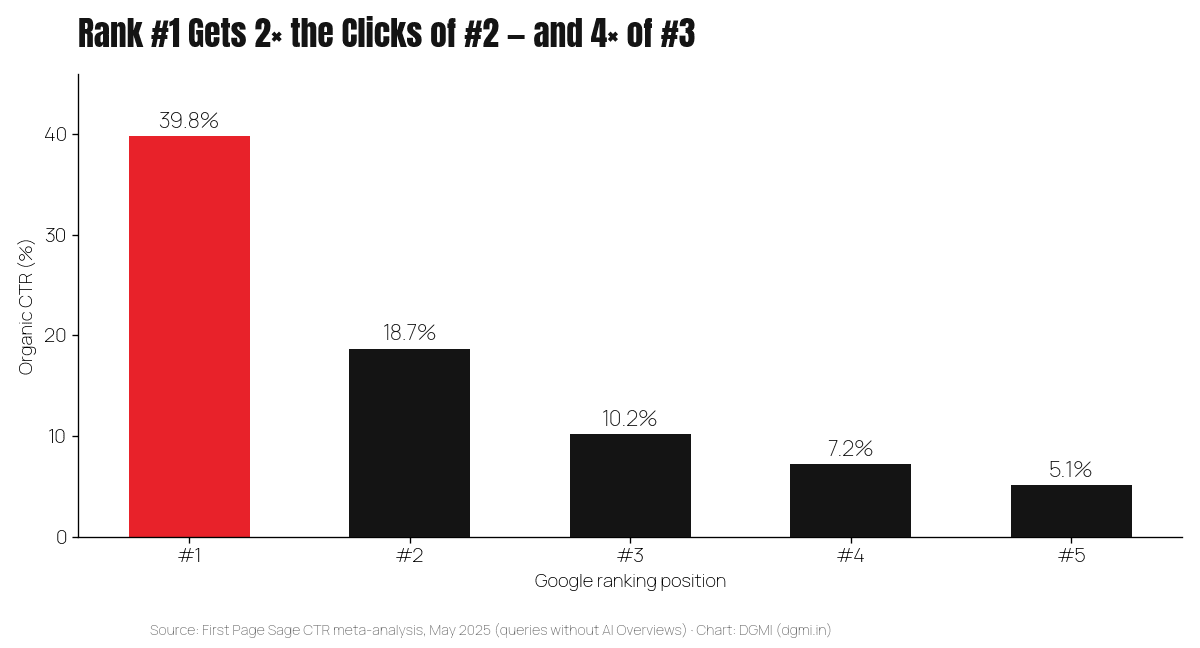
• Rank #1 earns a 39.8% click-through rate; rank #3 gets just 10.2%
• Pages at #1 have 3.8× more backlinks than positions 2–10
• And with ~58% of searches now ending without any click, being cited by AI matters too — this checklist covers both
One picture before we start — this is why every point below is worth your time. The gap between ranking #3 and #1 isn’t small; it’s 4× the traffic:
Technical Foundation (Points 1–6)
If Google can’t crawl, load and trust your site, nothing else on this list matters. Fix these first.
- ☑ 1. Your site loads over HTTPS. Type your domain with
http://— it should redirect tohttps://automatically. No padlock = trust penalty with both users and Google. - ☑ 2. Core pages load in under 3 seconds on mobile. Test free at PageSpeed Insights. The usual culprits: uncompressed images and bloated plugins.
- ☑ 3. The site is genuinely mobile-friendly. Open it on your phone: no horizontal scrolling, tap targets big enough, text readable without zooming. Most Indian traffic is mobile-first — Google judges you on the mobile version.
- ☑ 4. Google Search Console is connected and a sitemap submitted. If you can’t measure it, you can’t fix it. GSC is free and non-negotiable.
- ☑ 5. No accidental “noindex” or robots.txt blocks. In GSC → Pages, check your important pages are indexed. You’d be surprised how many “SEO problems” are one leftover checkbox from development.
- ☑ 6. One version of every URL. www vs non-www, trailing slash vs not, http vs https — pick one and 301-redirect the rest. Duplicate versions split your ranking strength.
On-Page SEO (Points 7–14)
- ☑ 7. Every page targets ONE primary keyword — chosen from real search data, not guesswork. Two pages chasing the same keyword compete with each other.
- ☑ 8. Title tags are unique, under 60 characters, keyword near the front. The title tag is still the single highest-leverage on-page element you control.
- ☑ 9. Meta descriptions are written like ad copy (under 158 characters, with a reason to click). They don’t directly affect ranking — they directly affect CTR, which is the point.
- ☑ 10. One H1 per page, matching the search intent. Subheadings (H2/H3) follow a logical outline — ideally phrased as the questions people actually ask.
- ☑ 11. URLs are short and readable.
/seo-checklist-for-beginners/beats/index.php?p=4823every day. - ☑ 12. Images have descriptive file names and alt text. “seo-checklist-chart.png” with real alt text — accessibility, image search traffic, and AI understanding in one move.
- ☑ 13. Internal links connect your pages with descriptive anchors. Every important page should be reachable within 3 clicks from the homepage; every new post should link to 2–4 older relevant pages (like this one links to our career guide).
- ☑ 14. Schema markup on key pages. Organization, Article, FAQ — structured data helps rich results (results with star ratings see up to 35% higher CTR) and feeds AI systems clean facts.
🎯 Want to Learn to Do All of This — Live, on a Real Website?
In DGMI’s Digital Marketing + AI Course, you don’t read about audits — you perform one, 1:1 with a mentor of 12 years, on a real site. Experience the teaching style first with a 100% practical crash course class — FREE this week.
Content & E-E-A-T (Points 15–19)
- ☑ 15. Every page answers its search intent within the first screen. Someone searching “digital marketing course fees” wants a number, not your brand story. Lead with the answer, then elaborate.
- ☑ 16. Content shows real experience — first-hand examples, screenshots, numbers, opinions. Google’s quality systems and AI engines both reward the “E” (Experience) that generic AI-pasted content can’t fake.
- ☑ 17. Named authors with real bios. Anonymous content is a trust dead-end. Every article should say who wrote it and why they’re qualified.
- ☑ 18. Facts cite named sources with links — the way this checklist does. Sourced claims earn trust from readers, Google and AI systems alike.
- ☑ 19. Old content gets updated, not abandoned. A visible “Updated [date]” with genuinely refreshed stats outperforms publishing yet another thin new post.
Local & Off-Page (Points 20–23)
- ☑ 20. Google Business Profile claimed and fully filled. Correct primary category, services, photos, posting weekly. For local businesses this single point outweighs most of this list.
- ☑ 21. NAP consistency everywhere. Your Name, Address and Phone must be identical on your site, GBP, Justdial, and every directory — mismatches quietly erode local rankings.
- ☑ 22. Reviews flowing in, and every one answered. Volume, recency and your responses are all signals. Ask happy customers the same day — not “someday”.
- ☑ 23. Backlinks earned from relevant, real websites. Directories, industry blogs, local press — quality over quantity, and never bought in bulk (Google’s spam policies are enforced hard, as the June 2026 spam update just reminded everyone).
AI-Era Checks (Points 24–25)
These two didn’t exist on beginner checklists two years ago. In 2026, with AI Overviews compressing clicks even for rank #1, they’re where the new opportunity lives.
- ☑ 24. Your content is structured for AI answers. Question-style headings, a direct 40–60 word answer immediately below each, FAQ schema, and comparison tables. This is the foundation of GEO — our full explainer is on the resources page.
- ☑ 25. AI crawlers aren’t blocked. Check your robots.txt allows GPTBot, PerplexityBot and Google-Extended (unless you deliberately choose otherwise). Being cited by ChatGPT and AI Overviews is the visibility channel replacing lost clicks — brands cited in AI Overviews see roughly 35% more organic clicks than uncited ones on the same results page.
How to Use This Checklist (The 3-Weekend Plan)
Weekend 1: points 1–6. Purely technical, mostly one-time fixes — get the foundation solid. Weekend 2: points 7–14 on your five most important pages only; don’t try to fix 50 pages at once. Weekend 3: points 15–23 — rewrite your weakest page for intent, set up GBP properly, request your first five reviews. Then make points 24–25 part of everything you publish going forward. Re-run the full checklist monthly; SEO is a habit, not a project.
FAQ
How long does SEO take to show results?
For a new site doing this checklist properly: expect first movement in 4–8 weeks and meaningful traffic in 3–6 months. Local SEO (points 20–22) usually moves fastest — GBP improvements can show within weeks. Anyone promising page 1 in days is selling you something dangerous.
Do I need paid tools for this checklist?
No. Every point here can be checked with free tools: Google Search Console, PageSpeed Insights, your own phone, and Google’s rich results test. Paid tools like SEMrush and Ahrefs make keyword research (point 7) and backlink analysis (point 23) faster and deeper — worth it once you’re serious, unnecessary on day one.
Is SEO still worth learning with AI answering searches?
More than ever — the skill has expanded, not expired. Roughly 58% of searches now end without a click, but the answers users read are pulled from websites that did this checklist well. The winners in 2026 optimize for both the click (points 1–23) and the citation (points 24–25). That combined skill set — SEO + GEO — is exactly what employers can’t find enough of.
What’s the single most common beginner mistake?
Skipping straight to backlinks and “hacks” while the basics are broken. A site with a wrong-intent homepage, 8-second load time and no Search Console doesn’t need links — it needs this checklist, in order, from point 1.
🚀 From Checklist Reader to SEO Practitioner
DGMI’s 3-month Digital Marketing + AI Course (₹29,999) takes you through every point on this list hands-on — you’ll audit, fix and rank a real website, then master Ads, Social, Analytics, AI & GEO on top. Live 1:1 classes, worldwide-recognized certification, and a free practical crash course class to start.
Questions? Contact us · hello@dgmi.in · +91 96940 03464

More free guides on the DGMI Resources page · Algorithm updates on our News desk · Want to publish your own guides? Join the DGMI Community and earn XP.
[…] trust, so it shows up when someone searches. This is the foundation everything else sits on. Our beginner SEO checklist covers it step by […]
[…] the data next: the SEO checklist · the keyword research guide · the audience research guide · the SEO vs GEO vs AIO guide · the […]
[…] up a real GA4 property, writing ad copy, and building pages within the first month. Our free SEO checklist and analytics guide show the kind of hands-on depth a real syllabus should […]
[…] SEO business checklist · the freelance clients guide · the GA4 and Search Console guide · the SEO checklist · the 100 AI prompts library · the how to choose an institute guide · discuss in the DGMI […]
[…] well on speed tests before you optimize anything, and speed is a Google ranking factor, as our SEO checklist […]