
Update desk, July 4, 2026: Google’s second spam update of the year is done. It started on June 24, finished on June 26 — one of the fastest rollouts on record — and many site owners felt it more than a “normal” spam update should feel. Here’s what’s confirmed, what’s speculation, and what you should actually do this week.
• Started: June 24, 2026 (~9:00 AM PT) · Completed: June 26, 2026
• Duration: 2 days, 1 hour — global, all languages
• Type: “normal” spam update via SpamBrain, Google’s AI spam system
• Does NOT target link spam or site-reputation abuse (confirmed by Google)
• No new spam policies announced with it
1. What Just Happened
On June 24, Google’s Search Status Dashboard logged a new ranking incident with a short, typically unhelpful note: the June 2026 spam update was rolling out globally, across all languages, and “may take a few days to complete.” Two days later — June 26 at around 2 PM ET — Google marked it complete.
On paper, routine. In practice, less so. Barry Schwartz at Search Engine Roundtable — the closest thing our industry has to a seismograph — noted the update “felt more widespread than a typical Google spam update”, and webmaster forums filled with reports of sharp swings in both directions, including from site owners insisting they don’t spam at all.
That last part is worth sitting with. Every spam update produces collateral noise — sites that swing during the rollout and settle afterwards. Which is exactly why the first rule of update week is: don’t diagnose mid-rollout, and don’t panic-edit your site based on two days of data.
2. What This Update Targets — and What It Doesn’t
Google published no target list, but two useful facts are confirmed. First, this is a SpamBrain tuning — an improvement to the AI-based spam-detection system Google has run since 2022, making it better at catching existing policy violations and spotting new spam patterns. Second, when Schwartz asked Google directly, the company confirmed the update does not target link spam and does not target the site-reputation-abuse (“parasite SEO”) policy.
Read together, that points enforcement at content-level violations: scaled content abuse (mass-produced pages with no added value), cloaking, sneaky redirects, scraped content, and similar tactics already banned under Google’s spam policies. No new rules — tighter enforcement of the existing ones.
3. How It Compares to Past Spam Updates
The most striking thing about recent spam updates is how compressed the rollouts have become:
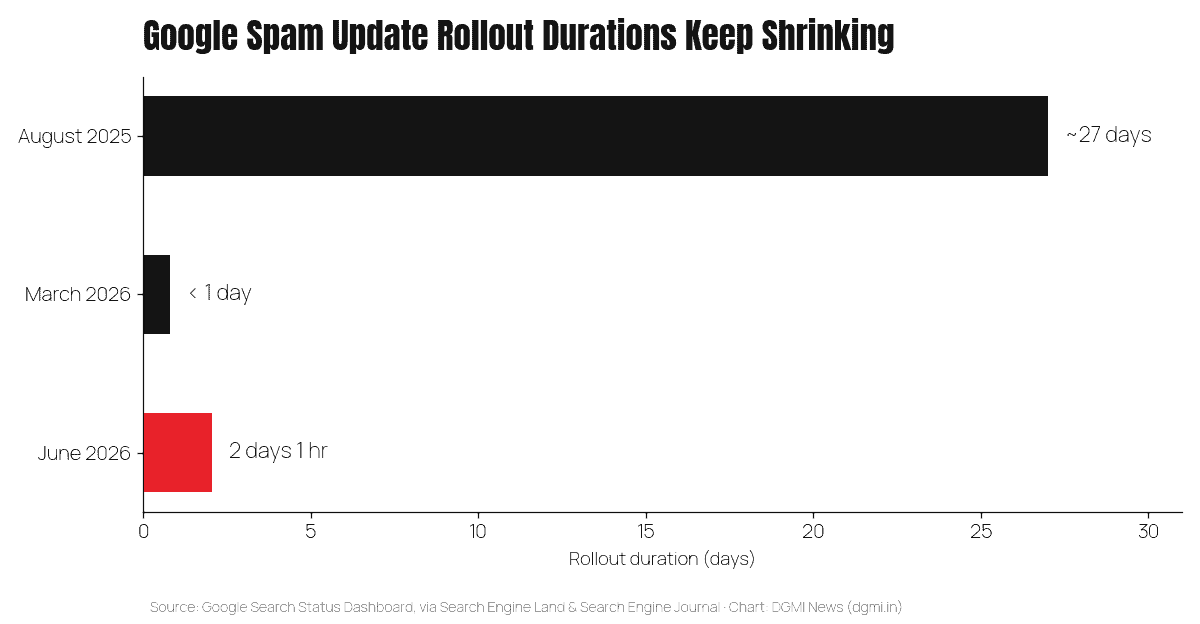
| Update | Rollout | Duration | Notes |
|---|---|---|---|
| August 2025 spam update | Aug–Sep 2025 | ~27 days | One of the longest spam rollouts |
| March 2026 spam update | Mar 24–25, 2026 | < 1 day | Fastest spam rollout on record |
| June 2026 spam update | Jun 24–26, 2026 | 2 days, 1 hour | Felt broader than its label |
Note the calendar, too: 2026 has already delivered a Discover core update (February), a spam update (March), a core update (March), another core update (May), and now a second spam update — five confirmed algorithm events in six months. Google’s enforcement cadence has visibly accelerated, and “optimize once, coast for a year” is no longer a survivable strategy.
4. The Bigger Picture: Spam Enforcement Meets AI Search
One contextual detail deserves more attention than it’s getting. Forty days before this rollout — on May 15, 2026 — Google quietly expanded the opening definition of its spam policies: spam now explicitly includes attempts to manipulate the generative AI responses Google shows in Search, not just classic rankings.
To be clear about what’s fact and what’s inference: Google has not said this update enforces the AI clause, and connecting the two is speculation. But directionally, the message is unambiguous — as AI Overviews and AI Mode answer more queries, Google is extending its spam framework to cover them. Anyone currently experimenting with tricks to get quoted by AI answers should assume the same enforcement machinery is watching.
5. What to Do This Week — Exact Checks
- ✓ Annotate the window. Mark June 24–26 in Google Search Console and your analytics so this update’s effect stays separable from whatever rolls out next.
- ✓ Compare clean periods. In GSC, compare the 14 days before June 24 against June 27 onward — clicks, impressions and average position. Mid-rollout days are noise; exclude them.
- ✓ Read the shape. A sharp step down on June 24–26 that stays flat = this update. A gradual slope that started earlier = a content-quality problem, not this rollout.
- ✓ If you dropped and stayed down: audit honestly against Google’s spam policies — scaled/mass-produced pages, scraped content, cloaking, doorway pages. Fix what you find, then expect reassessment in months, not days; that’s Google’s own stated timeline for spam recoveries.
- ✓ If you weren’t affected: do nothing dramatic. Log the dates, keep publishing genuinely useful content, and remember a core update is statistically due in the coming weeks — 2026’s cadence suggests the year is far from done.
📰 Get every update the day it drops
DGMI News covers every Google algorithm update and major marketing development — reported fast, explained simply, no fluff.
Subscribe free → earn 25 Community XP as a welcome reward 🎁
Email only. No spam, unsubscribe anytime.
6. Quick FAQ
My rankings moved this week — was it this update?
Possibly, but verify before concluding. If the change is a sharp step between June 24–26 that persists after June 27, this update is the likely cause. Gradual declines that started earlier point to content-quality issues instead, and note that Google also ran a June 2026 core-adjacent volatility period earlier in the month — the shape and dates of your data matter more than the headline.
Is this a penalty? Should I file a reconsideration request?
No. Spam updates are algorithmic, not manual actions — there’s nothing to appeal and reconsideration requests don’t apply. If Search Console shows no manual action, recovery comes from fixing violations and waiting for Google’s systems to reassess, which the company says can take months.
Does this update punish AI-written content?
Not as such. Google’s systems target unhelpful, mass-produced, policy-violating content regardless of how it was made. AI-assisted content with genuine human expertise and editing has not been the stated target of any 2026 update; scaled low-value production — human or AI — has.
What’s expected next from Google?
Based on the ~90-day core-update cadence Google has settled into (March and May core updates are already done), industry trackers expect another core update in the August–September window — historically the most volatile stretch of the year. We’ll cover it here when it lands.

Sources: Google Search Status Dashboard · Search Engine Land · Search Engine Journal · Search Engine Roundtable
← All news & updates · Learning the fundamentals? Start with our career guide and free resources.