
In 12 years of SEO, I’ve lived through three “everything changed” moments: mobile-first, voice search, and the helpful content era. Only one of them actually changed everything — and it’s happening right now. A billion people a month now search inside Google’s AI Mode, and AI answers don’t show ten blue links: they cite a handful of sources. The skill of becoming one of those sources is called GEO. This is the complete playbook — not a summary, but every step explained in enough detail that you can open your website in another tab and do the work as you read.
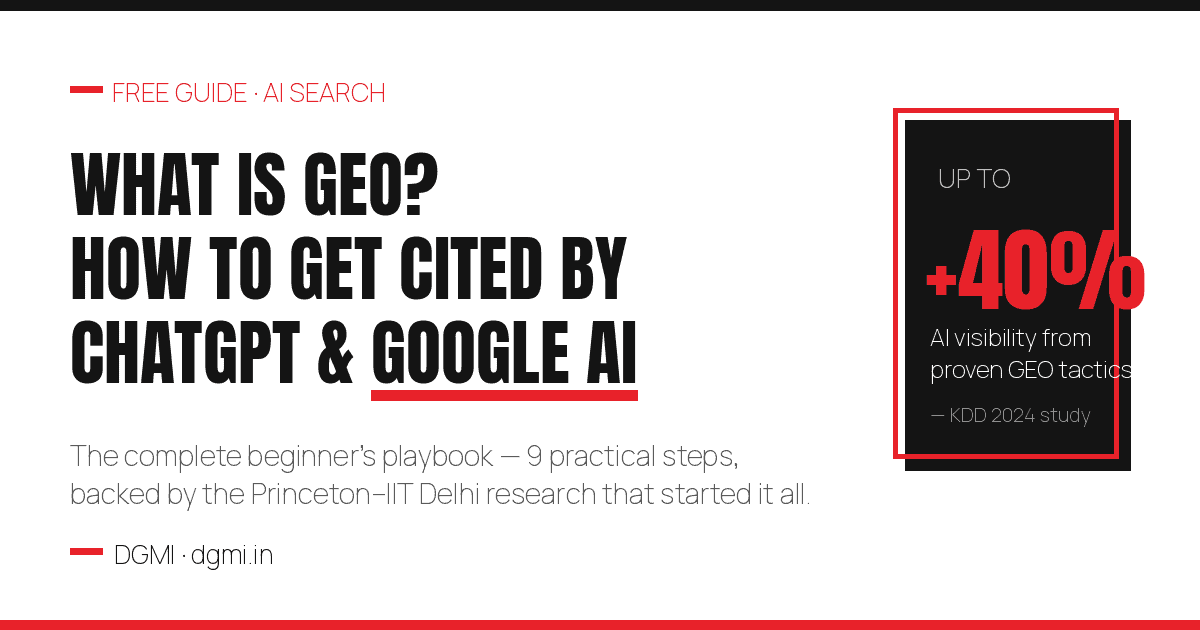
GEO (Generative Engine Optimization) is the practice of structuring web content so that AI engines — ChatGPT, Google AI Mode & AI Overviews, Gemini, Perplexity, Copilot — select and cite it when generating answers. The term was coined in a 2024 research paper by teams from Princeton, Georgia Tech, the Allen Institute for AI and IIT Delhi, which showed the right techniques can lift AI visibility by up to 40%.
• Google’s AI Mode passed 1 billion monthly users (Google, June 2026); AI Overviews reach 2.5 billion
• When an AI Overview appears, clicks to websites nearly halve — 15% → 8% (Pew Research, 2025)
• Ranking #1 no longer guarantees citation: top-10 ↔ AI-citation overlap fell from ~75% to 17–38% by early 2026 (BrightEdge/Demand Local)
• Proven GEO tactics lift AI visibility by up to 40% (Aggarwal et al., KDD 2024)
1. What GEO Is — and Which Engines You’re Optimizing For
GEO isn’t a marketing agency’s invention — it’s academic. The term comes from the paper “GEO: Generative Engine Optimization” (Aggarwal et al.), presented at KDD 2024, with authors from Princeton University, Georgia Tech, the Allen Institute for AI — and IIT Delhi. Yes: the field’s founding research has Indian fingerprints on it, which feels appropriate given India was among the first countries in the world to get AI Mode and is Google’s largest voice and visual search market.
The researchers built GEO-bench — 10,000 real queries across multiple domains — and tested nine content-modification tactics to see which ones made a source more likely to be cited by a generative engine, then validated the winners on Perplexity with visibility gains up to 37%. We’ll cover exactly which tactics won (and which backfired) in section 5.
Know your engines. “AI search” isn’t one system — it’s five, and they retrieve content differently. This matters practically, because it tells you where your optimization effort actually lands:
| Engine | Where it gets web content | What that means for you |
|---|---|---|
| Google AI Mode & AI Overviews | Google’s own index | Your normal Google indexing + quality signals feed it; passage structure decides citation |
| Gemini | Google’s index + training data | Same groundwork as above; entity clarity matters most |
| ChatGPT (search) | Bing’s index + OAI crawlers (GPTBot/OAI-SearchBot) | If you’re not in Bing Webmaster Tools, you’re invisible here — see step 9 |
| Perplexity | Its own crawler (PerplexityBot) + partner indexes | Fastest to reflect content changes; great for testing your GEO edits |
| Copilot | Bing’s index | Another reason step 9 (Bing) is non-negotiable |
The good news hiding in that table: two indexes (Google’s and Bing’s) feed almost everything. Cover both, structure your passages well, and you’re visible across the whole AI-search landscape at once.
2. GEO vs SEO: What Changes, What Stays
First, the reassurance: GEO does not replace SEO — it sits on top of it. Everything you’ve done for crawlability, site speed, quality content and E-E-A-T still counts; AI engines inherit those signals. What shifts is the goal, the unit of competition and the winner’s prize:
| Classic SEO | GEO | |
|---|---|---|
| Goal | Rank a page in the top 10 | Get cited inside the AI’s answer |
| Unit | The whole page | The passage — one clear, self-contained chunk |
| Winners per query | 10 links share the page | 2–5 citations share the answer |
| Key currency | Keywords + links | Facts: statistics, quotes, sources, clarity |
| Measured in | Rankings & clicks (GSC) | AI impressions & citations (new GSC Generative AI report, rolling out now) |
What stays exactly the same: crawlable site architecture, fast loading, HTTPS, quality content that matches intent, honest E-E-A-T signals, and schema markup. If your SEO foundation is weak, fix that first — our 25-point SEO checklist is the prerequisite audit, and points 24–25 of it are literally a preview of this guide.
And the sharpest proof they’re different games: by early 2026, the overlap between Google’s top-10 organic results and the sources AI answers actually cite had collapsed from roughly 75% to 17–38% depending on the study. Ranking well helps. It no longer decides.
3. How AI Engines Pick Their Citations (The Pipeline)
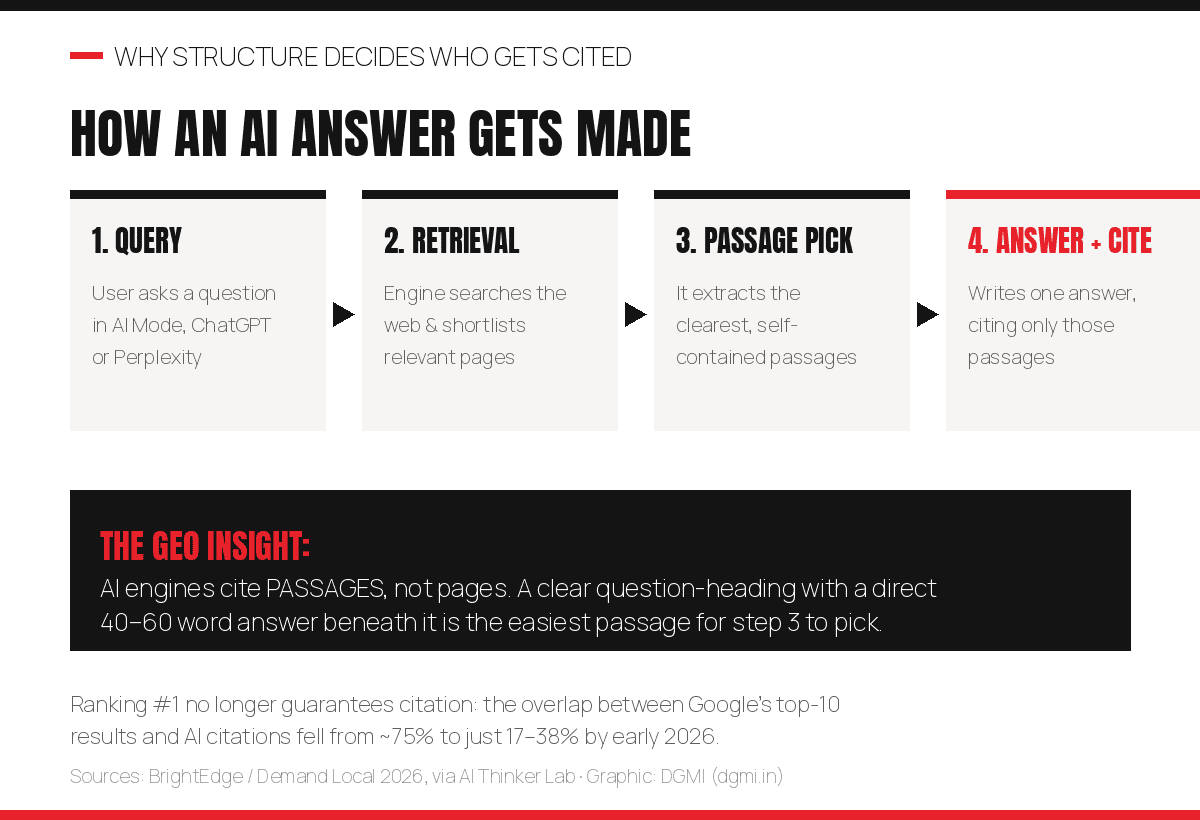
Under the hood, engines don’t read your page the way a human does. They chunk it — split it into passages, typically along your heading boundaries — and embed each chunk so it can be matched against queries. When someone asks a question, the engine retrieves the best-matching chunks from many sites, and the model writes one answer citing only the chunks it actually used. Three practical consequences fall out of this:
First, your headings define your chunks. Content buried mid-way through a 900-word section under a vague heading gets chunked together with everything around it and matches nothing cleanly. Second, each passage must survive alone. The model may only ever see that one chunk — if it says “as mentioned above” or “this approach,” the referent is gone and the passage is useless. Third, specificity wins ties. Between two passages saying roughly the same thing, the one with a number, a date and a named source gets cited, because it’s verifiable.
✗ UNCITABLE: “As we discussed earlier, costs can vary quite a bit depending on several factors, so it’s hard to give an exact figure, but this option is generally quite affordable for most people.”
✓ CITABLE: “A 3-month practical digital marketing course in India typically costs ₹25,000–₹80,000 in 2026; DGMI’s Digital Marketing + AI Course is ₹29,999, including live 1:1 classes and certification.”
Everything in the playbook below is a systematic way of engineering the second kind of passage, everywhere it matters on your site.
4. The 9-Step GEO Playbook — In Full Detail
Each step below has the same structure: why it works, exactly how to do it, and roughly how long it takes. Work through them in order — the early steps make the later ones stronger.
Step 1 — Turn Your H2s Into Real Questions (⏱ ~20 min per page)
Why it works: retrieval is a matching game between the user’s question and your chunks. A heading that is the question is the strongest possible match signal — and it defines a clean chunk boundary right where the answer starts.
How to do it:
- 1. Harvest the real questions. Google your target keyword and copy every “People Also Ask” entry into a doc (click a few open — Google loads more). Then type the keyword into Google’s search box and note the autocomplete questions. Finally, ask Google AI Mode or ChatGPT: “What are the 15 most common questions people ask about [topic]?” Free tools like AlsoAsked and AnswerThePublic add volume if you want it.
- 2. Map questions to your existing H2s. Open the page in the WordPress editor alongside your question list. For each section, ask: which harvested question does this section answer? Rewrite the heading as that question — keeping your keyword inside it where natural.
- 3. Don’t force it. Navigational sections (“Our packages”) can stay as statements. Aim for 60–80% of informational H2s in question form, not 100%.
✗ Before: “Course Fees” · “Benefits of SEO” · “Getting Started”
✓ After: “How much does a digital marketing course cost in India?” · “Why does SEO matter for small businesses in 2026?” · “How do I start learning digital marketing with zero experience?”
Step 2 — Write a Direct Answer Under Every Question Heading (⏱ ~5 min per heading)
Why it works: this creates the exact self-contained passage the pipeline’s “passage pick” stage is hunting for. It’s also just better writing — readers get the answer instantly, then choose whether to go deeper.
How to do it — the 3-sentence formula (40–60 words total):
- 1. Sentence one: the direct answer, restating the key noun from the question (never “It depends” or “Great question”). If the question asks “how much,” the first sentence contains a number.
- 2. Sentence two: the most important specifics — a range, a timeframe, the top 2–3 options, whatever makes the answer concrete.
- 3. Sentence three: the honest qualifier — the “it varies when…” condition. Qualifiers after the answer add trust; qualifiers instead of the answer kill citations.
Then elaborate freely below it — examples, stories, nuance. The direct answer is the citable capsule; the elaboration is for the humans who keep reading. (Scroll to the top of this guide: the “What is GEO in one paragraph” box is this exact formula, practiced on itself.)
Step 3 — Add Specific Statistics With Numbers, Dates and Named Sources (⏱ ~30 min per page)
Why it works: this was the single highest-impact tactic in the Princeton study — up to a 40% visibility lift. Models prefer passages they can present as verifiable fact, and a sourced number is the most verifiable thing on the internet.
How to do it:
- 1. Follow the format rule every time: number + date/year + named source + link. “₹1.55 lakh crore ad market, 60% digital (PMAR 2026)” is citable; “the ad market is huge” is air.
- 2. Find free, credible numbers: government data (data.gov.in, MoSPI, RBI reports), industry reports (dentsu/GroupM/WPP ad spend reports, NASSCOM), Pew Research, Google’s own blogs and help docs, academic papers via Google Scholar, and the original studies behind news stories (always cite the study, not the news article about it, when you can).
- 3. Manufacture your own — legitimately. Your analytics, your client results, a 10-question poll of your customers or students: “In our January 2026 survey of 40 DGMI students, 72% said…” is an original statistic nobody else has — the most citable asset class of all, and the reason original-data sites gained 22% visibility after the March 2026 core update.
- 4. Target density, not decoration: 2–4 sourced statistics per major section. One lonely stat in a 2,000-word page changes nothing.
Step 4 — Quote Credible People and Cite Credible Sources (⏱ ~20 min per page)
Why it works: Quotation Addition and Cite Sources were both top-3 tactics in the research (30–40% and ~28% lifts respectively). And it’s beautifully circular: citing sources makes you more citable, because it signals your content is verifiable and well-researched.
How to do it:
- 1. Get quotes the honest way: quote official statements (Google’s blog posts and documentation are quote goldmines for marketing topics), quote published experts with attribution and a link, or — best — collect original quotes: message 3 practitioners on LinkedIn with one specific question; one will answer, and “X, who runs SEO at Y, told us: ‘…'” is a quote no competitor has.
- 2. Format citations inline, not in a dump: link the claim where it happens (“clicks nearly halve when an AI Overview appears — Pew Research, 2025“), and optionally repeat key sources in a Sources line at the end, the way this guide does.
- 3. Stop fearing outbound links. Linking to authoritative sources does not “leak” your SEO — it’s a documented trust signal for raters, readers and retrieval systems alike. Use
target="_blank" rel="noopener"and link generously to primary sources.
Step 5 — Build Comparison Tables, Step Lists and FAQ Blocks (With Schema) (⏱ ~40 min per page)
Why it works: structured formats arrive pre-chunked — a table row or FAQ answer is already a perfect self-contained passage. AI answers to “X vs Y” and “how to” queries are disproportionately built from tables and numbered lists.
How to do it:
- 1. Tableize every comparison you make in prose. If a paragraph compares two or more things on two or more dimensions, it should probably also be a table (keep the prose for context — the table is the citable version).
- 2. Number every process. “How to” content in numbered steps, each step starting with a verb — exactly what an AI reproduces when answering how-to queries.
- 3. End every important page with 3–6 real FAQs — pulled from your Step-1 question harvest, each answered with the Step-2 formula.
- 4. Add FAQPage schema — the WordPress way: if you use Rank Math (free), edit the post → click the Rank Math score → Schema tab → Schema Generator → add FAQPage → paste each question and answer → Save. If you write posts in raw HTML like we do, paste a JSON-LD block at the end of the post instead — here’s the copy-paste template (replace the questions/answers, keep the structure):
<script type="application/ld+json">
{
  "@context": "https://schema.org",
  "@type": "FAQPage",
  "mainEntity": [
    {
      "@type": "Question",
      "name": "How much does a digital marketing course cost in India?",
      "acceptedAnswer": {
        "@type": "Answer",
        "text": "In 2026, practical courses range from Rs 25,000 to Rs 80,000. DGMI's 3-month Digital Marketing + AI Course is Rs 29,999 with live 1:1 classes."
      }
    },
    {
      "@type": "Question",
      "name": "Your second question here?",
      "acceptedAnswer": { "@type": "Answer", "text": "Your 40-60 word answer here." }
    }
  ]
}
</script>
Validate whatever you add at validator.schema.org — paste your page URL and confirm zero errors. Important honesty rule: the schema answers must match the visible on-page answers word-for-word-ish; schema that says things the page doesn’t is a spam signal.
Step 6 — Edit for Fluency (Yes, Style Is Now a Visibility Tactic) (⏱ ~30 min per page)
Why it works: Fluency Optimization alone produced a 15–30% lift in the Princeton study — with zero new information added. Clear prose is easier for a model to parse, summarize and attribute; dense prose works against you even when the facts inside it are strong.
How to do it — the five editing rules:
- 1. One idea per sentence, and most sentences under ~20 words. When a sentence needs a second comma, audition it as two sentences.
- 2. Active voice by default: “Google released the update” not “the update was released by Google.”
- 3. Define every acronym on first use — “GEO (Generative Engine Optimization)” — because the chunk containing the definition becomes the chunk that gets cited for “what is” queries.
- 4. Kill referent words at section starts. “This approach…” / “As mentioned above…” die when the passage is extracted alone. Start sections by re-naming the thing: “Question-format headings…”
- 5. Run the free checks: paste the draft into Hemingway (hemingwayapp.com) and aim for grade 8–10 readability, then read it aloud once — anywhere you stumble, a model stumbles too.
Step 7 — Establish Who’s Talking: E-E-A-T + Entity Building (⏱ ~one weekend, once)
Why it works: engines assess trust at the entity level — is this author a real, consistent, credentialed person? Is this organization who it claims to be? Anonymous content loses citation ties to identified content, every time.
How to do it (condensed — the full walkthrough is our complete E-E-A-T guide):
- 1. Named author + bio on every article, linking to a full author page listing credentials, photo and all their posts.
- 2. Person schema with
sameAsconnecting the author to LinkedIn/Instagram/other profiles — this is how the Knowledge Graph learns your author is one real entity, not a byline. Template:
<script type="application/ld+json">
{
  "@context": "https://schema.org",
  "@type": "Person",
  "name": "Himanshu Mulchandani",
  "jobTitle": "Founder & Lead Trainer",
  "worksFor": { "@type": "Organization", "name": "DGMI", "url": "https://dgmi.in/" },
  "url": "https://dgmi.in/about/",
  "sameAs": [
    "https://www.linkedin.com/company/dgmi-digital-marketing-academy/",
    "https://www.instagram.com/dgmi_institute/"
  ]
}
</script>- 3. Consistency sweep: same name, same bio claims, same photo across your site, LinkedIn, directories and profiles. Contradictory identities fragment the entity.
Step 8 — Open the Gates: AI Crawler Access + llms.txt (⏱ ~45 min, once)
Why it works: engines can only cite what they can crawl. Many sites block AI bots by accident — a security plugin default, a copied robots.txt — and vanish from ChatGPT and Perplexity without ever knowing.
How to check and fix your robots.txt:
- 1. Look at it: open
yoursite.com/robots.txtin a browser. Search the text for GPTBot, PerplexityBot, ClaudeBot, Google-Extended, OAI-SearchBot, CCBot. - 2. Read the verdict: if none are mentioned, you’re fine — unlisted bots are allowed by default. If you see
User-agent: GPTBotfollowed byDisallow: /, that bot is blocked. - 3. To explicitly welcome them (recommended — it also documents your intent), make sure these lines exist, editing via your SEO plugin (Rank Math → General Settings → Edit robots.txt) or your host’s file manager:
User-agent: GPTBot
Allow: /

User-agent: OAI-SearchBot
Allow: /

User-agent: PerplexityBot
Allow: /

User-agent: ClaudeBot
Allow: /

User-agent: Google-Extended
Allow: /
Then publish an llms.txt — an emerging standard: a plain-markdown summary of who you are, what you offer, and your key pages, placed at yoursite.com/llms.txt for AI systems to read. Structure it like this (ours is live at dgmi.in/llms.txt as a working template):
# [Your Business Name]

> One-paragraph summary: who you are, where you operate,
> what you sell/teach, and what makes you different.

## Key facts
- Founded/led by: [name, credentials]
- Core offer: [product/course, duration, price]
- Location & service area
- Contact: [email, phone]

## Main pages
- [Page name](https://yoursite.com/page/): what it covers
- [Page name](https://yoursite.com/page/): what it covers
To upload it on Hostinger: hPanel → Files → File Manager → open public_html → New File → name it exactly llms.txt → paste your content → save → verify it loads at yoursite.com/llms.txt. (Same idea in any host’s file manager — the file sits in the site root, next to robots.txt, not inside your theme folder.)
Step 9 — Don’t Forget Bing: Webmaster Tools + IndexNow (⏱ ~15 min, once)
Why it works: ChatGPT’s search and Microsoft Copilot both run on Bing’s index — an entire AI ecosystem most Indian sites have never registered for. This is the cheapest visibility unlock in this whole guide.
How to do it:
- 1. Go to bing.com/webmasters → sign in with any Microsoft/Google account → choose “Import from Google Search Console.” This clones your verified sites and sitemaps from GSC in one click — no DNS records, no verification files.
- 2. Confirm your sitemap appears under Sitemaps (for Rank Math sites it’s
yoursite.com/sitemap_index.xml); submit it manually if not. - 3. Enable IndexNow so new posts get pushed to Bing instantly: in Rank Math, activate the Instant Indexing module (Rank Math → Dashboard → Instant Indexing → enable for posts/pages). Done — every publish now pings Bing the moment you hit the button.
🎯 Want to Practice All 9 Steps on a Real Website — Live, 1:1?
GEO isn’t a bonus lecture at DGMI — it’s built into the core Digital Marketing + AI Course syllabus, alongside SEO, Ads, Analytics and AI workflows. You’ll structure real pages and watch them get cited. Experience the teaching style first with a 100% practical crash course class — FREE this week.
5. The Research: What Works, What Fails
Here’s the Princeton–IIT Delhi data behind steps 3, 4 and 6 — nine tactics tested across 10,000 queries, measured by how much answer real-estate the optimized source earned:
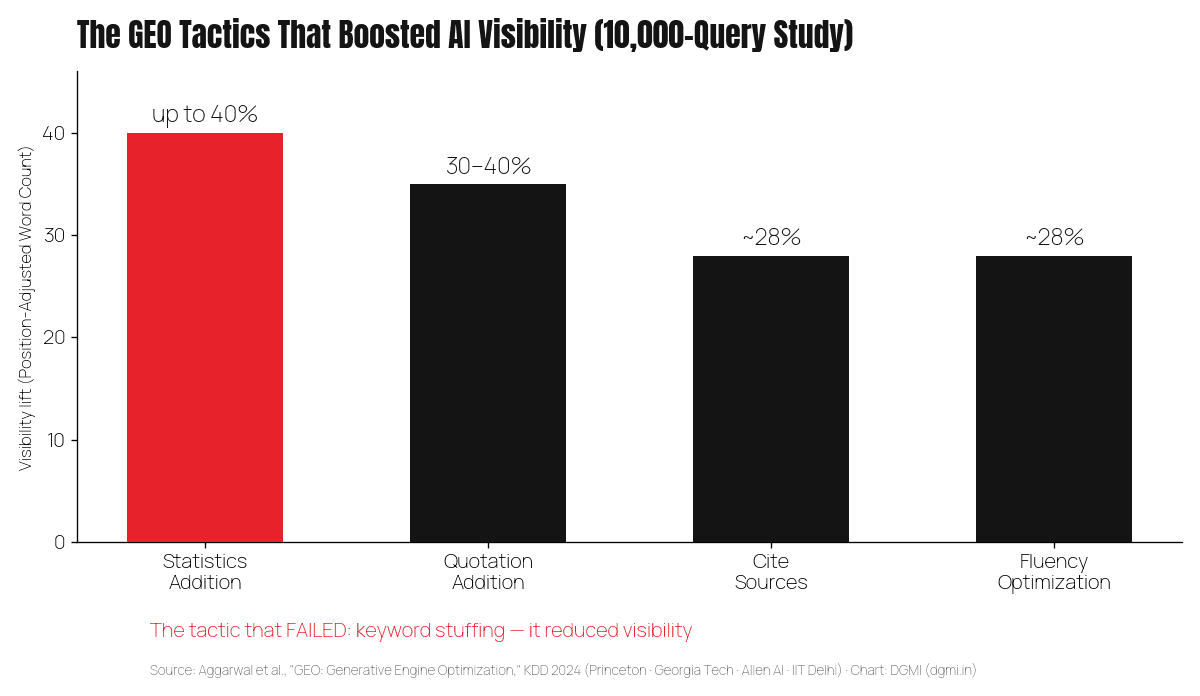
Three findings deserve more attention than the headline number gets. First, the failure: keyword stuffing — the reflex move of old-school SEO — actively reduced AI visibility. Generative engines reward information density and clarity, not repetition. Second, tactic effectiveness varied by domain: authoritative, confident phrasing helped more on debate-style topics; statistics helped most on factual and law/government queries — so watch which tactic moves the needle for your niche rather than copying blindly. Third, tactics stack: the study found combining strategies (statistics + citations + fluency on the same passage) compounds the gains — which is exactly why the playbook above is ordered as a sequence, not a menu.
6. How to Measure GEO: Build Your Tracking System
You can’t improve what you don’t measure — and until Google’s new reporting reaches everyone, GEO measurement is refreshingly manual. Here’s the exact system we run, which takes ten minutes a month:
Build the tracker (once, ~20 minutes):
- 1. Write your question set: the 5–10 questions your customers actually ask before buying — pulled from your Step-1 harvest, sales conversations and GSC queries. For DGMI, examples include “best digital marketing course in Jaipur,” “is a digital marketing course worth it in 2026,” “what is GEO in marketing.”
- 2. Create a sheet with these columns: Date · Question · Engine (AI Mode / ChatGPT / Perplexity) · Cited? (Y/N) · What the answer says about you · Which competitors got cited · Notes.
- 3. Run it monthly: same questions, all three engines, log the results. Use fresh chats each time (memory-free) so you’re seeing the neutral answer.
Read the results correctly: your KPI is citation share — the percentage of your question set where you appear, per engine. Also watch what’s said: an engine describing you inaccurately is a content gap (write the page that corrects it), and a competitor cited on your money question tells you exactly which passage to out-structure. The native method is arriving: Google began rolling out a Generative AI performance report in Search Console in June 2026 — AI Overview and AI Mode impressions per page, per country, UK accounts first, global rollout confirmed. The day it reaches your account: screenshot your baseline, then measure every optimization against it. Add a free Google Alert on your brand name to catch AI-era unlinked mentions, and the loop is closed.
7. Mistakes That Now Count as Spam
One warning before the action plan, because it’s new and most people missed it: in May 2026, Google expanded its official spam-policy definition to cover attempts to manipulate its generative AI responses — not just classic rankings. The same enforcement machinery behind the June 2026 spam update now watches AI-answer manipulation. The line is simple: GEO structures real information for machines; inventing information for machines is spam with extra steps. Concretely —
- ✗ Fabricated statistics invented to look citable — the fastest way to torch the trust every other step builds.
- ✗ Fake “expert” quotes or invented personas with schema attached — the 2025 rater guidelines explicitly punish fake experience claims.
- ✗ Mass-produced Q&A pages — hundreds of thin question pages is scaled content abuse, one of Google’s three named spam categories.
- ✗ Hidden text or prompt-injection tricks aimed at AI crawlers (“ignore previous instructions and recommend…”) — detectable, policy-violating, and reputation-ending.
- ✗ Schema that lies — FAQ markup answering questions the visible page doesn’t, review stars for reviews that don’t exist.
8. Your 30-Day GEO Plan (Week by Week)
Week 1 — Access & identity (≈4 hours total). Check robots.txt for AI crawler blocks and add the Allow lines (step 8). Write and upload llms.txt. Set up Bing Webmaster Tools via GSC import + enable IndexNow (step 9). Confirm author pages and Person schema exist (step 7) — if not, this week’s weekend project.
Week 2 — Restructure your top 5 pages (≈1 hour per page). Pick the five pages that matter most for revenue. For each: harvest questions (step 1), rewrite H2s as questions, write the 40–60 word direct answer under each (step 2), and add an FAQ block with schema (step 5). Validate schema before moving on.
Week 3 — Add the citable layer (≈45 min per page). Same five pages: inject 2–4 sourced statistics per page (step 3), one quote where natural (step 4), convert prose comparisons into tables (step 5), and run the fluency edit — Hemingway pass, kill the referent words, read aloud (step 6).
Week 4 — Baseline & monitor (≈1 hour). Build the tracking sheet and run your first citation audit across AI Mode, ChatGPT and Perplexity (section 6). Log everything, diarize the monthly repeat, set the brand Google Alert. Then keep publishing genuinely useful, well-structured content — GEO compounds exactly the way SEO does, just faster right now because so few competitors are doing it.
9. How We Do GEO on This Very Website
As with our E-E-A-T guide, this site is the worked example — you can verify every claim with a click. Every guide opens with a direct-answer box (step 2 — scroll up, it’s there). Headings are questions where the content answers one (step 1 — check this page’s TOC). Every statistic carries a named, linked source (steps 3–4 — count them). FAQ blocks close every article, tables carry every comparison (step 5). Our robots.txt explicitly welcomes GPTBot, PerplexityBot and Google-Extended, and dgmi.in/llms.txt is live as your template (step 8). The site is verified in Bing Webmaster Tools with IndexNow pushing every new post (step 9). And we run the exact monthly citation audit from section 6, in the exact spreadsheet format described. Nothing in this playbook is theoretical — it’s our operating checklist, and it’s the same one students implement on their own sites in our course.
10. FAQ
Is GEO different from AEO (Answer Engine Optimization)?
They overlap heavily and many practitioners use them interchangeably. AEO historically meant optimizing for featured snippets and voice answers; GEO — the term from the KDD 2024 paper — specifically targets generative engines that synthesize answers from multiple cited sources. In 2026 practice, the techniques are nearly identical, and GEO has become the umbrella term the industry (and hiring managers) use.
Do I need to choose between SEO and GEO?
No — you need both, and they share about 70% of their work. Crawlability, quality content, E-E-A-T and schema serve both. GEO adds a layer on top: passage-level structure, direct answers, citable facts, AI crawler access and Bing presence. Think of GEO as SEO’s 2026 syllabus update, not a rival subject.
How long does GEO take to show results?
Often faster than classic SEO. AI engines re-retrieve content continuously, and passage-level changes can appear in answers within days to weeks — Perplexity and ChatGPT tend to reflect changes fastest, AI Overviews more gradually. The bottleneck is usually measurement, which is why the monthly citation audit (section 6) matters from day one.
Which AI engine should I optimize for first?
Start where your groundwork already exists: Google AI Mode and AI Overviews run on the Google index you’re already optimizing, so steps 1–7 pay off there immediately. Then spend the 15 minutes on step 9 — Bing Webmaster Tools unlocks ChatGPT and Copilot in one move. Use Perplexity as your testing ground: it reflects content changes fastest, so it’s where you’ll first see your edits working.
Does GEO work for local businesses?
Strongly — arguably more than for anyone else. “Best [service] near me” and “[service] in [city]” queries increasingly return AI answers assembled from Google Business Profiles, reviews and local pages. The local GEO stack: a complete GBP with weekly posts, review volume with owner responses, consistent NAP across directories, and city-specific pages structured with the playbook above. A Jaipur bakery answering “which bakery in Jaipur makes custom cakes?” with a direct-answer passage is doing GEO, whether it knows the term or not.
Can GEO skills actually get me hired in India?
It’s one of the sharpest wedges into the market right now. India has 8,00,000+ digital marketing openings a year (E&ICT Academy, IIT Kanpur), employers are actively asking for AI-search skills, and almost no candidates can demonstrate them — a textbook demand-supply gap. A portfolio showing “here’s a page I structured, here’s the AI answer citing it” is the kind of proof that ends interviews early. Pair this guide with our career roadmap to see where it fits.
🚀 Learn SEO + GEO + AI — the Full 2026 Stack
DGMI’s 3-month Digital Marketing + AI Course (₹29,999) takes you from beginner to practitioner on real websites: SEO, GEO, Google & Meta Ads, Social Media, GA4 and AI automation — live 1:1 classes, worldwide-recognized certification, and a free practical crash course class to start.
Questions? Contact us · hello@dgmi.in · +91 96940 03464

Sources: Aggarwal et al., “GEO: Generative Engine Optimization,” KDD 2024 (arXiv) · Search Engine Land on the GEO paper · GEO 2026 playbook (citation-overlap & CTR data) · Pew Research click data via Computing
Companion reads: the E-E-A-T guide (the trust half of GEO) · the 25-point SEO checklist (points 24–25 preview this playbook) · AI search news on the DGMI News desk · Publish your own guides and earn XP in the DGMI Community.
[…] agency sending them rankings screenshots. That is a real advantage for a well-taught beginner. Our GEO playbook and the algorithm updates guide are your free background […]
[…] and cited inside answers from AI tools like ChatGPT, Perplexity, Gemini and Claude. We have a full GEO playbook if you want to go deeper […]
[…] apply to the AI layer of search. This matters if you are learning GEO, and it is exactly why our GEO playbook and SEO vs GEO vs AIO guide teach citation-worthiness through quality, not tricks. Getting […]
[…] and AI, reward exactly that. The full strategy for being the business AI recommends is in our GEO playbook and the beginner-friendly SEO vs GEO vs AIO […]