
Update desk, July 7, 2026: two things just became official in the same Google announcement — AI search is now mainstream at staggering scale, and for the first time ever, websites get a switch to pull themselves out of it. One of those numbers involves India more than any other country. Here’s what happened, what’s verified, and what to do before the controls reach Indian Search Console accounts.
• Google (June 3, 2026): AI Mode has passed 1 billion monthly users; AI Overviews reach 2.5 billion
• New in Search Console: a Generative AI performance report + an opt-out toggle for AI Overviews, AI Mode & AI in Discover
• Opting out does NOT affect normal rankings — Google confirms it’s not a ranking signal
• Rolling out UK-first (effective June 17) under a world-first regulatory order; global rollout planned, no date yet
• The Gemini app is excluded — opting out doesn’t remove you from Gemini answers
1. What Just Happened
On June 3, 2026, the UK’s Competition and Markets Authority issued what it calls a “world first” — a legally binding order requiring Google to give publishers a genuine way to opt out of AI search. Google complied the same day, shipping two things in Search Console:
First, a Generative AI performance report — a dedicated view showing how often your pages appear inside AI Overviews, AI Mode and AI features in Discover, broken down by page, country and device. It’s impressions-only for now (no click data yet), with history starting from May 18, 2026. Second, the opt-out toggle — under Settings → Search generative AI, letting a site exclude itself from those three AI surfaces while staying fully indexed and ranked in regular Search. Google states explicitly that the setting won’t be used as a ranking signal.
Both are live for a subset of UK site owners first, with the toggle taking effect June 17. A global rollout is confirmed as planned — with no announced date. That gap is your preparation window.
2. The Scale — and India’s Outsized Role in It
Buried in Google’s compliance announcement was the headline stat: AI Mode has surpassed 1 billion monthly users, with queries reportedly more than doubling each quarter, while AI Overviews now reach 2.5 billion people monthly. (Both figures are Google’s own, unaudited — worth remembering when you see them quoted as gospel.)
India’s fingerprints are all over that billion. India was the second country in the world to get AI Mode (June 2025), among the first languages beyond English (Hindi, September 2025), then received seven more Indian languages plus Search Live — first outside the US (October 2025). Google’s own India announcement says why: Indians are its largest user base globally for both voice and visual search, and AI Mode queries run nearly three times longer than traditional searches. The AI-search era isn’t arriving in India — India is one of the places it’s being built.
3. The Click Problem Behind the Regulation
Why did a competition regulator force this? Because of data like this:
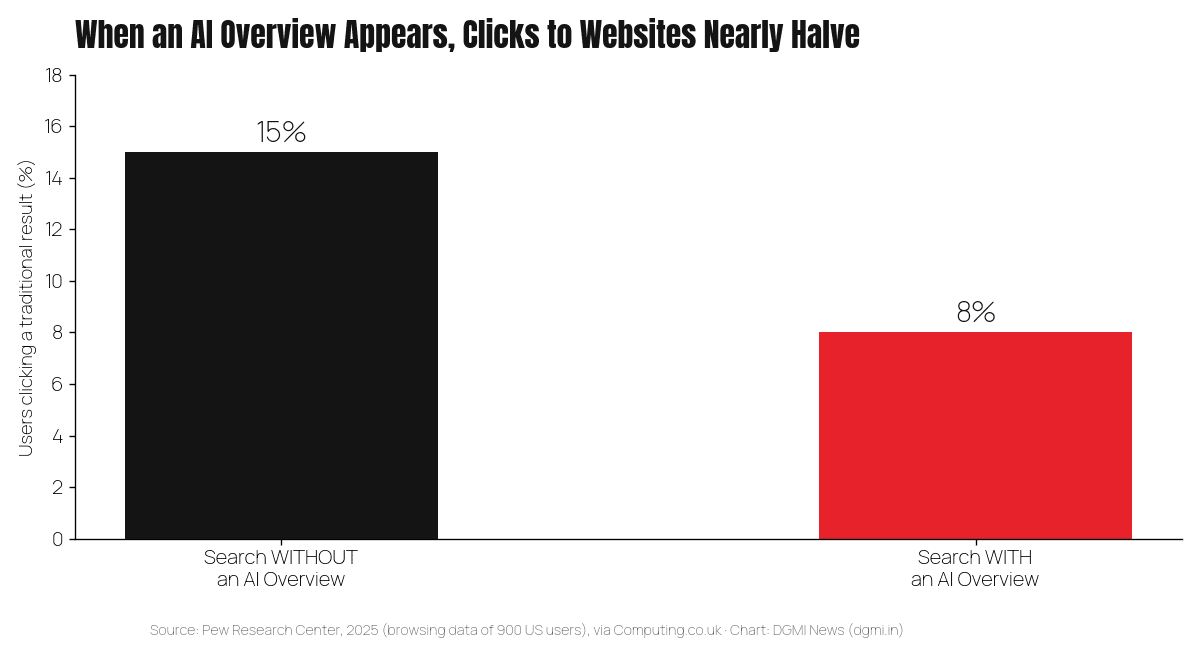
Pew’s 2025 analysis of real browsing behavior found users clicked a traditional result in just 8% of searches showing an AI Overview, versus 15% without one — and 26% of AI Overview searches ended the browsing session entirely, versus 16% without. Publishers argued their content was powering answers that no longer sent them readers; the CMA agreed they at least deserve the choice. Google, for its part, denies its AI features are hurting site visits and says it plans to show more links inside AI responses. The EU is running parallel proceedings. Expect this regulatory front to stay busy through 2026.
4. Should You Opt Out? (Almost Certainly Not)
For most businesses, lead-gen sites, blogs and local companies, opting out would be self-harm: AI answers are increasingly where customer journeys begin, and being cited there is free top-of-funnel visibility. Analysts reviewing the launch identify only a narrow set with a real case — subscription and premium-content publishers whose entire model depends on the click, or brands with specific misquotation risks.
Also crucial — don’t confuse the four different controls that now exist: the new GSC toggle (blocks AI Overviews/AI Mode, keeps rankings and snippets), Google-Extended in robots.txt (blocks AI model training, not AI Overviews), nosnippet (blocks AI features but also kills your normal search snippet), and noindex (removes you from everything). They do four different jobs; the new toggle is the only one that removes AI usage with zero organic trade-off.
5. What Indian Site Owners Should Do Now
- ✓ Do nothing rash. The toggle isn’t available in India yet, and when it arrives, the default (staying in) is the right call for almost everyone reading this.
- ✓ Watch Search Console for the new report. It appears under Performance when your account gets it. Day one job: note AI impressions for your top 10 URLs — that’s your baseline for every decision after.
- ✓ Make your content citable before the report arrives. Question-style headings, a direct 40–60 word answer under each, FAQ schema, comparison tables, named authors and sourced claims — the structure AI answers extract from. (Our E-E-A-T guide covers the trust half of this.)
- ✓ Track your citations manually until then. Once a month, ask AI Mode, ChatGPT and Perplexity the 5 questions your customers ask — log whether you’re cited. Free, ten minutes, and it’s the KPI everyone will be chasing in a year.
- ✓ If you’re a paywalled publisher, start the analysis now — you’re the exception with a genuine opt-out case, and you’ll want your traffic math done before the toggle reaches you.
📰 Get every update the day it drops
DGMI News covers every Google algorithm update and major marketing development — reported fast, explained simply, no fluff.
Subscribe free → earn 25 Community XP as a welcome reward 🎁
Email only. No spam, unsubscribe anytime.
6. Quick FAQ
When will the opt-out toggle and AI report reach India?
Google has confirmed a global rollout after the UK testing phase but hasn’t announced a date. Given India’s importance to AI Mode adoption, Indian Search Console accounts are unlikely to be far down the list — we’ll cover it here the day it lands. Note the underlying AI features (AI Overviews, AI Mode) are already fully live in India; only the controls and reporting are pending.
If I opt out, do I disappear from Google?
No. Opting out removes your content from exactly three surfaces — AI Overviews, AI Mode and AI Overviews in Discover. You remain indexed, ranked and shown normally in regular Search results and the standard Discover feed, and Google confirms the choice is not a ranking signal. You do lose all impressions and traffic those AI surfaces were sending you.
Does opting out keep my content out of Gemini too?
No — and this catches people out. The control applies only to Google’s Search AI products; the Gemini app is explicitly excluded, so your content can still appear in Gemini answers after opting out. Blocking AI model training is a separate mechanism (the Google-Extended directive in robots.txt), which in turn does not remove you from AI Overviews. Four controls, four different jobs.
Is this the end of SEO?
It’s the expansion of it. A billion people now search inside an AI interface that cites websites — which means the new competition is being the cited source, not just the blue link. The skills that win citations (structured answers, original data, E-E-A-T, schema) are learnable, measurable — soon natively in Search Console — and currently practiced by a small minority of sites. Fewer clicks per query, but a wide-open field.

Sources: TechCrunch · 9to5Google · Computing (incl. Pew Research data) · Google India blog · Digital Applied — GSC AI controls guide
← All news & updates · Related: June 2026 spam update · Make your site AI-citable: the E-E-A-T guide and the 25-point SEO checklist.