
Every week, a student or client asks me some version of the same question: “the algorithm changed again, what do I do now?” Fair question. In 2026 alone, Google shipped five confirmed updates, YouTube rebuilt discovery around satisfaction, Instagram’s chief publicly named the signals that decide reach, Facebook finished replacing its entire ad-targeting brain, and WhatsApp quietly became an advertising platform. I manage marketing across all five of these platforms for DGMI and for client businesses, so this guide is the one page I wish existed: every 2026 change that actually matters, verified from official statements and credible reporting, plus the practical marketing guidelines for each platform, written for beginners.
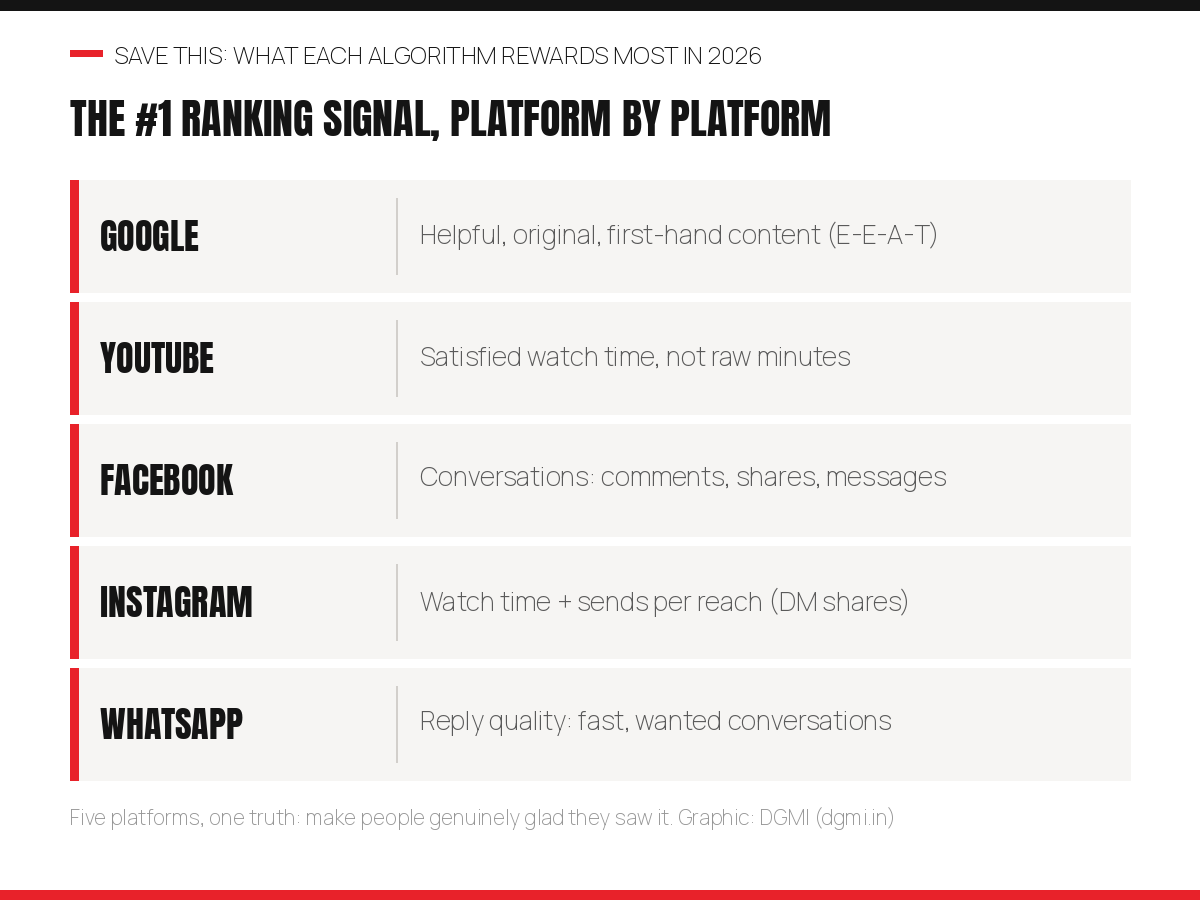
Every major platform moved in the same direction in 2026: rewarding genuine satisfaction and penalizing shortcuts. Google promotes original, first-hand content and demotes AI-paraphrased pages. YouTube ranks “satisfied watch time” above raw minutes. Facebook prioritizes conversations over passive likes and restricts unoriginal content. Instagram ranks on watch time and DM shares while penalizing repost accounts. WhatsApp rewards businesses whose messages people actually want and reply to, and now sells ads in its Updates tab. Master originality, retention and conversation, and every algorithm works in your favor.
• Google’s March 2026 core update: original content gained +22% visibility, AI-paraphrased content lost 71% of traffic (SE Ranking)
• Google AI Mode crossed 1 billion monthly users in June 2026
• Instagram: original content earns roughly 40 to 60% more distribution than reposts, and ~694,000 Reels are shared by DM every minute
• Meta’s own data: under the new Andromeda system, creative quality now drives more ad performance than targeting, budget and placement combined
1. Five Platforms, One Truth (Start Here)
Before the platform-by-platform details, understand the pattern, because it makes everything else easier to remember. For years, each platform had its own tricks: keywords for Google, tags for YouTube, hashtags for Instagram, engagement bait for Facebook, broadcast blasts for WhatsApp. In 2026, all five run on AI systems sophisticated enough to measure the thing tricks used to fake: did a real person genuinely benefit from this? Google measures it through originality and E-E-A-T. YouTube literally surveys viewers. Instagram watches whether people send your content to friends. Facebook counts conversations. WhatsApp watches whether people reply or block. Different sensors, same question.
2. Google in 2026: Updates + Marketing Guidelines
What changed in 2026
Google has shipped five confirmed algorithm events this year, and together they tell one story. The February Discover update ran 21 days and tightened content quality in the Discover feed. The March spam update rolled out in under a day, a speed signaling automated enforcement. The March core update (March 27 to April 8) was the year’s defining moment: SE Ranking’s analysis found sites with original, first-hand content gained around 22% visibility while AI-paraphrased content lost 71% of its traffic. A May core update (May 21 to June 2) continued the same direction, and a June spam update completed in just two days. Beyond ranking updates, Google formalized a policy against scaled AI manipulation in May, clarified in June that Google Search ignores llms.txt files, and its AI Mode crossed 1 billion monthly users, meaning a large share of searches now end in an AI answer that cites only a handful of sources. Getting cited by AI is the new page one; that discipline is called GEO, and we cover it fully in our GEO playbook.
Marketing guidelines for Google in 2026
- 1. Publish first-hand, verifiable content with named authors, cited sources, and original observations or data. This is precisely what the +22% winners share.
- 2. Use AI as an assistant, never a substitute. Draft with AI, verify and rewrite with human judgment. Unedited AI paraphrasing is what lost 71% of its traffic.
- 3. Structure for AI citation: question-style H2s, direct 40-to-60-word answers beneath them, statistics with named sources. These tactics lift AI visibility by up to 40% in published research.
- 4. Never panic during a rollout. Check Google’s Search Status Dashboard, wait for the update to complete, then respond with sitewide quality work, not tricks. The full 20-year pattern is in our algorithm history guide.
- 5. Local businesses: keep Google Business Profile active weekly; reviews, photos and posts are the local algorithm’s favorite food.
3. YouTube in 2026: Updates + Marketing Guidelines
What changed in 2026
YouTube’s biggest shift is philosophical: “satisfied watch time” now outranks raw watch time. The platform weights viewing by satisfaction signals, including the 1-to-5 star survey pop-ups viewers now see more often, whether viewers return, and whether your video extends their session. YouTube’s own growth director, Todd Beaupre, framed it plainly: watch time is weighted by satisfaction, not just minutes. Practical consequences: a tightly-edited 6-minute video with high retention beats a padded 15-minute one, and clickbait now actively kills videos because high clicks plus low satisfaction ratings suppress long-term discovery. Second big change: the Shorts and long-form algorithms are now fully decoupled, Shorts appear in regular search and the Home feed, and each format must be optimized separately. Third: discovery got micro-niched. The Browse feed clusters viewers by watch-history patterns, so focused channels get matched to exactly the right audience while generic channels get filtered. This levels the field dramatically: a 100-subscriber channel can outrank a million-subscriber one when its satisfaction metrics are superior, and features like Hype (fans boosting creators under 500K subscribers onto leaderboards) push the same direction. Finally, YouTube’s AI-content position matured: disclosed AI assistance is fine; undisclosed synthetic content faces suppression.
Marketing guidelines for YouTube in 2026
- 1. Niche down hard. One clear topic, a consistent series, and the clustering algorithm becomes your distribution engine. Broad “everything” channels are the biggest losers of 2026.
- 2. Win the first 30 seconds. Cut slow intros, front-load the promised value, use pattern interrupts. Early abandonment stalls a video before wide testing.
- 3. Deliver exactly what the title promises. Satisfaction surveys punish the gap between packaging and content. Curiosity is good; deception is fatal.
- 4. Run Shorts as a discovery feeder: hook in 1 to 2 seconds, design for replays, and point viewers toward your long-form, where depth and revenue live. Optimize the two formats separately.
- 5. Build sessions, not uploads: end screens, follow-up videos and playlists that keep viewers on a chain of your content raise session contribution, one of 2026’s rising signals.
- 6. For businesses: search-intent videos (“how to choose an interior designer in Jaipur”) convert better than viral attempts, and now get discovered through both YouTube search and Google’s AI answers.
4. Facebook in 2026: Updates + Marketing Guidelines
What changed in 2026
Two separate revolutions, organic and paid. Organic: the Feed now optimizes for meaningful interactions (comments, shares, messages) over passive likes, personalizes around your interest graph rather than global virality, and is actively restricting the reach of unoriginal content to “protect and elevate creators,” complete with a copyright check for Reels. Facebook is even warning page admins that links inside captions can hurt reach and nudging links into comments, and limiting how many link posts some accounts can share monthly. Native video earns dramatically more organic reach than link posts in industry analyses. Paid: the bigger story. Meta finished rolling out Andromeda, a new AI delivery system (running on custom NVIDIA hardware, reportedly 10,000x more complex than its predecessor) that reads your ad creative itself to decide who sees it. Meta’s own data says creative quality now drives more performance than targeting, budget and placement combined. Old structures (stacked interests, many narrow ad sets, tight lookalikes) now actively slow delivery. In 2026 Meta also added a “Chat on WhatsApp” lead objective, an Opportunity Score in Business Suite, and post-comparison tools in the Professional Dashboard.
Marketing guidelines for Facebook in 2026
- 1. Post to start conversations, not collect likes. Questions, local relevance, community content. A post with 30 comments outranks one with 300 silent likes.
- 2. Go native: upload video directly, keep it short, and put external links in the first comment, not the caption.
- 3. Never repost others’ content; Facebook’s unoriginality restrictions now mirror Instagram’s. Original or nothing.
- 4. In ads, creative variety IS the targeting. Feed Andromeda 3 to 5 genuinely different angles (different hooks, formats, personas) in simple consolidated campaigns, and let the system find your buyers. Our own free-class campaigns run exactly this way: three psychological angles, one campaign, and the machine sorts who sees what.
- 5. Fix your signals: Pixel plus Conversions API with strong event match quality is the fuel Andromeda runs on. Weak tracking now costs more than weak budgets.
- 6. Use native lead forms for Indian audiences; pre-filled forms consistently beat landing pages on cost per lead in most local-service tests, including ours.
5. Instagram in 2026: Updates + Marketing Guidelines
What changed in 2026
Instagram is unusually transparent now: its head, Adam Mosseri, has publicly confirmed the three signals that matter most. Watch time (viewers decide within roughly 1.7 seconds; passing the 3-second mark is the first threshold), likes per reach (weighted more for reaching your existing followers), and sends per reach (DM shares, the most powerful signal for reaching new audiences; an estimated 694,000 Reels are shared by DM every minute). Views are now the primary analytics currency. Beyond signals, four structural changes define 2026: the aggregator penalty (original content earns roughly 40 to 60% more distribution, repost-heavy accounts get excluded from recommendations, and Instagram can even swap your repost for the original creator’s version), “Your Algorithm” (users now curate their own recommendation topics in Content Preferences, live globally since early 2026), keyword SEO replacing hashtags (captions and profiles are searchable; hashtag following is gone), and Mosseri’s end-of-2025 memo committing Instagram to prioritize “raw, real human content” over AI-generated material through 2026. Longer Reels (up to 3 minutes) now reach non-followers, and recommended content increasingly competes inside the Feed itself.
Marketing guidelines for Instagram in 2026
- 1. Create send-worthy content. Before posting, ask: “who would forward this to a friend, and why?” Relatable, useful, or genuinely funny wins DM shares, and DM shares win reach.
- 2. Win the first 3 seconds of every Reel: movement, a bold claim, or the payoff teased upfront. Design for rewatches; loops count.
- 3. Be original or be invisible. No watermarked TikTok reposts, no meme aggregation. Raw, human, clearly-yours content is exactly what Mosseri says 2026 rewards.
- 4. Do Instagram SEO: put your real keywords in your name field, bio, captions and on-screen text (“Jaipur digital marketing institute”, not just #dgmi). Search is a growing discovery surface.
- 5. Follow the cadence that Instagram itself suggests: around 2 Reels plus 3 to 5 feed posts weekly, consistently. Consistency beats bursts.
- 6. Use Stories for relationships, Reels for reach: polls, questions and replies deepen the relationship signals that keep you in your followers’ Feed.
- 7. Track Sends and Views in Insights, not likes. What people share privately is your true content report card.
🎯 Algorithms Change. Skills Compound.
Every platform above rewards people who understand marketing fundamentals plus modern AI workflows. That is exactly what DGMI’s Digital Marketing + AI Course teaches: SEO, GEO, ads, content, analytics and AI, live and 1:1 on real projects. Experience the teaching first with a 100% practical crash course class, FREE this week.
6. WhatsApp in 2026: Updates + Marketing Guidelines
What changed in 2026
WhatsApp does not rank a feed the way the others do, but it absolutely has algorithms: systems that score business messaging quality, decide rate limits, and now decide ad delivery. Three changes matter. First, WhatsApp officially carries ads: Status ads in the Updates tab (they work like Stories ads, and a tap starts a chat with the business), alongside promoted Channels. Second, Meta wired WhatsApp deeper into its ad machine: the new “Chat on WhatsApp” lead objective and click-to-WhatsApp campaigns make conversation the conversion, and Meta keeps adding business AI and calling features because it openly wants WhatsApp to be where business happens. Third, quality enforcement got stricter: business numbers that message people who did not opt in, or that get blocked and reported, face rate limits and bans. The invisible algorithm here scores whether people want your messages, measured by replies, blocks and reports. For India, where WhatsApp is effectively the country’s default messaging layer and repeat customers drive the majority of business revenue in several industry studies, this is the highest-intent marketing channel that exists.
Marketing guidelines for WhatsApp in 2026
- 1. Opt-in is everything. Build your list through forms, ads and in-store requests where people choose to hear from you. Bought lists and cold blasts get numbers banned, deservedly.
- 2. Reply fast, ideally within 15 minutes. Speed is the conversion multiplier on this platform; our own free-class enquiries convert dramatically better inside the first hour than after it.
- 3. Set up the free business toolkit: greeting message, quick replies, catalog, and labels. Ten minutes of setup makes a small business feel professionally run.
- 4. Run click-to-WhatsApp ads for lead generation. For Indian local businesses, a conversation beats a form fill almost every time. Pair the ad with a question-based opener so the chat starts naturally.
- 5. Message like a helpful human, not a broadcaster: useful updates, order confirmations, genuine offers, at most a few marketing touches a month. Every block teaches the quality algorithm to distrust your number.
- 6. Use Channels and Status for one-to-many, keeping 1:1 chat for high-intent conversations. That separation keeps your number’s quality score healthy.
7. The Cross-Platform Playbook (7 Universal Rules)
Zoom out and the five platforms collapse into seven rules. Master these once and every future “algorithm update” headline becomes a small adjustment instead of a crisis.
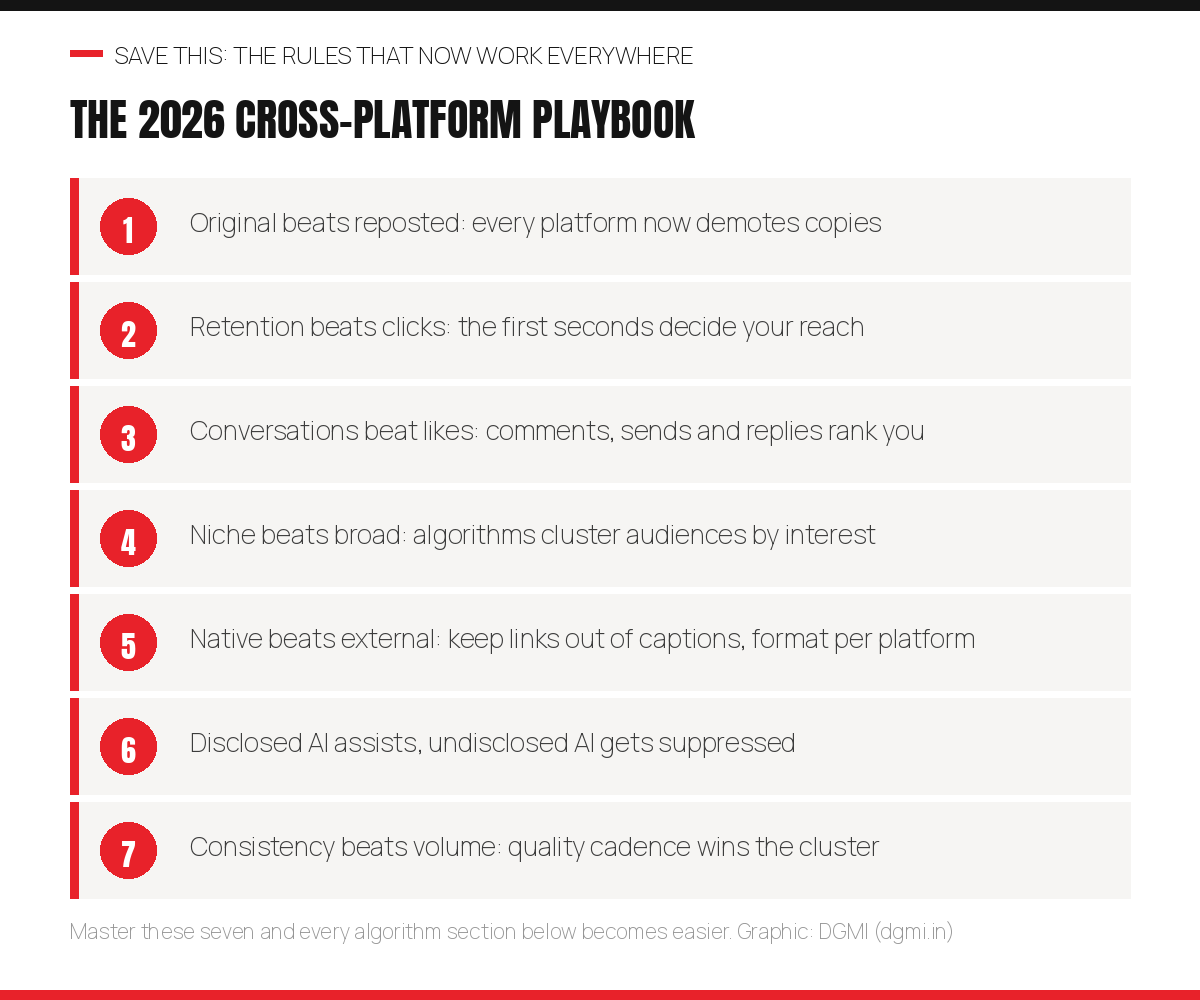
Notice what is NOT on the list: posting times, hashtag counts, follower milestones, engagement pods. Those levers either stopped mattering or now actively hurt. The 2026 game is simple to describe and demanding to execute: make original things a specific audience genuinely values, in each platform’s native format, consistently, with AI assisting openly rather than impersonating you. Everything in our resource library, from the E-E-A-T guide to the AI tools stack, is a deeper dive into some corner of that sentence.
8. Which Platform First? The Priority Matrix
Beginners and small businesses cannot do five platforms well, and should not try. Pick by goal:
| Your situation | Start here | Add next |
|---|---|---|
| Local service business (clinic, salon, tutor) | Google (GBP + reviews) | WhatsApp + Instagram |
| Product or D2C brand | Instagram (Reels) | Meta ads + WhatsApp |
| Expertise or education business | YouTube + Google (blog) | Instagram + WhatsApp |
| Job seeker building a personal brand | LinkedIn + one content platform | A published portfolio |
| Community or repeat-purchase business | WhatsApp (opt-in list) | Facebook groups + email |
The pattern: one discovery platform plus one relationship platform. Discovery (Google, YouTube, Instagram, Facebook) brings strangers in; relationship (WhatsApp, email, community) turns them into customers who return. Our freelance clients guide and Google Ads guide show both halves in action.
9. How to Stay Updated Without Drowning
You do not need to follow fifty gurus. Five official sources cover everything: Google’s Search Status Dashboard (every confirmed update), YouTube’s official blog and Creator Insider channel, Adam Mosseri’s own Instagram account (he announces ranking changes there first), Meta’s Business News hub for Facebook and ads, and the WhatsApp Business blog. Then one honest summary layer: the DGMI News desk, where we cover each significant update in plain language within days, exactly like the breakdowns in this guide, and subscribing earns you 25 XP in our community. Fifteen minutes a week from these sources beats hours of recycled YouTube panic videos.
10. FAQ
Which algorithm update matters most in 2026?
For most businesses, Google’s March 2026 core update, because the +22% versus minus 71% split between original and AI-paraphrased content set the rule every other platform is also enforcing: originality or invisibility. For creators specifically, Instagram’s confirmed shift to watch time and sends per reach, plus YouTube’s satisfied-watch-time model, changed daily content decisions the most. The good news is they all reward the same behavior, so one strategy serves every platform.
Do hashtags still work on Instagram in 2026?
Barely, and not the way people use them. Instagram removed hashtag following, and discovery now runs on keywords in captions, profiles and on-screen text, plus the core signals (watch time, sends, likes per reach). Use 3 to 5 relevant hashtags as light categorization if you like, but invest your effort in Instagram SEO and send-worthy content. Thirty hashtags on a mediocre Reel changes nothing.
Is AI-generated content banned on these platforms?
No platform bans AI assistance; every platform now punishes AI impersonation. Google demotes scaled, unoriginal AI content (the minus 71% group). YouTube suppresses undisclosed synthetic content but accepts disclosed AI help. Instagram’s leadership has committed to prioritizing raw human content and is exploring AI labels. The consistent safe pattern, and the one we teach: AI drafts and assists, humans verify, add first-hand value, and stay visibly the author. Our E-E-A-T guide covers the Google side in depth.
My reach suddenly dropped. Which platform’s update caused it?
Diagnose before blaming an update. Check the platform’s official update source (dashboard, blog, or Mosseri’s account) for a rollout overlapping your dates. Then audit yourself against the seven universal rules: reposted content, weak first seconds, links in captions, broad unfocused topics, blast messaging. In our experience, most “algorithm hit me” cases are actually one of those five. If a confirmed update does overlap, respond with quality improvements sitewide or channel-wide, never with panic deletion or tricks.
I am a beginner. Should I learn all five platforms at once?
No. Learn marketing fundamentals once (audience, intent, content, measurement), then go deep on the one discovery platform plus one relationship platform that fit your goal from the priority matrix above. Fundamentals transfer; platform mechanics you can learn in a weekend each. This is exactly how our course sequences it: fundamentals and live projects first, then platform depth where your career or business needs it.
🚀 Learn the Skills Every Algorithm Rewards
DGMI’s 3-month Digital Marketing + AI Course (₹29,999) teaches the full 2026 stack: SEO and GEO, YouTube and content strategy, Meta and Google ads, WhatsApp funnels, analytics and AI workflows, all practiced live and 1:1 on real projects with worldwide-recognized certification. Start with a free practical crash course class.
Questions? Contact us · hello@dgmi.in · +91 96940 03464
Sources for quoted data and changes: Google Search Status Dashboard · SE Ranking March 2026 core update analysis · vidIQ: YouTube algorithm 2026 (Beaupre statements) · Confirmed YouTube 2026 changes · Sprout Social: Instagram algorithm (Mosseri signals) · Instagram 2026 changes and originality data · SocialPilot: Facebook algorithm and Andromeda · Facebook 2026 updates tracker · Meta WhatsApp advertising 2026
Go deeper per platform: Google’s full algorithm history · the GEO playbook (AI search) · the E-E-A-T guide · the Google Ads guide · the AI tools stack · the AI agents build · daily updates on the DGMI News desk · discuss in the DGMI Community.
[…] If your traffic has dropped while your rankings held steady, this is almost certainly why, and our algorithm updates guide covers the related platform […]