
Every SEO student eventually asks me the same question: “Sir, why did this website suddenly lose all its traffic?” And the answer, nine times out of ten, begins with two words: algorithm update. In my 12 years of doing SEO, I’ve personally lived through most of the updates in this guide. I’ve seen client websites double overnight, and I’ve done the 2 AM recovery work when others crashed. This is the complete story, told in simple language, of every major update from 2003 to today, what each one punished, what it rewarded, and the lesson it left behind. Learn these, and you’ll understand why modern SEO works the way it does.
A Google algorithm update is a change to the formula Google uses to rank websites in search results. Google makes thousands of small tweaks every year, but a few times a year it releases major updates, like Panda, Penguin or the core updates, that can significantly raise or drop a website’s traffic based on its quality, links, and trustworthiness.
• Google changes its algorithm thousands of times a year, but only a handful are “major” updates that reshape rankings
• A single update can be huge: Panda affected ~11.8% of all queries; the March 2024 core targeted a 45% cut in unoriginal content
• The pace is accelerating: 2026 has already seen five confirmed algorithm events in six months
• And the direction is consistent: after the March 2026 core, sites with original data gained +22% visibility while AI-paraphrased content lost 71% of its traffic (SE Ranking)
1. What Is an Algorithm Update? (And the 3 Types)
Think of Google as a librarian managing the world’s biggest library. When you ask a question, the librarian decides which books (websites) to hand you first. The algorithm is the librarian’s rulebook for making that decision, and an update is the librarian learning a new, smarter rule.
For students, it helps to know that updates come in three flavors:
- 1. Core updates, broad improvements to how Google judges quality overall. Nothing specific is “targeted”; the whole rulebook gets smarter. These cause the biggest ranking movements and arrive a few times a year.
- 2. Spam updates, focused strikes against rule-breakers: bought links, scaled junk content, hacked pages. If you don’t cheat, these usually feel like a quiet day (or a good one, as cheaters fall away).
- 3. Feature/system launches, new capabilities added to search itself, like mobile-friendliness becoming a signal, or AI Overviews appearing. These change the playing field, not just the scores.
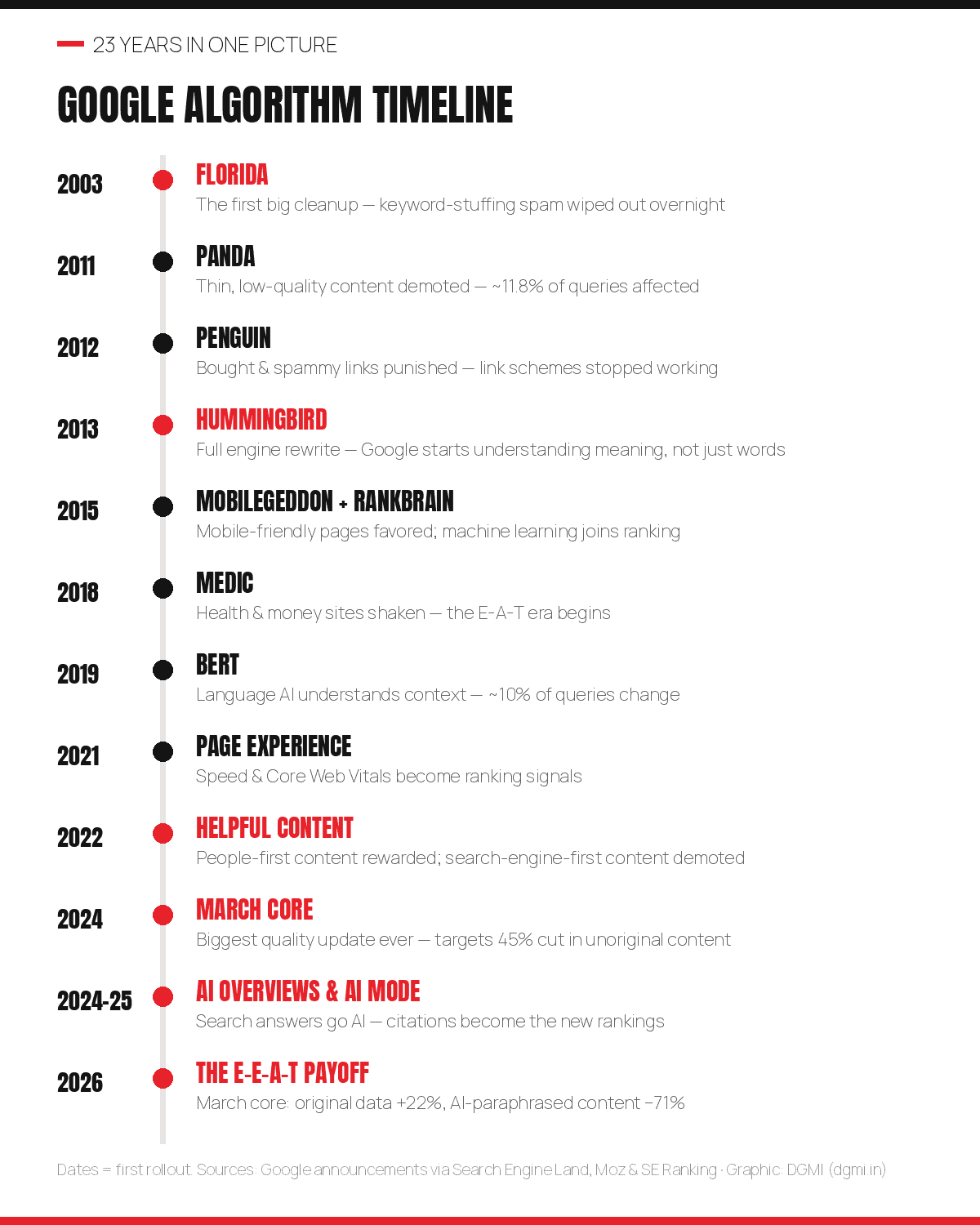
Here’s the whole 23-year story in one picture, we’ll walk through it era by era:
2. Era 1: The Spam Wars (2003–2012)
In the early days, ranking on Google was embarrassingly easy to fake. Repeat your keyword 50 times, buy a few thousand links, done. This era is Google declaring war on those tricks, and winning.
🌪️ Florida: November 2003
What it did: Google’s first famous update, landing right before the holiday shopping season. Websites stuffed with repeated keywords, the #1 trick of the time, vanished from results overnight. Thousands of businesses woke up invisible.
How important: Historic. It was the moment the industry learned that Google could, and would, change the rules without warning.
The lesson it left: tricks have expiry dates. Every update since has repeated this message; Florida said it first.
🐼 Panda: February 24, 2011
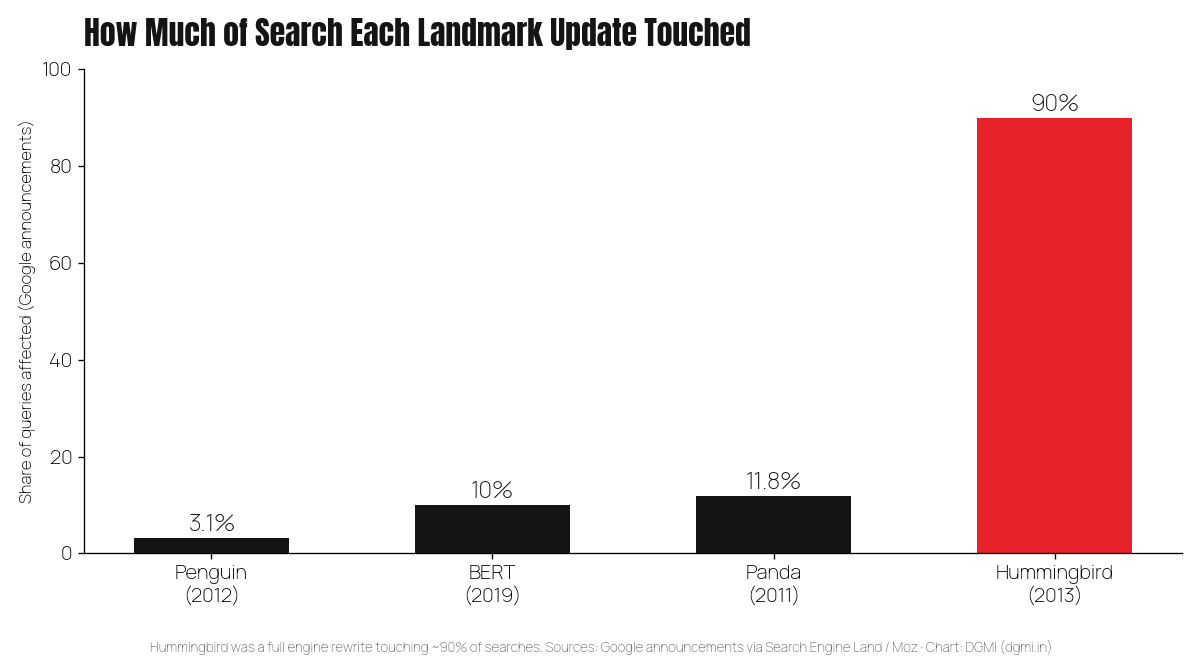
What it did: punished thin, low-quality content, pages with little useful text, copied content, and “content farms” that mass-produced shallow articles purely to rank. Google said it affected ~11.8% of all queries, a gigantic share.
How important: Era-defining. Panda made “content quality” a survival requirement instead of a nice-to-have, and it ran as a recurring filter for years before being folded into the core algorithm.
The lesson it left: every page must earn its existence. If a page exists only for Google and not for a human, it’s a liability. (This is the ancestor of everything we teach in our 25-point SEO checklist.)
🐧 Penguin: April 24, 2012
What it did: attacked unnatural links, bought backlinks, link exchanges, and spammy directories, which were the second great cheat of the era. It affected ~3.1% of English queries, and unlike a penalty you could apologize for, Penguin was algorithmic: the rankings just fell.
How important: Very. Entire “link building agencies” selling thousands of junk links died within months. In September 2016, Penguin 4.0 became part of the real-time core algorithm, meaning link spam is now evaluated continuously, forever.
The lesson it left: links must be earned, not manufactured. One relevant, editorial link outweighs a thousand purchased ones, a rule that Google’s spam updates still enforce today.
3. Era 2: Understanding Language (2013–2019)
With the worst spam beaten back, Google turned to a harder problem: actually understanding what people mean. This era turns Google from a keyword-matching machine into something that reads.
🐦 Hummingbird: August 2013
What it did: not a filter, but a complete rebuild of the search engine itself, like replacing a car’s engine while keeping the body. Hummingbird let Google understand whole questions and meaning (“things, not strings”), touching an estimated ~90% of searches.
How important: Foundational. Every language ability Google has today, including AI search, stands on Hummingbird’s shoulders.
The lesson it left: write for meaning, not exact keyword matches. Answering the question behind the search became the job.
🕊️ Pigeon: July 24, 2014
What it did: rebuilt local search, tying map results much closer to traditional ranking signals and distance.
How important: Huge for every shop, clinic, restaurant and local service. “Near me” SEO as a discipline starts here.
The lesson it left: local businesses need real SEO too, a complete Google Business Profile, local citations, reviews and location pages.
📱 Mobilegeddon: April 21, 2015
What it did: made mobile-friendliness a ranking signal on mobile searches, announced in advance, with a scary nickname the industry invented.
How important: Directionally massive. The impact on day one was mild, but it announced where the world was going; Google later moved to mobile-first indexing, where the mobile version of your site IS your site.
The lesson it left: design for the phone screen first. In India especially, an overwhelmingly mobile-first internet, this is non-negotiable.
🧠 RankBrain, announced October 2015
What it did: introduced machine learning into ranking for the first time, an AI system helping interpret queries Google had never seen before (about 15% of daily searches are brand new). Google called it one of its most important ranking signals.
How important: A quiet revolution. You couldn’t “optimize for RankBrain”, which was exactly the point. The algorithm began learning from what satisfied users.
The lesson it left: satisfy the searcher, and the machine learns to reward you. User satisfaction became the invisible ranking factor.
⚕️ Medic: August 1, 2018
What it did: a core update that disproportionately hit health, finance and other “Your Money or Your Life” (YMYL) websites, the topics where bad information can genuinely harm people. Sites without credible authors and trust signals dropped hard.
How important: This is the birth of the E-A-T era (Expertise, Authoritativeness, Trust, the extra E for Experience came in 2022). Suddenly who wrote it mattered as much as what was written.
The lesson it left: show your credentials. Author bios, sources, and transparency stopped being decoration, the full modern system is in our E-E-A-T guide.
🔤 BERT: October 25, 2019
What it did: brought a language AI model into search that understands context, the difference between “traveling to USA visa” and “traveling from USA visa.” Affected ~10% of queries at launch.
How important: The bridge to today. BERT-style language models are the direct ancestors of the AI systems now writing answers in AI Mode.
The lesson it left: natural, clear writing wins. You can’t trick a system that reads almost like a person; you can only be genuinely clearer than competitors.
🎯 Want to Learn SEO That Survives Every Update?
This history is a lesson straight from DGMI’s Digital Marketing + AI Course, where you don’t just read about updates, you build a real website designed to survive them: quality content, earned links, E-E-A-T and GEO, live 1:1 with a mentor of 12 years. Try a 100% practical crash course class. FREE this week.
4. Era 3: Experience & Helpfulness (2020–2023)
⚡ Page Experience & Core Web Vitals: June 2021
What it did: made the experience of using a page, loading speed, visual stability, responsiveness, measured as “Core Web Vitals”, a ranking consideration.
How important: Moderate as a ranking factor, major as a mindset: a slow, jumpy page now costs you twice: in rankings and in the visitors who leave before it loads.
The lesson it left: performance is part of SEO. Compress images, use decent hosting, test in PageSpeed Insights.
⭐ Product Reviews Updates: 2021–2023
What it did: a series of updates rewarding review content with first-hand evidence, original photos, real testing, pros and cons, and demoting thin “top 10” lists rewritten from Amazon descriptions.
How important: Big for affiliate and review sites; a preview of the Experience “E” going mainstream.
The lesson it left: prove you actually used the thing. First-hand experience became a visible, checkable requirement.
🤝 Helpful Content Update: August 25, 2022
What it did: introduced a sitewide signal against “search-engine-first” content, pages created to rank rather than to help. Crucially, enough unhelpful content could drag down your whole site, not just the bad pages. Strengthened sharply in September 2023, then integrated into the core algorithm in March 2024.
How important: One of the most consequential updates of the decade, the September 2023 version caused some of the most dramatic traffic losses ever recorded for sites built on mass-produced content.
The lesson it left: “Would this content exist if Google didn’t?” If the honest answer is no, the algorithm eventually notices.
🕸️ Link Spam Updates & SpamBrain: 2021–2022
What it did: deployed SpamBrain, Google’s AI spam-fighting system, against link schemes, this time neutralizing bought links (making them worthless) rather than only punishing them.
How important: It quietly ended the “buy links, apologize later” economy: money spent on spam links now often just evaporates.
The lesson it left: the same one Penguin taught, now enforced by AI that never sleeps.
5. Era 4: The E-E-A-T + AI Era (2024–2026)
💥 March 2024 Core Update: March 5 to April 19, 2024
What it did: the biggest quality update Google had ever shipped, a 45-day rollout (the longest on record) that absorbed the Helpful Content system into the core algorithm and aimed to cut low-quality, unoriginal content in results by 45%. Alongside it came three new named spam policies: scaled content abuse (mass-produced pages, including AI-generated junk), site reputation abuse (“parasite” content on rented sections of trusted sites), and expired domain abuse.
How important: Era-defining, the moment Google formally answered the flood of cheap AI content. Thousands of AI-content sites were deindexed entirely during the rollout.
The lesson it left: scale without value is now a named offense. AI can help you produce; it cannot replace having something real to say.
🤖 AI Overviews & AI Mode: May 2024 onward
What it did: changed the results page itself. AI Overviews (launched at Google I/O, May 2024) put AI-written answers above the links; AI Mode followed as a full conversational search experience, reaching 1 billion monthly users by June 2026, with India among its very first and biggest markets.
How important: The biggest change to what SEO is since Google began. AI answers cite a handful of sources, so being cited joined being ranked as the goal. That new skill has a name, GEO, and our complete playbook covers it step by step.
The lesson it left: structure your content so machines can quote it, direct answers, statistics, sources, clear passages.
📈 The 2025–2026 Cadence: Quality Tightens, AI Rules Arrive
What happened: updates settled into a relentless rhythm, multiple core and spam updates a year, each reinforcing the same direction. 2026 alone has already delivered five confirmed events in six months: a February Discover update, a March spam update, the March 2026 core (the most volatile on record: 79.5% movement in top-3 results, with sites publishing original data gaining +22% visibility while AI-paraphrased content lost 71% of traffic, per SE Ranking), a May core update, and the June 2026 spam update, one of the fastest ever at just over two days. And in May 2026, Google expanded its spam policies to cover a brand-new offense: manipulating AI answers themselves, fake statistics and invented quotes designed to trick AI citations are now written into policy.
The lesson this era leaves: everything since 2011 was practice for this. Original experience, verifiable facts, real authorship, the E-E-A-T playbook, is no longer one strategy among many. It’s the whole game, in both classic rankings and AI answers.
6. The Master Reference Table (Save This)
| Update | First rollout | What it targeted / changed | Lesson in one line |
|---|---|---|---|
| Florida | Nov 2003 | Keyword stuffing | Tricks expire |
| Panda | Feb 2011 | Thin/duplicate content (~11.8% of queries) | Every page must earn its existence |
| Penguin | Apr 2012 | Unnatural links (~3.1%); real-time from 2016 | Links are earned, not bought |
| Hummingbird | Aug 2013 | Full engine rewrite; meaning-based search (~90%) | Answer the intent, not the keyword |
| Pigeon | Jul 2014 | Local search overhaul | Local businesses need real SEO |
| Mobilegeddon | Apr 2015 | Mobile-friendliness as a signal | Phone screen first |
| RankBrain | Oct 2015 | First machine learning in ranking | Satisfy the searcher; the AI notices |
| Medic | Aug 2018 | YMYL trust; E-A-T era begins | Show who’s talking and why to trust them |
| BERT | Oct 2019 | Context-understanding language AI (~10%) | Clear, natural writing wins |
| Page Experience | Jun 2021 | Core Web Vitals: speed & stability | Performance is part of SEO |
| Helpful Content | Aug 2022 | Search-engine-first content; sitewide signal | Would this exist without Google? |
| March 2024 Core | Mar 2024 | 45% unoriginal-content cut; 3 new spam policies | Scale without value is an offense |
| AI Overviews / AI Mode | May 2024 → | AI answers above links; citations era | Get quoted, not just ranked (GEO) |
| 2026 core & spam cycle | 2026, ongoing | Record volatility; AI-manipulation now spam | Original experience is the whole game |
7. How to Survive ANY Update: 6 Evergreen Rules
Notice something across 23 years? Every update rewarded the same website. Different technology, same values. Build these six things and updates become good news days:
- ✓ 1. Publish only pages that earn their existence, genuinely useful, genuinely yours (Panda’s rule, still enforced).
- ✓ 2. Earn links; never buy them (Penguin’s rule, now policed by AI).
- ✓ 3. Answer the intent behind the search in clear, natural language (Hummingbird + BERT’s rule).
- ✓ 4. Prove who you are, real authors, credentials, sources, transparency (Medic’s rule; the full system is the E-E-A-T guide).
- ✓ 5. Add original experience to everything, your data, your screenshots, your results (the 2024–2026 rule, worth +22% visibility in March 2026).
- ✓ 6. Structure content so machines can quote it, direct answers, statistics, sources (the AI-era rule; step-by-step in the GEO playbook).
8. How to Track Updates Like a Professional
Three habits make you the person in the room who knows what’s happening: (1) Bookmark Google’s official Search Status Dashboard (status.search.google.com), every confirmed update, with start and end dates, straight from the source. (2) Annotate your own data: whenever an update is confirmed, note the date against your Search Console and GA4 charts, in six months, you’ll be able to say which update moved your traffic, which is exactly the analysis employers pay for. (3) Follow one trustworthy explainer so you get the “what it means” without the panic, that’s precisely why we run the DGMI News desk: every confirmed update, reported fast, explained simply, with what-to-do steps. (And a small first-hand note that doubles as proof: this very website is built on every rule in section 7, it’s our permanent test lab, and our students’.)
9. FAQ
How often does Google update its algorithm?
Small changes happen daily, thousands per year. Confirmed major events (core updates, spam updates) arrive several times a year; 2026 has already had five in six months. Only the major ones typically cause visible ranking swings, and Google announces those on its Search Status Dashboard.
My traffic dropped after an update. What should I do first?
First, confirm it was actually the update: check the dashboard dates against your Search Console data, and wait until the rollout ends before judging (rankings swing mid-rollout). Then diagnose honestly against section 7’s six rules: thin pages, unearned links, missing authorship, no original value. Then fix the weakest area sitewide. Recovery from core updates is real but usually appears at the next core update, so the work is measured in months, not days. Panic deleting or mass “SEO tricks” make it worse.
Is an algorithm update the same as a Google penalty?
No, and the difference matters. A manual action (penalty) is a human reviewer flagging your site; it appears as a message in Search Console and has a formal reconsideration process. An algorithm update is automatic re-scoring: no message, no appeal, your site is simply being judged by smarter rules. Most traffic drops students see are algorithmic, not penalties.
Do updates affect new websites too?
Yes, but differently: a new site has little history to re-judge, so updates feel quieter. That’s actually your advantage: launching after the rules are known means you can build correctly from day one (real authors, earned links, original content) instead of renovating later. Every rule in this guide costs nothing extra when applied from the start.
Will AI search updates make SEO skills useless?
The opposite: they’ve made the skills bigger. AI answers still need sources, and someone still has to make websites worth citing: that’s SEO plus GEO. India alone has 8,00,000+ digital marketing openings a year (E&ICT Academy, IIT Kanpur), and “AI-search-ready SEO” is currently the rarest skill in those interviews. The people who understand this history are exactly the ones who’ll run the next era, our career roadmap shows where it leads.
🚀 Learn the SEO That Every Update Has Rewarded
DGMI’s 3-month Digital Marketing + AI Course (₹29,999) teaches update-proof SEO by doing: you build a real website with quality content, E-E-A-T, GEO and technical SEO, plus Google & Meta Ads, Analytics and AI workflows. Live 1:1 classes, worldwide-recognized certification, and a free practical crash course class to start.
Questions? Contact us · hello@dgmi.in · +91 96940 03464

Sources: Google Search Status Dashboard (official update log) · Google. Panda announcement · Google. March 2024 core update & spam policies · Moz. Google Algorithm Change History · SE Ranking March 2026 data via SEO-Kreativ
Continue learning: audit your site with the 25-point SEO checklist · build trust with the E-E-A-T guide · win AI citations with the GEO playbook · follow every new update on the DGMI News desk · discuss updates with fellow learners in the DGMI Community.
[…] mass-produce, so the filter needs sharpening more frequently. We track all of these changes in our Google algorithm updates history and the cross-platform updates […]