
Some Google news arrives with a press release and a keynote. The genuinely useful kind usually arrives the way this one did: a marketer posts a screenshot on LinkedIn asking “is anyone else seeing this?” This week, that screenshot showed something Google Business Profile owners have wanted for years, a simple view count on each post. It sounds tiny. It is not. GBP posts have always been a strange corner of local marketing: everyone is told to publish them, almost nobody can see whether anyone looks at them. If Google rolls this out fully, that black box finally gets a window, and the local businesses who understand what to do with the number will quietly pull ahead of the ones who ignore it. Here is the news, the honest context, and the playbook.
In mid-August 2026, marketer Muhammad Hussain shared a screenshot on LinkedIn showing view counts displayed on individual Google Business Profile posts in the dashboard, something GBP has never shown before. He could not see it on his own account, and Search Engine Watch, which reported the sighting on August 20, could not replicate it either, which tells us this is currently a limited test reaching a small group of profiles rather than an official launch. Google has not announced anything. If it rolls out widely, business owners will finally see which posts people actually look at, instead of publishing into silence. Nothing is required from you today, but this is exactly the right moment to get your posting habit in shape, so the data means something when it arrives.
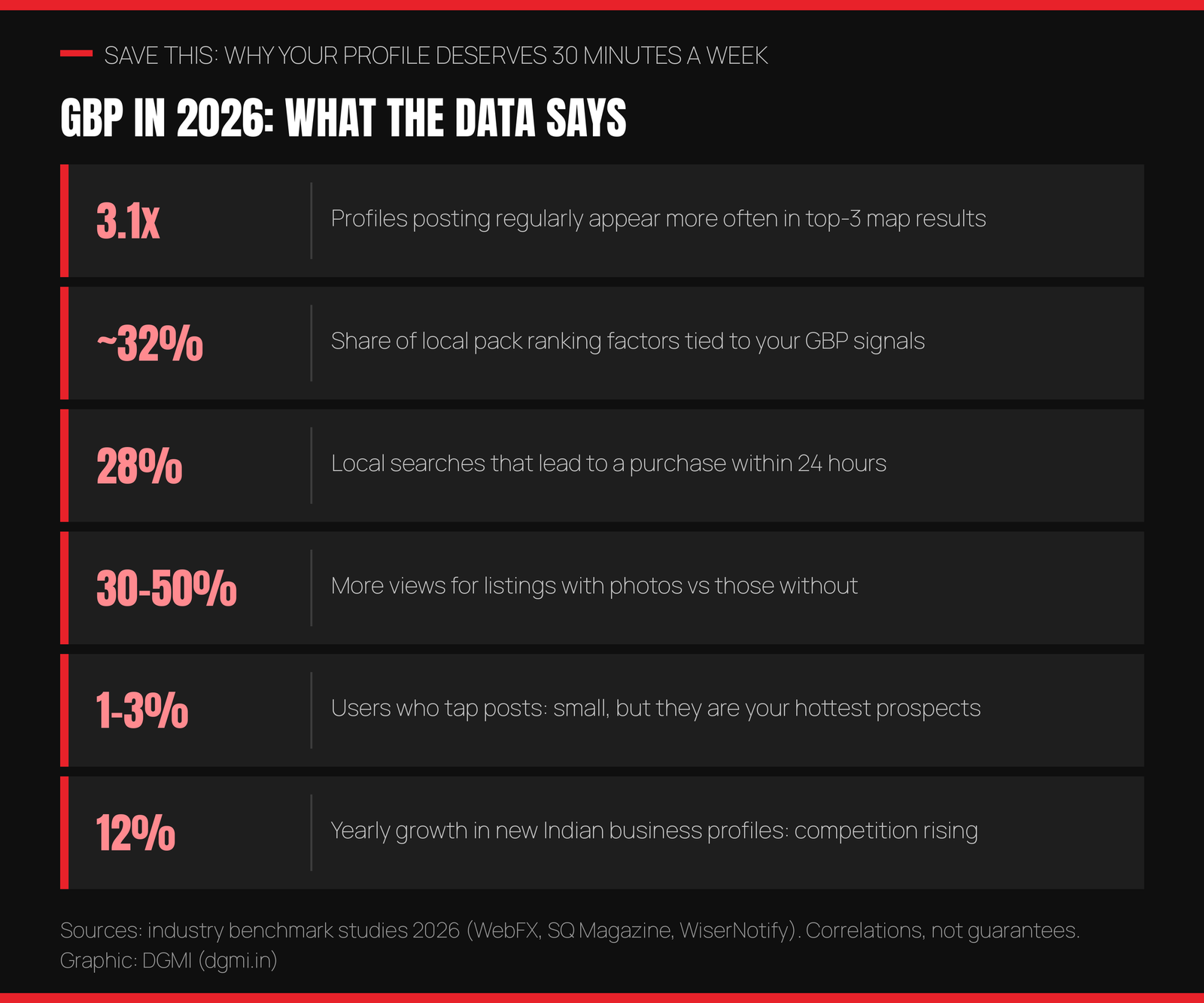
• Your GBP contributes roughly 32% of local pack ranking factors, and profiles that post regularly appear about 3.1x more often in top-3 map results (2026 benchmark studies)
• Local intent converts fast: about 28% of local searches lead to a purchase within 24 hours
• Listings with photos get 30 to 50% more views than those without
• India is one of the fastest-growing GBP markets, with roughly 12% yearly growth in new profiles, meaning your local competition is getting more serious every quarter
• And the honest number: only 1 to 3% of users interact with posts. Small, but those are people already looking at your business. We will unpack why that still matters below.
1. What Was Spotted, and What We Can Confirm
Let us be precise, because “Google launches post analytics” would be an overstatement of where this stands today.
What we know: a marketer shared a dashboard screenshot showing a views number attached to individual GBP posts, a simple “X people viewed” line under each publish date, and asked his network whether others could see it. He could not see it on his own profile. The journalist covering it could not reproduce it. Neither can most profiles we manage. That pattern, one person sees it, most do not, no announcement from Google, is the classic signature of a limited test: Google trying a feature with a small slice of users before deciding whether to ship it broadly.
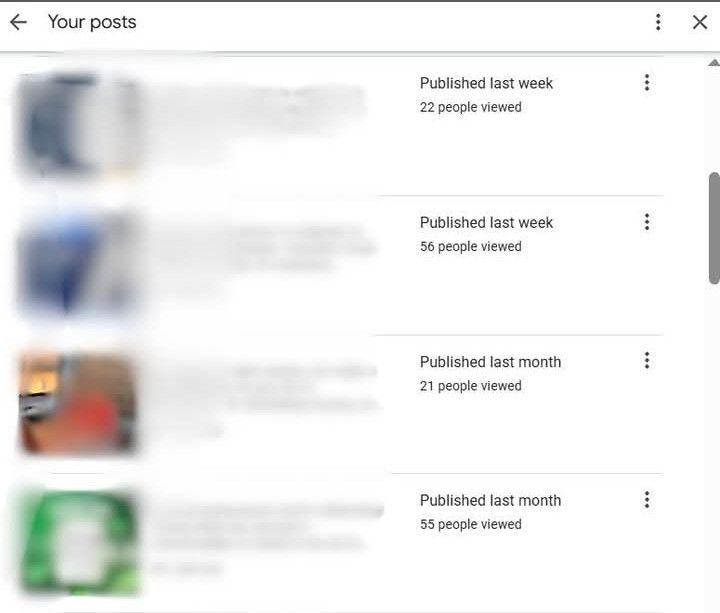
What that means practically: do not go hunting for the number in your dashboard today and do not pay anyone who promises to “enable” it. Tests like this either expand over weeks and months, or quietly disappear. Google runs experiments like this constantly; earlier this year it added performance metrics for Offer posts specifically, so per-post analytics is clearly a direction it is exploring rather than a one-off accident. The smart response is not chasing the feature, it is being ready for it, which is what the rest of this post is about.
2. Why a Small Number Is a Big Deal
To feel why this matters, you have to understand the strange situation GBP posts have lived in until now.
Google’s Performance tab tells you plenty about your profile overall: how many people found you, called you, asked for directions, clicked your website. But posts have been almost invisible in that data. You publish an update, an offer, a photo of your work, and then… nothing. No views, no reach, no signal about whether the post was seen by three hundred people or three. Marketers call this “publishing into a black box,” and it is the main reason most business owners abandon posting after a month: effort with no visible feedback dies quickly. That is basic human psychology, not laziness.
A per-post view count changes the psychology and the strategy at once. Psychologically, feedback keeps habits alive: seeing “214 views” on Tuesday’s post is a reason to write next Tuesday’s. Strategically, it turns posting from ritual into experiment: for the first time you could compare an offer post against a tip post against a photo post and let your own customers tell you, through their attention, what they want more of. That comparison loop is the entire engine of good marketing, and it is exactly how we teach students to think in every channel, from Reels to email. Now it may finally reach the humble Business Profile post.
3. GBP Posts 101 (For Complete Beginners)
If you have never touched this feature, here is the two-minute foundation.
A Google Business Profile post is a short update, like a mini social media post, that appears directly on your business listing in Google Search and Maps. When someone searches your business name, or finds you in the map results, your recent posts show right there on the profile: text, a photo, and optionally a button like “Call now,” “Book,” or “Learn more.” No website needed, no follower count, completely free.
There are three main types, and the names matter because they behave differently. Updates are general news and tips, and they typically stay visible for about six months. Offers are deals with a start and end date, displayed with a coupon-style treatment. Events have dates and times and stay visible until the event passes. For most small businesses, a steady rhythm of updates with an occasional offer is the right mix.
Where do people actually see them? Mostly in two places: on your profile when they search your name (so posts shape the impression of people already interested in you), and sometimes in the “Updates” or “Latest” areas of Maps. This placement is why the low interaction rate we mentioned is misleading, and that deserves its own honest section.
4. What the Data Honestly Says About Posts
Two facts sit side by side in the research, and honest marketing means holding both.
Fact one: few people interact with posts. Studies consistently put post interaction at roughly 1 to 3% of profile visitors. If you expected posts to perform like Instagram, that number feels like failure.
Fact two: active profiles massively outperform inactive ones. Profiles that post regularly appear about 3.1 times more often in the top three map results, and businesses with complete, active, photo-rich profiles win more calls, directions and clicks across every study. Google’s own positioning treats posts as engagement and freshness signals, and practitioners widely observe that an actively maintained profile simply performs better as a whole.
How do both fit together? Think of posts less like advertising and more like the lights being on in your shop. Few people stop to read the poster in your window, but everyone notices whether the shop looks open, alive and cared-for, and Google notices too. The 1 to 3% who do tap a post are not random scrollers; they are people already on your profile, comparing you against the competitor one tap away, at the exact moment of decision. A good post seen by thirty of those people is worth more than a thousand random impressions. And this, precisely, is why view counts are exciting: they will finally show you which posts those high-intent visitors actually notice.
🎯 Local SEO Is the Fastest Win in Digital Marketing
For most Indian small businesses, the Business Profile beats the website in enquiries per hour of effort, and it is one of the first practical skills DGMI students apply on real businesses. Learn it live and 1:1, starting with a 100% practical crash course class, FREE this week.
5. How to Use View Counts When You Get Them
When the number reaches your dashboard, here is how to read it like a marketer rather than collect it like a trophy.
Treat views as reach, not success. A view means your post appeared in front of someone, nothing more. The success metrics remain the actions underneath: calls, direction requests, website clicks, bookings, WhatsApp messages. Views tell you which posts earn attention; actions tell you which posts earn customers. You need both halves, and the actions side lives in your Performance tab and your own enquiry records, which is exactly the outcome-first reporting habit we teach in our analytics guide.
Compare post types, not single posts. One post’s number means little; patterns mean everything. After a month of mixed posting (the playbook below gives you the mix), ask: do offer posts consistently out-view tip posts? Do posts with faces beat posts with logos? Does Monday beat Friday? Three or four such answers, from your own audience, are worth more than any generic best-practices article, including this one.
Know the counting caveat. Google’s view metrics across its products count users in ways that do not match simple pageviews: multi-device visits and repeat views are handled in Google’s own manner, and methodology can change without notice, especially during a test. So use views for comparison between your posts, not as absolute truth, and never compare your numbers against someone else’s screenshot.
6. The Monthly Posting Playbook to Start Now
The best preparation for post analytics is a posting habit worth analysing. This is the mix I use on local client profiles: eight posts a month, about thirty minutes a week, deliberately varied so that when view counts arrive, the comparison between types teaches you something immediately.
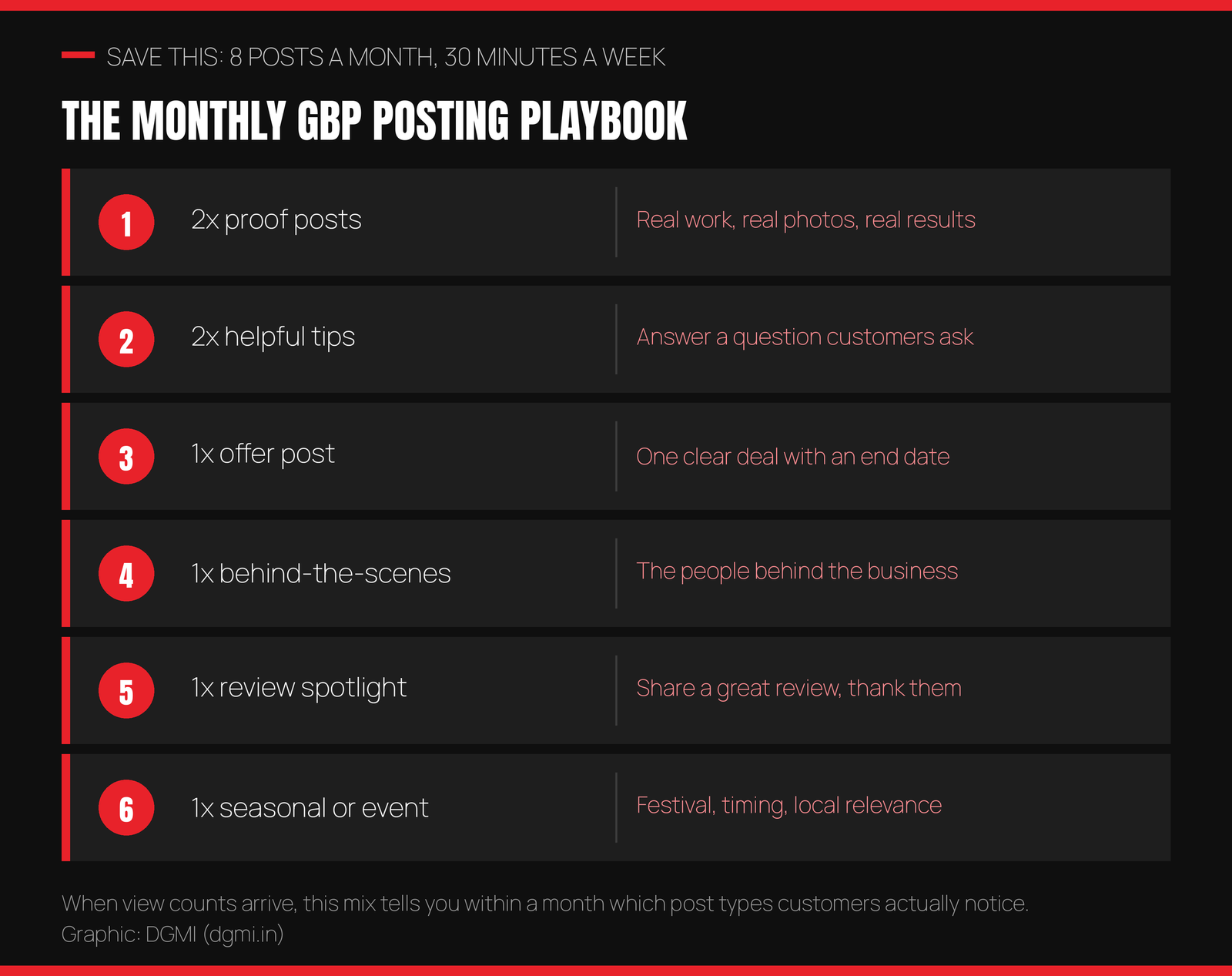
A few execution rules that separate posts people notice from posts people scroll past. Use real photos, your actual work, your actual shop, your actual team; stock images are invisible because everyone’s brain filters them out, and listings with genuine photos get 30 to 50% more views overall. Front-load the first line, because only the opening words show before the cutoff. One post, one message, one button: a post trying to say three things says nothing. And write like you talk to customers at the counter, because GBP is read by neighbours, not marketing departments. If writing is the bottleneck, prompts 81 to 90 in our 100 prompts library are built for exactly this, including a full GBP posts calendar prompt, and our audience research guide shows you how to find the questions your tip posts should answer.
7. The AI Angle: Why Active Profiles Win Twice
Here is the bigger picture that makes this small test worth a full article. Local search is becoming AI search. When someone asks Google’s AI, or ChatGPT, or Gemini, “best dentist near me” or “affordable interior designer in Jaipur,” the AI builds its recommendation heavily from Business Profile data: categories, reviews, photos, activity, and the details in your posts. An active, complete, regularly updated profile is raw material the AI can confidently recommend; a stale profile is a shrug.
That means every post you publish now works two shifts: once in front of the humans comparing you on Maps, and again as evidence for AI systems deciding which local business to name. Industry analysis of the revamped 2026 Performance reporting already treats AI-driven visibility as the defining local metric of the year. So the habit this news should trigger is bigger than chasing a view counter: it is treating your Business Profile as a living publication, because both audiences that matter, humans and AI, reward exactly that. The full strategy for being the business AI recommends is in our GEO playbook and the beginner-friendly SEO vs GEO vs AIO guide.

8. FAQ
I cannot see view counts on my Business Profile posts. Is something wrong?
Nothing is wrong. This is a limited test visible to a small group of profiles; the marketer who spotted it could not see it on his own account either, and neither could the journalists covering it. There is no setting to enable, no waitlist to join, and no service that can switch it on for you. If Google decides to ship it broadly, it will appear in your dashboard on its own. Until then, keep posting; the habit matters more than the counter.
Do Google Business Profile posts improve my local ranking?
Directly, probably only a little: practitioners generally treat posts as engagement and freshness signals rather than a primary ranking lever, with your category, reviews, and proximity doing the heavy lifting. Indirectly, the correlation is strong: regularly posting profiles appear around 3.1x more often in top-3 map results, partly because businesses that post also tend to maintain everything else well. The honest framing: post to convert the people already viewing your profile, and accept ranking benefit as a bonus, not the goal.
How often should a small business post on GBP?
Weekly is the sweet spot for most: frequent enough that your profile always shows something recent (updates expire from prominence after months, and stale profiles look abandoned), light enough to sustain for years. The eight-posts-a-month playbook above fits in about thirty minutes a week once you stop overthinking each post. Consistency over intensity: fifty-two ordinary weekly posts beat one heroic month followed by silence.
What should I post if my business is boring?
No business is boring to someone about to spend money on it; that person wants proof and answers. Post the questions customers ask you at the counter, with your answers. Post finished work with a before-and-after. Post the person who will actually serve them. A CA posting “3 documents to keep ready before filing” or a mechanic posting “why your AC smells and what it costs to fix” will out-perform any inspirational quote graphic ever made. Your daily conversations with customers are an endless content source; our audience research guide shows how to mine them systematically.
Is managing Google Business Profiles a real freelance service I could offer?
Yes, and it is one of the most beginner-accessible services in digital marketing: huge demand (India adds business profiles at roughly 12% a year), visible results within weeks, and owners who genuinely lack the time. Local SEO and GBP setup commonly bills ₹15,000 to 40,000 as a project in India, with ongoing management fitting naturally into monthly retainers. It is also the easiest service to demonstrate in a pitch, because you can audit a prospect’s profile in ten minutes and show them exactly what is missing. The full service-building path is in our SEO business checklist and freelance clients guide.
🚀 Master the Marketing That Local Businesses Pay For
DGMI’s 3-month Digital Marketing + AI Course (₹29,999) covers local SEO and GBP, full SEO and GEO, ads, analytics and AI workflows, taught live and 1:1 on real projects with worldwide-recognized certification. Start with a free practical crash course class.
Questions? Contact us · hello@dgmi.in · +91 96940 03464

Sources: Search Engine Watch: GBP now shows view counts for posts (Aug 20, 2026) · Google: About posts on your Business Profile (official) · Google: Business Profile performance (official) · WebFX: 2026 GBP benchmarks · SQ Magazine: GMB statistics 2026 · WiserNotify: 40 GBP statistics for 2026
Keep learning: the 100 AI prompts library (local business section) · the GA4 and Search Console guide · the audience research guide · the GEO playbook · the SEO vs GEO vs AIO guide · the SEO business checklist · the freelance clients guide · the August 2026 spam update coverage · discuss in the DGMI Community.
[…] 6. Content and images (₹0 to 25,000). Words and photos. Most quotes assume you supply them; when you do not, copywriting adds ₹5,000 to 25,000 and photography more. Real photos of your business beat stock every time, as we noted in the Business Profile guide. […]