
I started selling SEO the way most people do: badly. No niche, no fixed services, prices invented on the phone, and a “package” that changed with every client’s mood. It still worked, eventually, because SEO delivers real results, but I wasted almost a year learning things a checklist could have taught me in an afternoon. Today I run an agency practice with retained clients, and I also work white-label behind other agencies, which means I see both sides of this business: how clients buy, and how agencies actually make money. This guide is that missing checklist, in the order I would rebuild it if I were starting from scratch tomorrow, with Indian pricing ranges, the legal basics, and the twelve questions every beginner asks me.
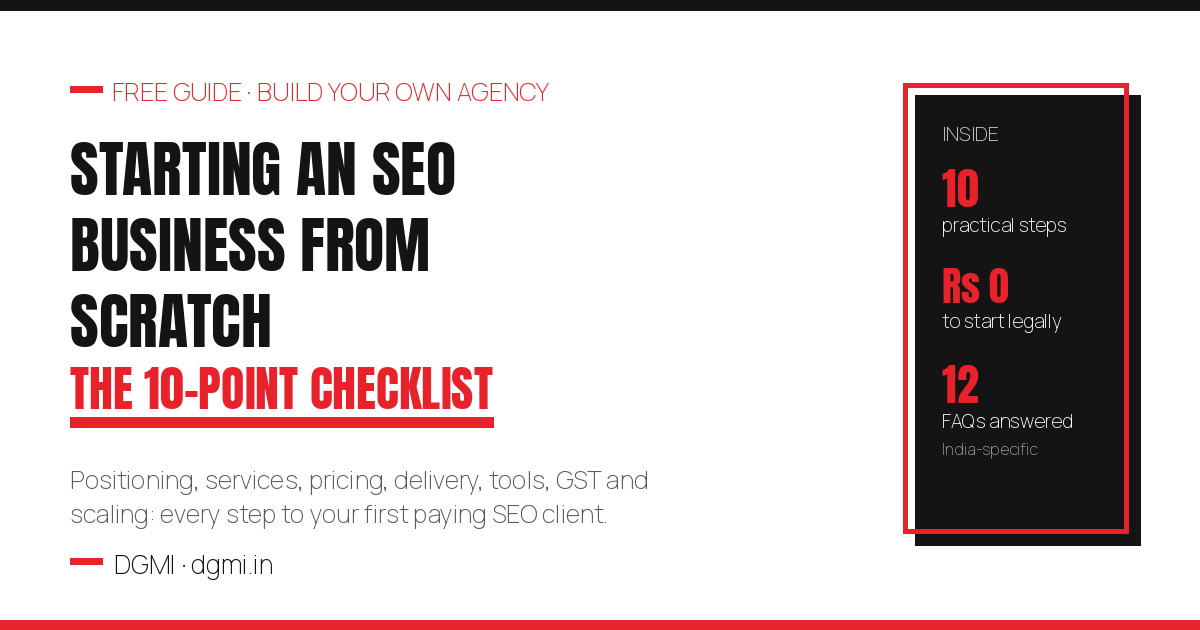
In practical order: pick one niche and one outcome you sell, design three services instead of twenty, price on outcomes using market ranges (audits ₹15,000 to 50,000; retainers ₹25,000 to 60,000 a month), build one piece of real proof before pitching anyone, set up the free tool stack (Search Console, GA4, Keyword Planner, Sheets), write a delivery SOP so every client gets the same process, sort invoicing and the GST threshold, get client one from your warm network rather than marketplaces, report business outcomes monthly instead of rankings, and scale with white-label partners before you hire. Startup cost can be near zero; the real investment is skill and proof.
• India has 15 million+ freelancers (second globally) and project-based hiring grew 38% in FY25; NITI Aayog projects 23.5 million by 2029-30
• SEO plus GEO specialists command ₹14 to 18 LPA in jobs versus ₹8 to 10 LPA for generalists, and the same premium shows up in what clients will pay
• AI search changed the game in your favour: AI Overviews appear on roughly 21% of searches and cut clicks 34 to 58% where they appear, so businesses urgently need someone who understands the new rules
• Startup cost for a solo SEO business: effectively ₹0 using free tools, which is why the barrier is competence, not capital
1. Before You Start: The Honest Reality Check
Three truths, so you build on solid ground. First, the barrier is competence, not capital. You can start with a laptop, free tools and zero rupees; nobody needs an office, a logo or a company registration to earn their first ₹25,000. That is genuinely liberating, and it is also why the field is crowded at the bottom: everyone can enter, so quality is the only moat.
Second, SEO is a slow product sold to impatient buyers. Results typically take three to six months, but clients feel every week of that wait. Almost every “difficult client” story I have heard traces back to expectations set badly in the first meeting. Your job is not just to do SEO; it is to explain the timeline honestly enough that the client can survive month two without panicking.
Third, 2026 made this business harder to fake and easier to win. AI search means the old game (rank a page, count the traffic) no longer fully describes the value, so if you can explain zero-click reality, AI citations and business outcomes to a worried business owner, you are instantly more credible than the agency sending them rankings screenshots. That is a real advantage for a well-taught beginner. Our GEO playbook and the algorithm updates guide are your free background reading.
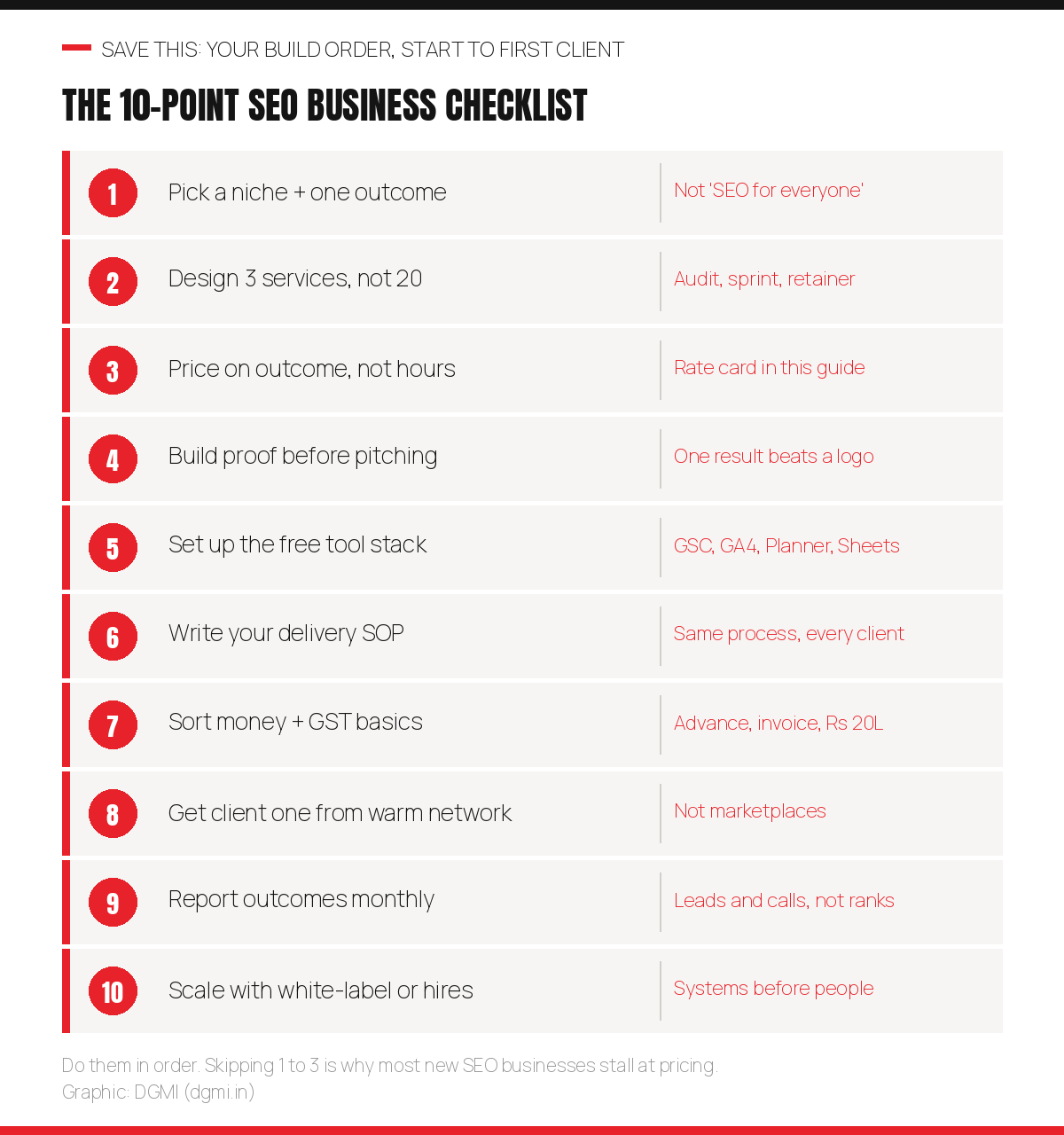
2. The 10-Point Checklist
Here is the entire build order on one screen. Save it, work top to bottom, and resist jumping ahead: the most common failure I see is someone with no niche and no proof trying to price a proposal, which is points 3 and 8 attempted without points 1, 2 and 4.
3. Each Point Explained in Detail
Point 1 · Pick a niche and one outcome
“I do SEO for anyone” is the most expensive sentence in this business, because it forces you to compete with every freelancer on earth on price alone. Pick a niche you can describe in one line: dental clinics in Tier-2 cities, D2C skincare brands, coaching institutes, real estate builders, B2B SaaS. Then attach one outcome: not “SEO”, but “more patient enquiries from Google” or “qualified demo requests.” Niching feels like shrinking your market; in practice it multiplies your close rate, because a dentist believes the person who has fixed three dental websites over the person who has “worked with various industries.” You can widen later, from a position of proof.
Point 2 · Design three services, not twenty
New agencies list every service imaginable, which confuses buyers and destroys your delivery quality. Offer exactly three: a paid audit and roadmap (the low-risk entry point that turns strangers into clients), a one-time implementation sprint (fix what the audit found), and a monthly retainer (the ongoing work where your income compounds). That ladder is a business model: audits create trust, sprints prove capability, retainers pay your bills. Everything else, from technical migrations to content at scale, is an add-on you introduce once the relationship exists.
Point 3 · Price on outcome, not hours
Hourly pricing punishes you for getting faster and invites clients to audit your time instead of your results. Price each service as a package with a clear scope, using the market ranges in the next section, and quote the number with a straight face followed by silence. If the budget is genuinely too small, reduce the scope, never the rate: a ₹15,000 audit is a real product, a discounted ₹15,000 retainer is a promise you will resent by week three. In my experience the clients who negotiate hardest before signing are the same ones who demand the most afterwards, which is a pattern worth respecting.
Point 4 · Build proof before you pitch
You do not need clients to have proof; you need a result. Pick one site you can influence today (your own blog, a friend’s business, a relative’s shop, a local NGO), apply the fundamentals from our SEO checklist, and record everything: before screenshots from Search Console, what you changed, and the after numbers 60 to 90 days later. One documented case study, honestly presented, beats a logo wall and a certificate collection. It is also the single fastest way to raise your prices, because you stop selling hope and start selling evidence.
Point 5 · Set up the free tool stack
Start with what costs nothing and covers 90% of the work: Google Search Console (the truth about your client’s search performance), Google Analytics 4 (behaviour and conversions), Google Keyword Planner (volumes), Google Business Profile (local work), Bing Webmaster Tools (free bonus data), and Google Sheets and Docs for audits, trackers and reports. Add a paid tool only when a specific client need justifies it, and pass that cost through in your pricing. Our AI tools guide and the 100 prompts library cover how to use AI to speed up audits and content briefs without publishing unverified output.
Point 6 · Write your delivery SOP
An SOP is simply your process written down: the exact steps of an audit, the monthly retainer rhythm (week 1 technical and analysis, week 2 content, week 3 authority and local, week 4 reporting and planning), the templates you reuse, and the checklist you tick before anything goes to a client. Writing it feels bureaucratic for a business of one, and it is the difference between an agency and a freelancer who is permanently improvising. It also makes you delegatable: the day you use a white-label partner or hire an assistant, your SOP is the thing you hand over.
Point 7 · Sort money and GST basics
Practical, not legal advice, and worth confirming with a CA for your situation. You can begin as a sole proprietor, and many Indian freelancers do: a current account in your business name and a simple invoice format are enough to start. Register for GST once your turnover crosses the ₹20 lakh threshold for services (₹10 lakh in some special category states); many agency clients prefer working with GST-registered vendors, so some people register earlier by choice. Non-negotiables from painful experience: take 40 to 50% advance before work begins, put scope in writing even if it is only a WhatsApp message the client confirms, invoice on a fixed date each month, and for foreign clients use Wise or Payoneer with proper documentation.
Point 8 · Get client one from your warm network
Your first client is almost never on a marketplace. They are in your phone contacts, your family’s business circle, your college network, or the shop two streets away with a website nobody has touched since 2019. The approach that works is not “I offer SEO services”; it is a specific observation: “your business ranks on page 2 for [term] while your competitor is on page 1, want me to show you why?” That single change in framing is why our client-getting guide spends most of its time on outreach that leads with the client’s problem. Local businesses, agency white-label work and referrals are the three fastest lanes for a new SEO business in India.
Point 9 · Report outcomes, not rankings
This is where most new SEO businesses quietly lose clients. Sending a rankings screenshot in 2026 is not just weak, it is misleading: rankings can hold steady while AI Overviews take the clicks. Report what the owner actually cares about: enquiries, calls, form fills, GBP direction requests and quote requests, plus the leading indicators (impressions, non-brand clicks, pages gaining visibility) that show progress before revenue moves. Add one paragraph of plain-English narrative each month: what we did, what happened, what it means, what is next. Clients renew because they understand the value, not because the value existed silently.
Point 10 · Scale with white-label before you hire
The moment you have more work than hours, the instinct is to hire. Resist it for one more cycle. Partner with a trusted white-label provider (or become one for other agencies, which is how a large part of my own practice runs) so you can take on volume without payroll risk. White-label work is also the most underrated income lane for a new SEO business: agencies need reliable delivery and pay ₹15,000 to 35,000 per client monthly for it, with zero sales effort from you. Hire only when your SOP is stable, your margin is proven, and the work is predictable enough that a new person can succeed at it.
4. What to Charge: The Starter Service Menu
These ranges come from current Indian market rates for solo operators and small agencies, matching what our own students and network report. Use them as a starting anchor, then adjust for your niche, city and proof: a documented case study justifies the top of every range from day one.
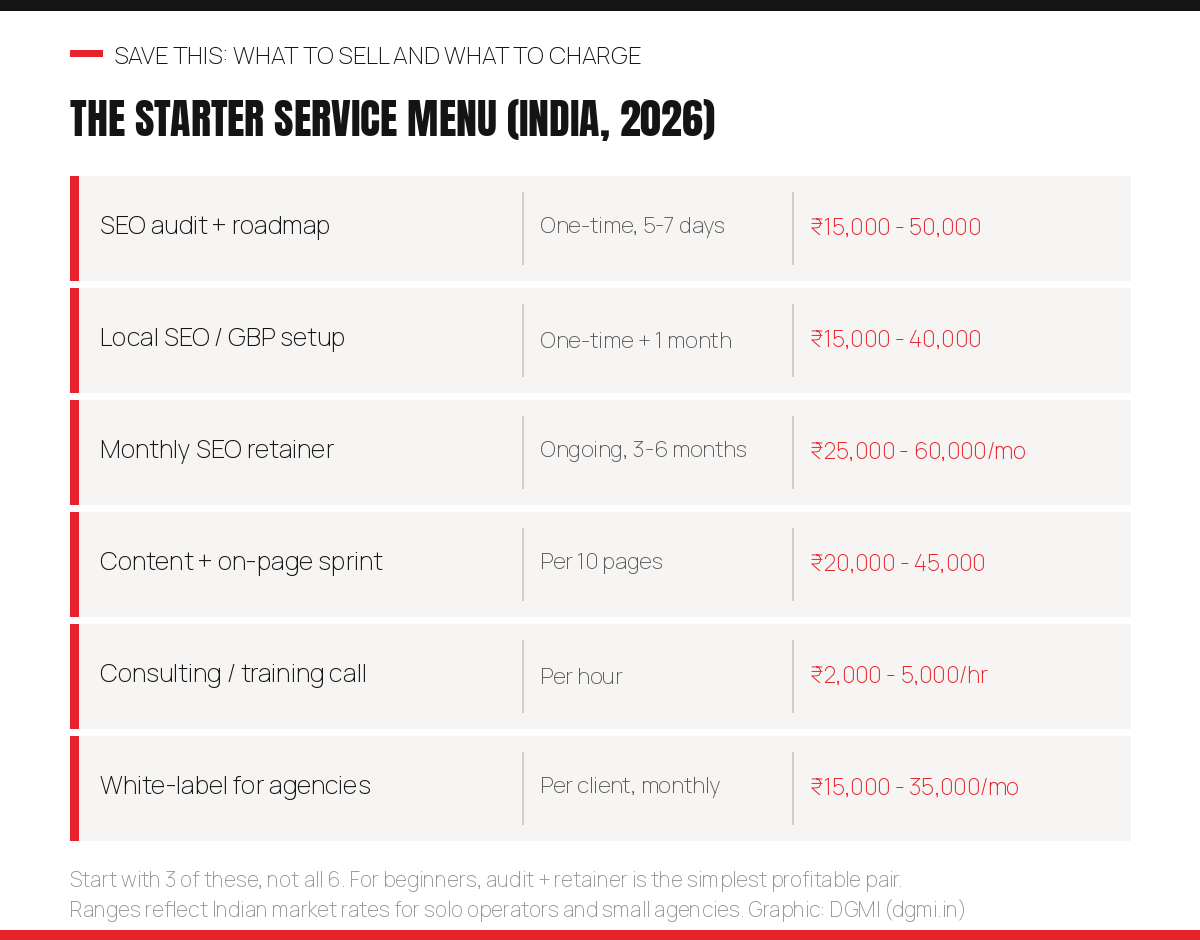
A simple way to choose your starting three: sell the audit to everyone (it is your lead magnet with a price tag, and it funds your time while you build trust), sell the retainer to whoever the audit convinces (this is where your income compounds), and pick ONE more based on your niche, either the local SEO/GBP service if you are targeting local businesses, or the content sprint if you are targeting content-hungry D2C or SaaS brands. Add consulting calls and white-label once you have spare capacity, not before.
5. Your First 90 Days, Week by Week
- Weeks 1-2 · Foundation. Pick your niche, write your three services and prices, set up the free tool stack, and register a simple business name and current account. Build a one-page site or even a well-written Google Doc as your “portfolio,” since you have no case study yet.
- Weeks 3-6 · Build proof. Run a full audit and 60 days of implementation on your one practice site, following our SEO checklist point by point. Document every before number in Search Console now, because you cannot recreate a “before” screenshot later.
- Weeks 7-9 · Outreach. List 30 warm-network businesses that plausibly need SEO. Send the specific-observation message from point 8 to 5 a week. Aim for 3 to 5 real conversations, not 30 cold pitches; quality of targeting beats volume at this stage.
- Weeks 10-12 · Close and deliver. Convert your first client, ideally into the audit-then-retainer ladder. Deliver it using your written SOP, exactly as you will for client fifty. Ask for a testimonial and a referral the moment they see their first real result, while the enthusiasm is highest.
🎯 Skip the Year I Wasted Figuring This Out
DGMI’s Digital Marketing + AI Course teaches the SEO skill AND the business skill together: audits, technical fixes, content, GEO, plus pricing, client handling and delivery systems, live and 1:1 on real projects. Start with a 100% practical crash course class, FREE this week.
6. 7 Mistakes That Kill New SEO Businesses
- ✗ 1. No niche, no positioning. “I do SEO for everyone” competes on price against the entire internet.
- ✗ 2. Underpricing to win the first client. Cheap clients demand the most and refer the least; you cannot raise a bad first price with the same client later.
- ✗ 3. No written scope. Vague verbal agreements are where scope creep and unpaid extra work both begin.
- ✗ 4. Promising rankings or timelines you cannot guarantee. No ethical SEO provider can promise a #1 ranking; promise process and reporting instead.
- ✗ 5. Reporting activity instead of outcomes. “We built 12 backlinks” means nothing to an owner; “we added 8 qualified enquiries” does.
- ✗ 6. Publishing AI content without verification. Google’s March 2026 core update rewarded original content (+22% visibility) and punished lazy AI paraphrase (−71% traffic); this applies to your clients’ sites and your own.
- ✗ 7. No advance, no invoice discipline. Chasing payment is the single most common freelancer complaint in India; 40 to 50% advance and a fixed invoice date prevent most of it.

7. FAQs (12 Questions Beginners Ask Me)
Do I need to register a company to start an SEO business in India?
No. You can start as a sole proprietor with just a bank account in your business name and a simple invoice format; many successful Indian freelancers operate this way for years. Formal registration (Private Limited, LLP) becomes worth considering once you have employees, want limited liability, or are pursuing larger corporate clients who require it contractually. Start simple; formalize as the business justifies the cost.
How much money do I need to start an SEO business?
Realistically close to ₹0. The core tools (Search Console, GA4, Keyword Planner, Sheets) are free, and your only true cost is time. Optional early expenses like a simple website or a paid audit tool can wait until your first client funds them. This is precisely why the barrier to entry is skill, not capital, and why proof of work matters more than a polished setup.
Can I start an SEO business with no prior experience or clients?
Yes, using the proof-before-pitching approach in point 4: apply real SEO work to a site you can access (your own, a friend’s, a relative’s) and document the before-and-after honestly. That becomes your case study. Pair it with genuine skill from a structured course or our free SEO checklist, since a case study without real competence behind it will not survive a second client.
How long does it take to get my first paying SEO client?
Following the 90-day plan above, most motivated beginners land their first client within 8 to 12 weeks, mostly because building genuine proof (weeks 3 to 6) cannot be rushed and warm-network trust takes a few real conversations. It can happen faster if you already have a strong personal network in a business-heavy circle, and slower if your niche or outreach message is unclear. The fastest lever is always the specificity of your outreach, not the volume.
Should I start solo or with a small team?
Start solo. A team adds payroll pressure and management overhead before you have proven pricing, delivery systems or steady demand. Use white-label partners for overflow work instead (point 10); it gives you team-level capacity without the fixed cost. Hire your first person only once you have a stable SOP that someone else can follow and a revenue base that comfortably covers a salary through slow months.
When do I need to register for GST?
For services, GST registration becomes mandatory once your aggregate annual turnover crosses ₹20 lakh (₹10 lakh in a few special category states). Below that threshold you are not required to register, though some freelancers register earlier because certain agency and corporate clients prefer or require GST-registered vendors for their own input credit. This is general guidance; confirm your specific situation with a chartered accountant as your revenue grows.
Do I need written contracts with clients?
Yes, at minimum a written scope of work, even if it is just a detailed WhatsApp message the client confirms in writing. It should cover deliverables, timeline, price, payment terms (advance percentage, due dates) and what is explicitly NOT included. A written scope prevents the two most common new-agency problems: scope creep and payment disputes. A simple one-page agreement is far better protection than a beautifully designed contract nobody reads.
Can I guarantee page-1 Google rankings to clients?
No, and you should actively avoid anyone who asks you to. No ethical SEO provider, however skilled, can guarantee a specific ranking, because Google’s algorithm weighs hundreds of factors outside any single provider’s control, and Google’s own guidelines warn against providers who make such promises. What you can responsibly promise is a defined process, transparent reporting, and realistic timelines based on the client’s competition and starting point.
Is AI replacing the need for SEO businesses?
It is changing the work, not removing the need. AI Overviews and zero-click search mean pure “get more clicks” SEO is less complete a pitch than it was in 2020, but businesses now need MORE expert help, not less: understanding GEO and AI citations, diagnosing whether a traffic drop is a penalty or a zero-click effect, and using AI tools responsibly without falling into the −71% content trap. Our AI and jobs guide covers this shift in full. An SEO business that understands 2026 search is more valuable than ever; one still selling 2015-style link building is not.
How do I handle a client who thinks my price is too high?
First, confirm they are comparing like-for-like scope, since many “cheaper” quotes exclude reporting, content or technical work you include. If the budget is genuinely limited, reduce the scope (a smaller audit, fewer pages, less frequent reporting) rather than the rate, so your effective hourly value stays intact. If they still push back after a fair comparison, it is usually a sign they undervalue the work itself, and those clients are disproportionately likely to become difficult later; it is often healthier to let them go.
What is white-label SEO and should a beginner try it?
White-label means you deliver SEO work behind another agency’s brand; their client never knows you exist. It is an excellent lane for a competent beginner who is weaker at sales than delivery, because the agency handles client acquisition and you focus purely on execution at agreed rates (commonly ₹15,000 to 35,000 per client monthly). It is a strong income stabilizer alongside your own direct clients, not usually a full replacement for building your own brand long-term.
How do I scale from one client to a real agency?
Scale systems before people: document your SOP fully, prove your service ladder converts (audit to sprint to retainer) across several clients, and build white-label or subcontractor relationships to absorb overflow demand without fixed payroll risk. Only hire once a role’s output is predictable enough that a trained person can deliver it to your standard using your written process. Most premature agency failures come from hiring to solve a demand problem that a systemized solo practice, or a white-label partnership, could have absorbed instead.
🚀 Build the SEO Skill Your Business Depends On
DGMI’s 3-month Digital Marketing + AI Course (₹29,999) covers everything this checklist assumes you already know: technical SEO, content, GEO, local SEO, analytics and AI workflows, taught live and 1:1 on real projects with worldwide-recognized certification. Start with a free practical crash course class.
Questions? Contact us · hello@dgmi.in · +91 96940 03464

Sources for quoted data: NITI Aayog gig and platform economy projections · AmbitionBox salary data via Kraftshala (May 2026) · Ahrefs CTR research on AI Overviews · SE Ranking: March 2026 core update analysis · CBIC: GST registration threshold guidance · Google SEO Starter Guide (official)
Go deeper: the SEO checklist · the GEO playbook · the freelance clients guide · the specialization guide · the 100 AI prompts library · the audience research guide · the AI and jobs guide · discuss in the DGMI Community.
[…] · the audience research guide · the 100 AI prompts library · the specialisation guide · the start an SEO business checklist · discuss in the DGMI […]
[…] A word of honesty about what tracking cannot tell you: a WhatsApp click is not a customer, it is an intent signal. If ten people click and two buy, your real conversion story lives partly in your inbox, not your dashboard. Good marketers hold both. This is also why we teach reporting business outcomes rather than vanity metrics in our SEO business guide. […]
[…] in ten minutes and show them exactly what is missing. The full service-building path is in our SEO business checklist and freelance clients […]
[…] to 50,000+ for small businesses, and maintenance retainers stack on top, as we mapped in the SEO business checklist and the freelance clients guide. It is also the foundation every other skill sits on: you cannot […]