NEWS ANALYSIS · Published October 1, 2026 · Last updated October 1, 2026
For two years, the comfortable assumption in marketing was that AI chat was the ad-free room: the place people went to think, while the ads stayed back in Google and Instagram. September 2026 is the month that assumption formally died. On September 10, Amazon, the company whose ad platform most Indian D2C brands already use for marketplace ads, announced it now sells ad space inside ChatGPT: select US advertisers buy through Amazon’s DSP, Amazon manages the campaign, and OpenAI’s system decides which ads appear as text or image placements beneath ChatGPT’s answers. Six days later OpenAI announced “Sponsored Agents.” A week after that, ChatGPT’s ad rollout passed 60 countries. And the detail that matters most for readers of this blog slipped out with far less noise back on August 31: OpenAI’s self-serve ads platform, which opened to all US businesses in May, is now open to businesses in India. This is not a “coming soon” story anymore. Here is what actually launched, how the new placements work, whether a small Indian advertiser should touch them yet, and why the organic side of this, GEO, just became the most valuable skill in the room.
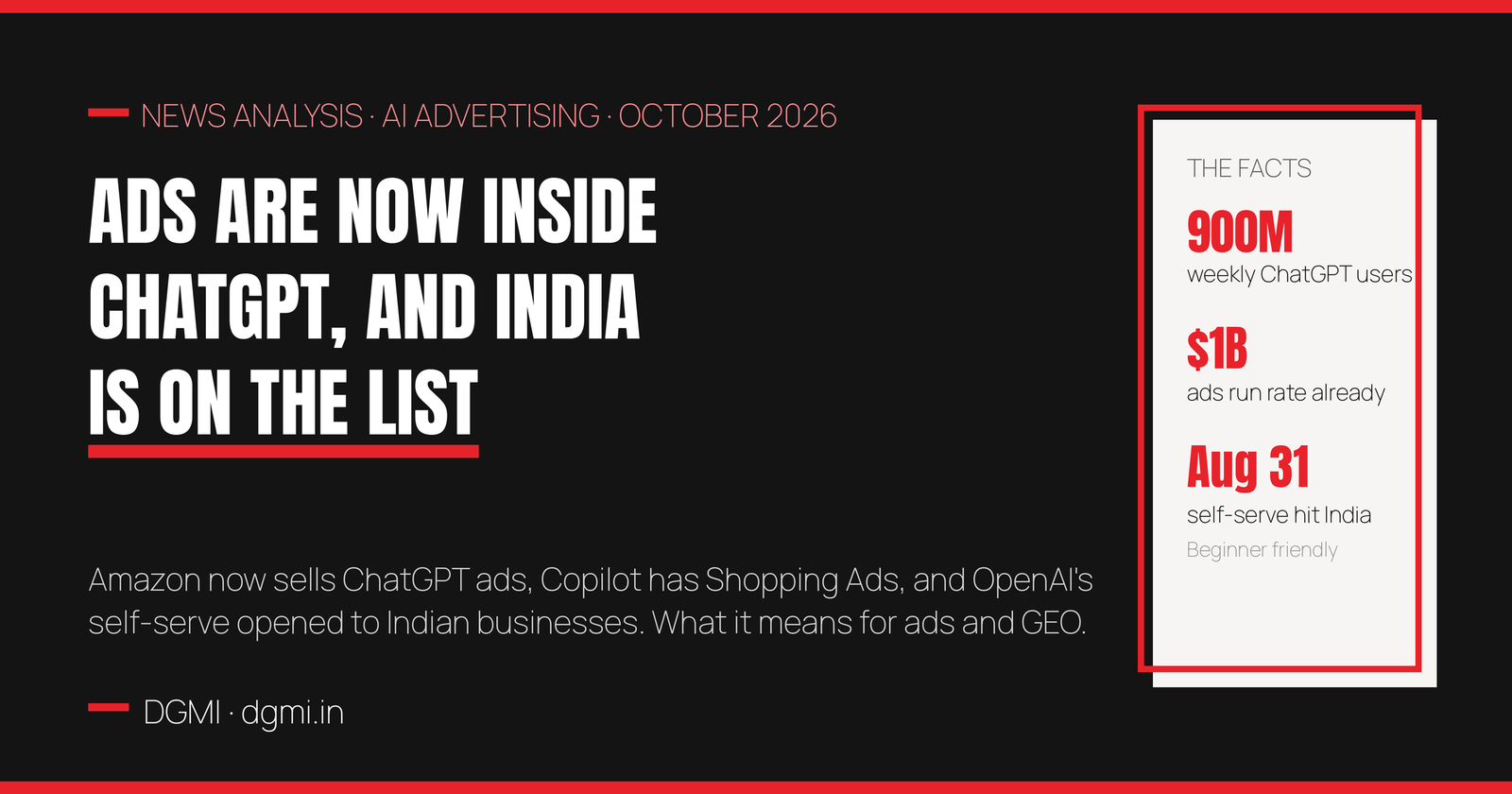
ChatGPT officially runs ads: OpenAI announced them in January 2026, began testing in February, opened a self-serve ads platform to all US businesses in May and to India, Europe, the Middle East and North Africa from August 31, and the rollout passed 60 countries in late September. Ads appear as labeled text or image placements beneath responses for Free and Go-tier users, matched to the conversation. In September, Amazon began selling ChatGPT placements through its own ad platform (Amazon manages, OpenAI delivers; US pilot, Delta Vacations among the first), OpenAI announced a Sponsored Agents format, Bing put Shopping Ads inside Copilot, and the business already runs at a $1 billion annualized revenue rate. For most small advertisers the right move today is preparation and small experiments, not big budgets; and because ads sit beneath answers, earning a place inside the answer, GEO, just became more valuable, not less.
• ChatGPT reported about 900 million weekly active users in February 2026; its ads business has reached a $1B annualized run rate within months (CNBC)
• Self-serve access: all US businesses since May 5; India, Europe, Middle East and North Africa since Aug 31; 60+ countries since Sept 23
• Amazon DSP pilot (Sept 10): select US advertisers buy ChatGPT placements through Amazon Ads; Amazon runs campaigns, OpenAI’s system controls delivery; Delta Vacations among the first
• Ad load is rising: ads per user per hour on ChatGPT’s US mobile app grew ~26% month over month from April to August (Sensor Tower data via MediaPost); Amazon itself was the #1 retail advertiser on ChatGPT in that window
• Not just OpenAI: Bing has Shopping Ads in Copilot; Snapchat shipped an Ads MCP so AI agents can manage campaigns; sponsored results in AI travel answers jumped from 6% to 24% of hotel prompts (March to May 2026)
1. What Just Happened in September
Three announcements in thirteen days turned ChatGPT ads from an experiment into an industry. September 10: Amazon Ads announced its OpenAI partnership. The mechanics matter: advertisers who already use Amazon’s ad platform (including its programmatic buying tool, the Amazon DSP) can now extend campaigns into ChatGPT without ever dealing with OpenAI directly. Amazon sets up and manages the campaign; OpenAI’s ad system makes every decision about which ads appear, when, and where. It is a US pilot with select brands, Delta Vacations among the first named. Until this deal, ChatGPT ads were bought directly from OpenAI or through smaller ad-tech intermediaries; plugging in Amazon connects OpenAI’s inventory to one of the largest pools of commerce advertisers on earth.
September 16: OpenAI announced Sponsored Agents, now testing with select US advertisers, pointing at a future where a brand’s AI agent, not just its banner, is the ad. September 23: the ads rollout crossed 60 countries, adding Indonesia, Malaysia, the Philippines, Singapore, Thailand, Vietnam and Taiwan. Add the pieces from outside OpenAI in the same season, Bing integrating Shopping Ads into Copilot and Snapchat shipping an Ads MCP server that lets AI assistants access and manage campaign data, and the pattern is unmistakable: conversational AI is being wired for advertising from both ends, as the surface where ads appear and as the interface that manages them. We flagged the first half of this story when TikTok turned AI into an ad factory; this is the second half arriving.
2. Nine Months From No-Ads to 60 Countries
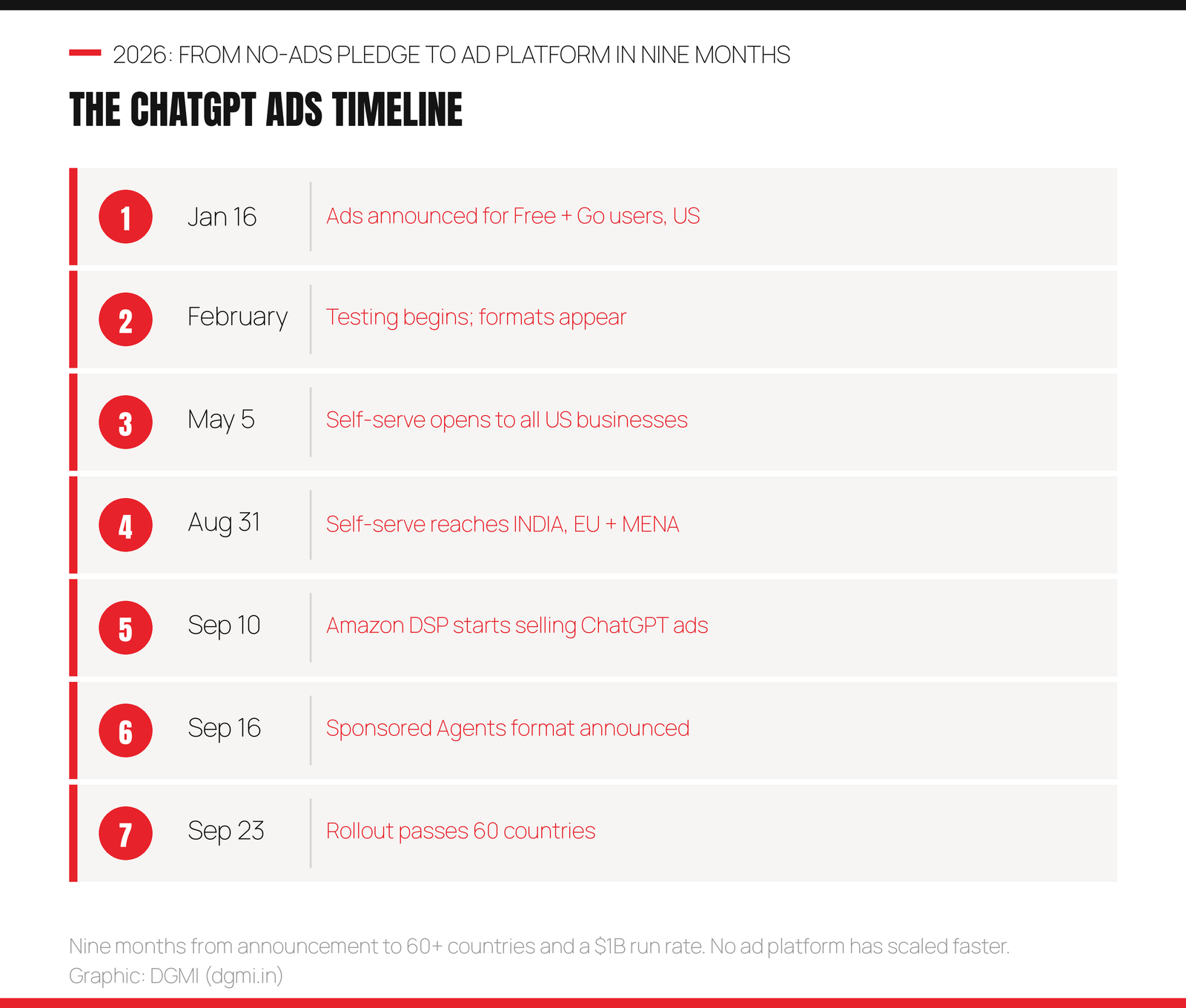
Speed is the story inside the story. Google took years to build its ad machine; OpenAI announced principles-first ads for its US Free and Go tiers on January 16, was testing by February, opened self-serve to every US business on May 5, reached India and three more regions on August 31, and crossed 60 countries by late September, with the business already at a reported $1 billion annualized pace. No ad platform has scaled across this many markets this fast, and the reason is structural: the audience (roughly 900 million weekly users) was already there before the first ad ran.
For beginners, the timeline teaches one professional reflex: platforms move faster than curricula. Anyone who learned “AI chat has no ads” as a fact in 2025 is teaching history now. The marketers who win platform shifts are the ones who track announcements the way we tracked this one, which is also why DGMI keeps a rolling updates tracker and teaches from live platforms, not slide decks.
3. How ChatGPT Ads Actually Work
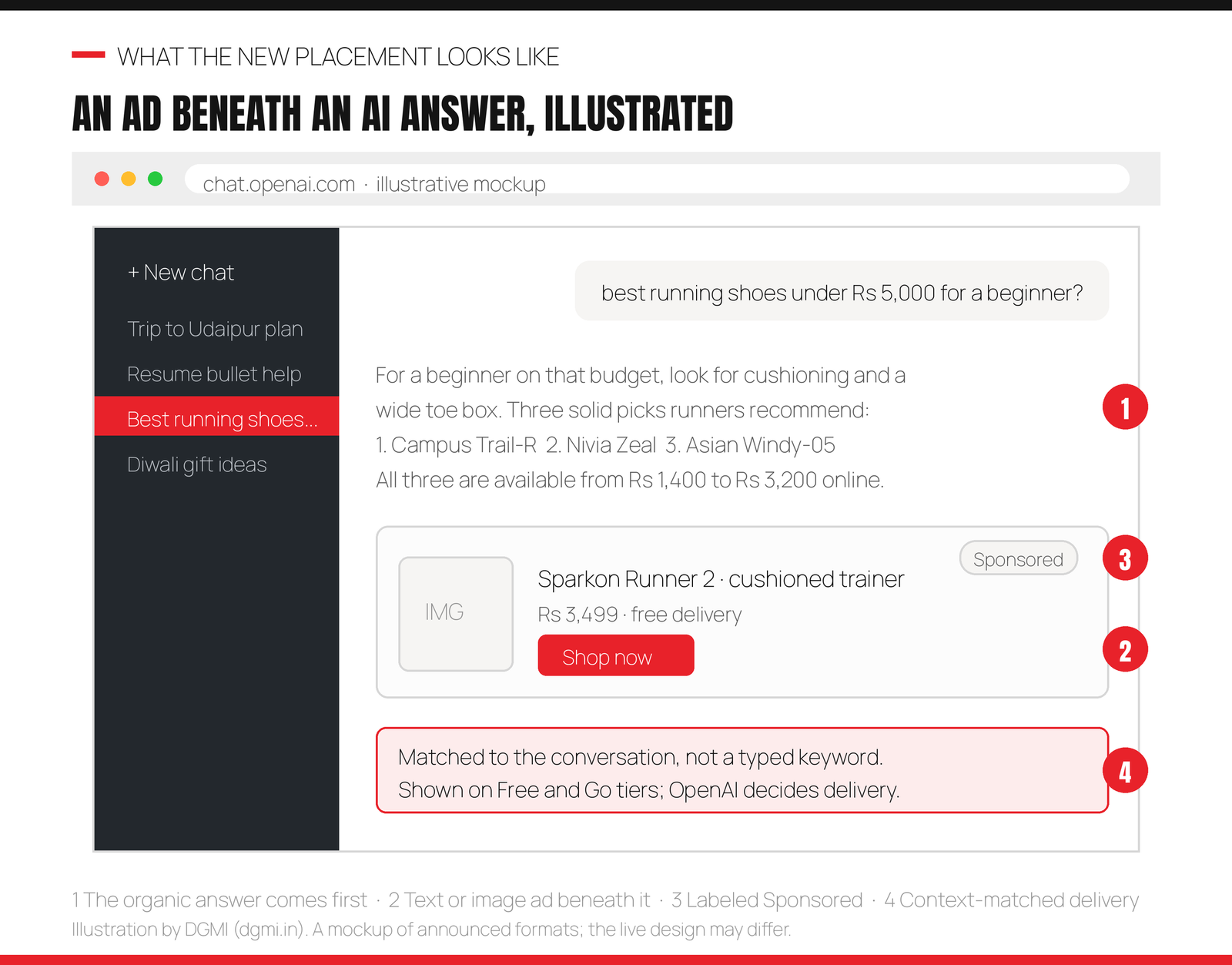
Where ads appear: as clearly labeled text or image placements beneath ChatGPT’s responses, shown to users on the Free tier and the $8/month Go tier; paying Plus and Pro subscribers are the ad-light audience. OpenAI published a set of ads principles alongside the January announcement, with the answer itself staying organic and the sponsorship sitting below it, which is also why this post keeps insisting the answer slot and the ad slot are different games.
How targeting differs from Google Ads: in search, you bid on a typed keyword; here, delivery is matched to the conversation, which can carry far richer intent (“planning a first 5K, flat feet, budget Rs 5,000” is a paragraph no keyword ever captured). That context is the medium’s promise and its sensitivity, and OpenAI keeps delivery decisions entirely on its side of the fence, even for campaigns bought through Amazon. How buying works: three doors now exist, the self-serve ChatGPT Ads Manager at ads.openai.com (the one open to India), OpenAI’s sales team for large advertisers, and, since September 10, the Amazon DSP route for the US pilot. What is next: reported work on “click-to-chat” formats, where an ad opens a conversation rather than a website, and the Sponsored Agents test, both signs that the format war inside AI chat is just beginning.
4. The Wider Landscape: Every AI Chat, an Ad Surface
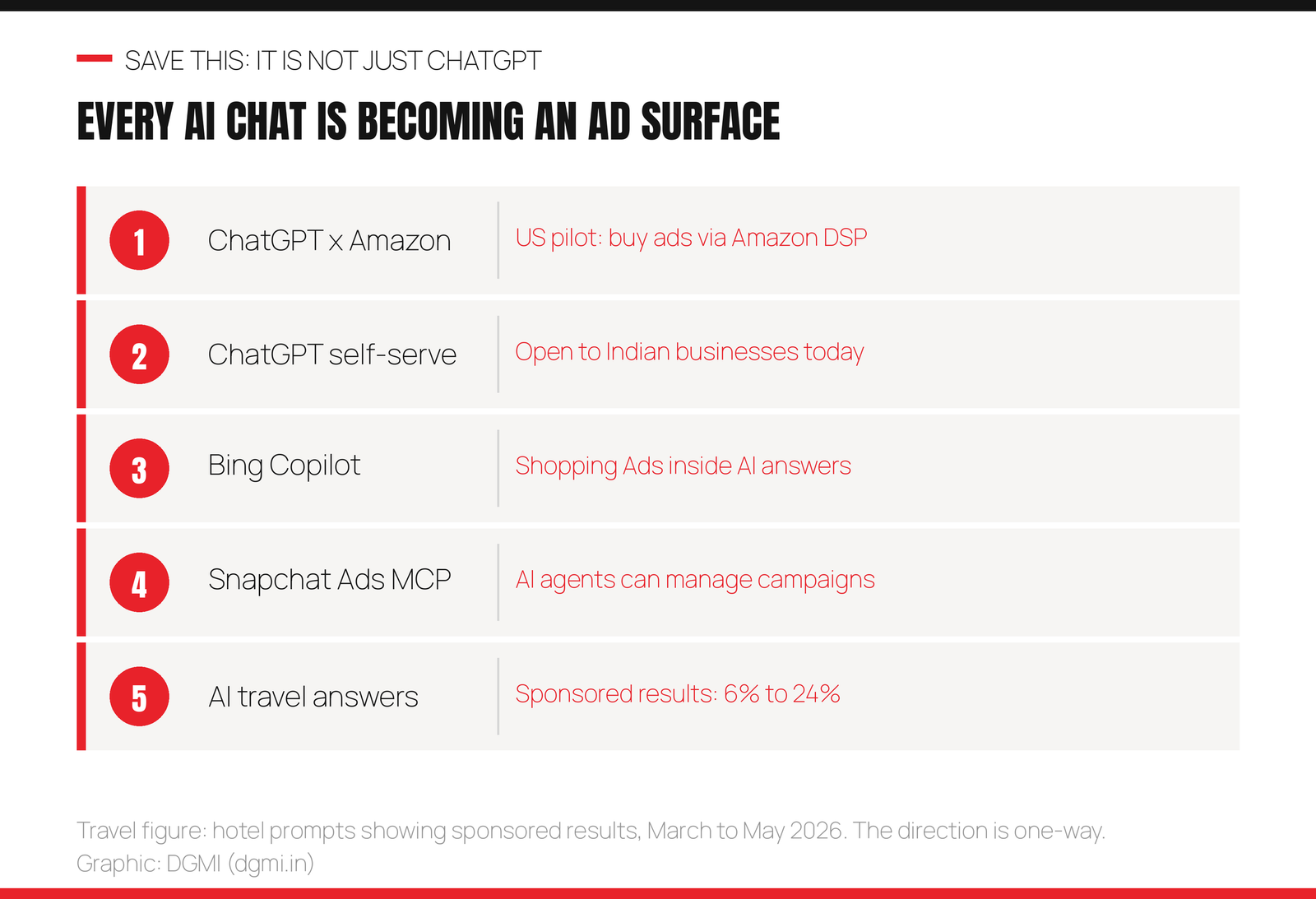
Zoom out and ChatGPT is one tile in a mosaic. Microsoft is threading Shopping Ads into Copilot’s AI results, which matters because Copilot rides inside Windows and Bing. Google has been showing ads around AI Overviews and AI Mode for a while, with AI Overviews now appearing on roughly four in ten desktop searches. Snapchat’s Ads MCP flips the direction: instead of ads appearing in AI, it lets AI assistants (ChatGPT, Claude, Gemini) reach into the ad platform to read and manage campaign data, an early look at the “AI agent as media buyer” future. And the creep is measurable where researchers have counted: the share of AI travel answers for hotel prompts containing sponsored results quadrupled from 6% to 24% between March and May 2026. The pattern across every platform is identical and one-directional: first the audience, then the answers, then the ads.
5. Can Indian Businesses Run ChatGPT Ads? (Yes)
Here is the fact most Indian coverage missed while the Amazon headline was loud: since August 31, 2026, OpenAI’s self-serve ads platform is open to businesses in India, alongside Europe, the Middle East and North Africa. The Amazon DSP route is a US-only pilot; the front door at ads.openai.com is not. A Jaipur coaching institute or a Mumbai D2C brand can, today, create an account and see the same ads manager a US business sees: campaign setup, creative, and placements across ChatGPT’s ad surfaces, with OpenAI running an early-advertiser credit promotion through the end of September (check ads.openai.com for whatever the current offer is, as these change monthly).
Being able to and being ready to are different questions, which section 6 answers honestly. What is unambiguous is the strategic fact: for the first time since Google Ads reached India, a genuinely new, massive-audience ad platform is open to Indian small businesses in its first year, while most of the market has not noticed. Every earlier platform tells the same story about this phase: the advertisers who learned the system while attention was cheap, early Google Ads, early Facebook, early WhatsApp API, bought customers at prices that never came back. Whether ChatGPT repeats that curve is unknown; that the curve favors early learners is not. The skills transfer directly from what you already know: the audience thinking from our target audience guide and the intent logic from the Google Ads keyword research guide, translated from keywords to conversations.
🎯 Learn the Platforms While They Are Young
DGMI students run real campaigns on Google and Meta, build GEO-ready content, and study new surfaces like ChatGPT ads the week they launch, live, 1:1, on real projects. See how current our classroom is in a 100% practical crash course class, FREE this week.
6. Should a Small Advertiser Spend Yet? The Honest Take
The enthusiastic answer would sell better; here is the accurate one. Reasons for caution are real and documented: industry reporting on the Amazon deal openly lists measurement gaps, clunky tooling and limited ad formats as the platform’s current problems, with one eMarketer analyst noting OpenAI is still building the basics of an ad sales operation. There is no decade of benchmarks, no mature conversion modeling, and your ₹30,000 learns less here, per rupee, than it would on platforms where attribution works. Reasons to experiment are also real: rising ad load (that 26% month-over-month climb) means inventory is expanding while advertiser competition is thin, which is historically when attention is cheapest.
So the DGMI house rule for any new platform applies unchanged: experiment with money you can afford to learn with, never money you need to work. In practice: keep Google and Meta as your performance backbone; cap a ChatGPT test at 5 to 10% of ad budget; send clicks to a page with clean GA4 tracking and UTM tags so your analytics measure what their dashboard cannot yet; and write down what a successful test means before spending (cost per lead under X, not “see what happens”). If you run ads for clients, this discipline is itself the product: being the freelancer who can say “we tested the new thing properly” is worth more than being first or loudest, a theme our freelance clients guide turns into a career.
7. The Organic Side: GEO Just Got More Valuable
Look at the mockup in section 3 again and notice the geography: the ad sits beneath the answer. The three shoe brands inside the answer paid nothing. That slot, the recommendation itself, cannot be bought, is read first, and carries the trust of the medium, which makes it this era’s version of ranking #1 organically, and it is exactly what GEO (Generative Engine Optimization) pursues. The arrival of paid placements does not diminish that game; it prices it. Every rupee advertisers pay to sit under the answer is a public valuation of being in the answer.
And September delivered unusually concrete guidance on how that slot is won. Research into ChatGPT’s recommendation behavior found that for “best X” category queries, models lean on brand-category associations learned from sustained web presence, with low-presence brands facing roughly 2% odds of being recommended; you cannot schema-markup your way out of being unknown. Meanwhile Meltwater found YouTube has overtaken Reddit as the most-cited platform across eight major AI products, and Tinuiti measured YouTube citations in Google’s AI Mode quadrupling in early 2026. Translation for beginners: the AI-answer slot is won with the patient assets, a consistent brand entity, real reviews, genuinely useful pages, and increasingly video, which is precisely the work our SEO vs GEO vs AIO guide maps and the opposite of a trick. (Tricks aimed at AI answers are already covered by Google’s spam policies, as the September spam update analysis details.)
8. The 6-Step Preparation Playbook
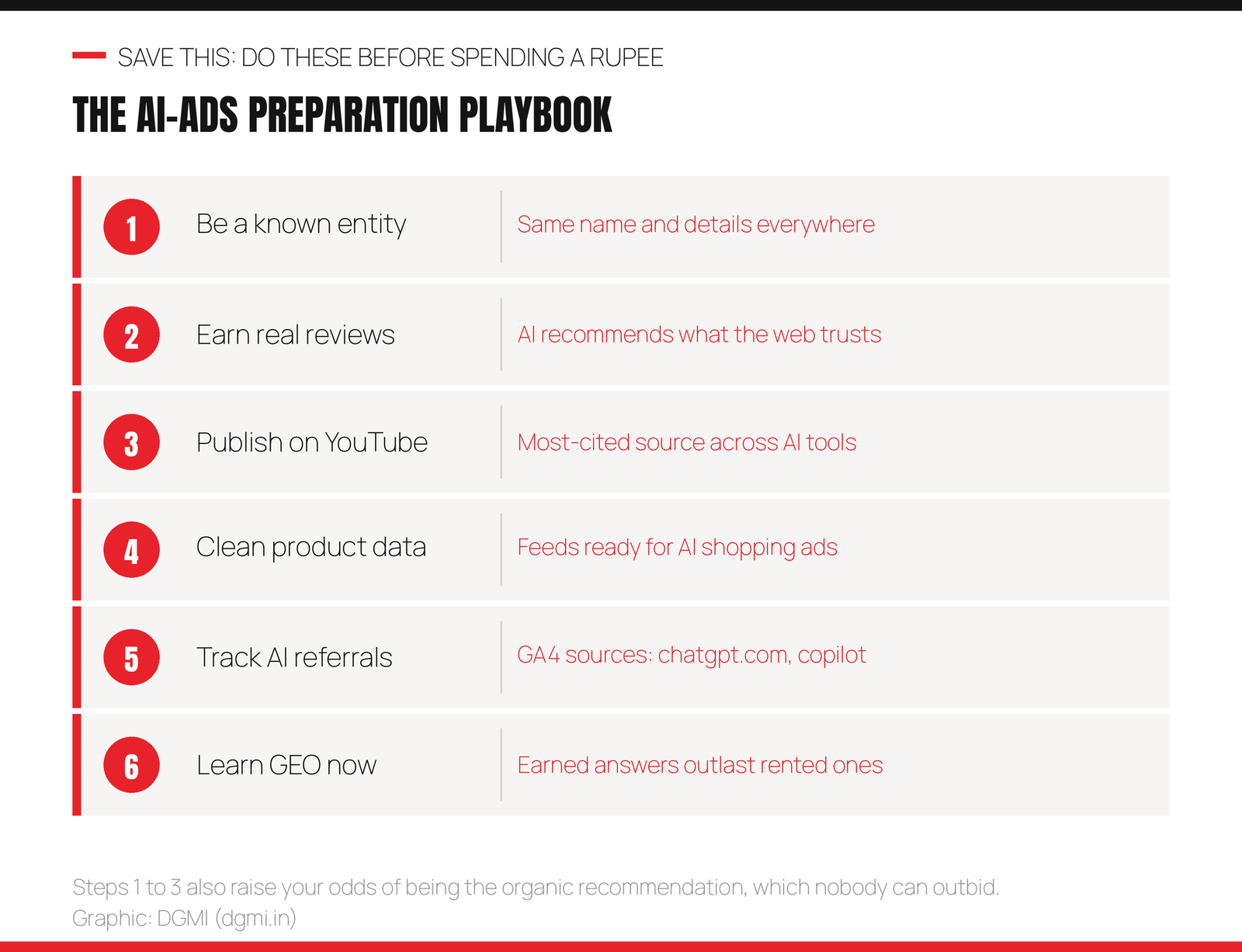
1. Be a known entity: identical business name, description, category and contact details across your site, Google Business Profile, social bios and directories; AI systems recommend entities they can resolve confidently. 2. Earn real reviews where your customers already leave them; recommendation engines lean on the web’s trust signals, and reviews are the loudest. 3. Publish on YouTube: even simple, genuinely helpful videos now feed the most-cited source across AI tools; one good “how to choose X” video is both a GEO asset and future creative for AI-side ads. 4. Clean product data: if you sell products, accurate titles, prices, stock and a tidy feed are the raw material every AI shopping format (Copilot’s included) will read. 5. Track AI referrals today: in GA4, check Traffic acquisition for sources like chatgpt.com, copilot and gemini, and annotate when they start growing; you cannot value a channel you never measured. 6. Learn GEO properly, because every step above compounds there, and the organic slot is the one no budget rents.
9. Risks and Open Questions
Trust is the whole product. People confide in AI chat in ways they never typed into a search box, which makes conversation-matched advertising both powerful and radioactive; one badly-matched sensitive ad is a news cycle. OpenAI’s published principles and its keep-the-answer-organic line exist precisely because of this, and how firmly that line holds as revenue pressure grows is the question everything else hangs on. Ad load creep is already measurable (that 26% monthly climb); every platform in history has ratcheted this dial, and user tolerance in a conversational medium is untested. Measurement is immature, as covered, which is a risk you manage with your own analytics rather than theirs. And disclosure norms are unsettled: what “Sponsored” must look like inside an agent’s conversation, or a click-to-chat flow, is being invented in real time, with regulators watching. None of these are reasons to ignore the shift; all of them are reasons to approach it like a professional: prepared, measured, and unimpressed by hype in either direction.

10. FAQ
Does ChatGPT really show ads now?
Yes. OpenAI announced ads in January 2026, began testing in February, and has rolled them out across 60+ countries since. Ads appear as labeled text or image placements beneath ChatGPT’s responses for users on the Free and Go tiers, matched to the conversation’s context. The business reached a reported $1 billion annualized revenue rate within months, and since September 10, select US advertisers can also buy placements through Amazon’s ad platform.
What exactly is the Amazon and OpenAI ads deal?
A US pilot announced September 10, 2026: brands that advertise through Amazon Ads, including the Amazon DSP, can extend campaigns into ChatGPT without a direct OpenAI relationship. Amazon builds and manages the campaigns; OpenAI’s ad system makes all delivery decisions about which ads appear, when and where. Delta Vacations was among the first named pilot brands. It adds a major buying route; it does not change where or how ads display.
Can a business in India advertise on ChatGPT?
Yes. OpenAI’s self-serve ads platform, opened to all US businesses on May 5, 2026, expanded to India, Europe, the Middle East and North Africa from August 31, 2026, with the global rollout passing 60 countries in September. Indian businesses can sign up at ads.openai.com. The Amazon DSP route remains a US-only pilot for now. Whether you should spend yet is a separate question; start with a small, measured test if you do.
Who sees ads in ChatGPT, and who does not?
Ads target the Free tier and the lower-priced Go subscription; higher paid tiers like Plus and Pro are positioned as ad-light or ad-free experiences. Placements appear beneath responses with sponsored labeling, and OpenAI’s stated principles keep the organic answer itself separate from paid content. Formats are still evolving, with click-to-chat ads and Sponsored Agents in testing, so expect the details to change over the coming year.
How is advertising in AI chat different from Google Ads?
Google search ads target a typed keyword; AI chat ads are matched to an ongoing conversation, which can carry much richer intent and context. That makes relevance potentially higher, but the ecosystem is younger: measurement, benchmarks and formats are immature compared with Google’s two decades of tooling. The professional approach is to treat it as an experimental channel measured with your own GA4 and UTMs, alongside, not instead of, mature platforms.
Can I pay to be recommended inside ChatGPT’s actual answer?
No. Across OpenAI’s published principles and the Amazon partnership’s structure, ads are separate, labeled placements beneath responses, while the answer’s recommendations remain organic. Influencing the answer itself is the domain of GEO: sustained brand presence, consistent entity information, real reviews and genuinely useful content, with research showing low-web-presence brands face roughly 2% odds of being recommended. Attempting to manipulate AI answers through spam tactics falls under existing search spam policies.
Should I move my ad budget to ChatGPT ads now?
Not your core budget. Keep proven platforms as your backbone and cap any ChatGPT experiment at roughly 5 to 10% of spend, with your own tracking (UTM-tagged landing pages, GA4 key events) defining success before you start. The platform’s measurement is still maturing, which industry reporting openly acknowledges. The stronger immediate investment for most small businesses is the preparation playbook: entity consistency, reviews, YouTube and GEO, which pays on the free side of the answer regardless.
What are Sponsored Agents?
A format OpenAI announced on September 16, 2026, currently testing with select US advertisers, in which a brand’s AI agent experience itself becomes the sponsored unit, rather than a static text or image ad. Details are limited while testing runs, but together with reported click-to-chat formats, it signals where this medium is heading: ads you talk to, not just see. Watch disclosure norms closely here; they are being defined in real time.
🚀 The Answer Slot Cannot Be Bought. Learn to Earn It.
DGMI’s 3-month Digital Marketing + AI Course (₹29,999) covers ads on every major platform, GEO for the AI-answer era, analytics that measure new channels honestly, and the AI workflows reshaping all of it, live and 1:1, with 9+ real projects and worldwide-recognized certification. Start with a free practical crash course class.
Questions? Contact us · hello@dgmi.in · +91 96940 03464
Sources: OpenAI: ChatGPT Ads (official self-serve platform) · Digiday: Amazon brings its DSP to ChatGPT Ads · PYMNTS: Amazon as a gateway to ChatGPT ads · Quartz: partnership structure and $1B run rate · MediaPost: Delta Vacations pilot and ad-load data
Keep learning: the GEO guide · the SEO vs GEO vs AIO guide · the TikTok AI ads analysis · the September 2026 spam update analysis · the Google Ads keyword research guide · the GA4, Search Console and Tag Manager guide · the best AI tools for marketing · the will AI kill marketing jobs analysis · discuss in the DGMI Community.