Imagine scrolling through your feed and stopping on a video that feels completely normal: someone in their bedroom, holding a product, talking to the camera the way a friend would. Now imagine nobody filmed it. No camera, no room, no person. That is not a prediction anymore, it is a button inside TikTok’s ad platform, and in 2026 it got dramatically better. If you are learning digital marketing right now, this news probably makes you a little nervous. I want to walk you through it calmly: what actually changed, what it honestly means for creators, and the part almost nobody is explaining clearly, which is how a beginner can turn this exact shift into a real income. No panic, no hype.
TikTok has been expanding Symphony, its AI advertising suite, since 2024. It now lets brands type a prompt and get a finished TikTok-style video, turn a single product photo into short ad clips, and use AI avatars that model clothes, hold products and demonstrate apps, complete with voiceovers in 30+ languages and lip-synced dubbing. In April 2026, TikTok began integrating ByteDance’s newer Dreamina (Seedance 2.0) video model for more realistic output, and at Cannes Lions in June 2026 it announced Symphony Agent, a chat-style layer that coordinates the whole suite. Everything generated carries an automatic AI label that cannot be removed. In short: influencer-style advertising without the influencer, available free to advertisers inside TikTok Ads Manager.
• TikTok says platform-native ads lift purchase intent 37% and brand favourability 38%, and 79% of users prefer brands that clearly understand the platform’s style
• Reported results from AI creative: American Eagle saw 60% higher ROAS using Symphony’s product showcase feature; one advertiser using the Avatar API reported 12.3x more creative output, a 19% CTR lift and 6.2% better ROAS
• Why brands want volume: high-performing TikTok ads fatigue in 7 to 10 days, roughly 2 to 3 times faster than Meta
• The human counterweight: 92% of consumers trust user-generated content over brand messaging, and a May 2026 Canva study found consumers accept useful AI ads but still value visible human input
1. What TikTok Actually Launched (in Plain English)
TikTok’s ad tools have a name: Symphony. It started in 2024 as a helper that wrote scripts and made simple visuals. Over the last two years it has grown into something much bigger, and 2026 was the year it stopped feeling like a toy.
The simplest way to understand it: a brand can now type a sentence describing the video it wants, and get a finished TikTok-style clip. It can upload one product photo and receive short videos built around it. And it can pick a digital avatar, a person who does not exist, to wear the clothes, hold the product or demonstrate the app while speaking in a natural voice. The avatar does not need a contract, does not get tired, and does not charge a fee.
Two updates made this genuinely different in 2026. In April, TikTok started rolling in Dreamina, built on ByteDance’s Seedance 2.0 model, which produces noticeably more realistic video and keeps a product looking consistent from shot to shot. Then in June, at the Cannes Lions advertising festival, TikTok announced Symphony Agent: instead of clicking through separate tools, an advertiser can now chat with an assistant that coordinates research, scripting, generation and campaign steps together. TikTok says the underlying models were tested by internal safety and intellectual property teams alongside outside red-teaming partners before release.
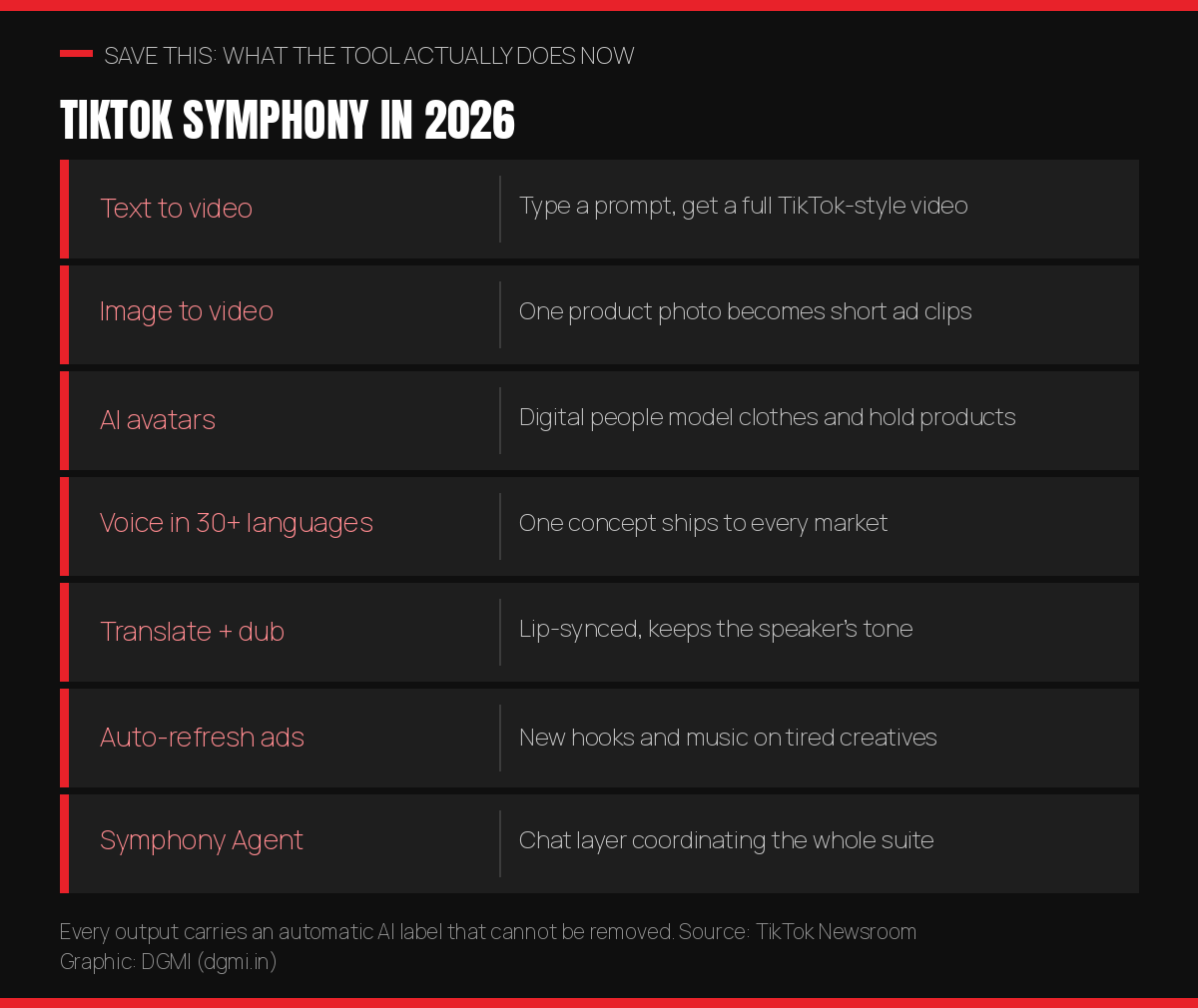
One detail matters more than the features: TikTok says all AI-generated content from these tools carries a label automatically, and the creator cannot remove it. Content also passes safety review before going live. Hold on to that fact, because it becomes your advantage later in this article.
2. Wait, TikTok Is Banned in India. Why Does This Matter to Me?
Fair question, and it deserves a straight answer before we go further. TikTok has been unavailable in India since 2020, so you cannot open the app or run these ads from here. This news still matters to you for three practical reasons.
First, the same capability is arriving everywhere. Meta is pushing comparable AI creative tools across Facebook and Instagram, and India’s Reels-first economy runs on exactly the same kind of short, native-looking video. What TikTok ships tends to appear on Instagram within a year. Watching TikTok is watching your own near future.
Second, Indian marketers serve global clients. A freelancer in Jaipur can absolutely be hired by a US, UK or UAE brand that advertises on TikTok, and increasingly is. Understanding these tools makes you employable in markets where TikTok is the main advertising platform, without ever installing the app.
Third, and most importantly, the underlying skill is platform-independent. The real shift is not “TikTok did a thing.” It is that video ads no longer require a camera crew, a studio or a famous face. That reality has already reached Indian brands. Whether you deliver that video to a D2C skincare brand in Mumbai for Instagram or to a Dubai retailer for TikTok, the skill you sell is identical.
3. What This Honestly Means for Creators
I am not going to tell you this is all wonderful, because it is not. Let me give you both sides, because you deserve an honest read rather than a comforting one.
The genuine concern. Thousands of creators earn a living from brand deals, and a chunk of that work is simple: hold the product, say the script, film it in your room. If a brand can generate twenty versions of that video before lunch, some of those small deals disappear, and the flood of cheap synthetic content can push prices down for everyone. That pressure is real and it is already visible in the lower end of the market.
The equally real other side. The tools have a clear ceiling, and even TikTok’s own positioning acknowledges it. AI avatars work well for product explanations and straightforward informational content. They work poorly where trust does the selling: honest testimonials, emotional storytelling, community, a face people have followed for two years. That May 2026 Canva research found the same thing from the audience side, that people accept AI in advertising when it is useful, but still value visible human input. And remember the mandatory label: viewers are told when something is synthetic, which means brands cannot quietly pass off an avatar as a trusted friend’s recommendation.
So the honest summary is the same one running through everything we teach at DGMI right now: AI is removing tasks, not the whole job. The task of “be a body holding a product on camera” is being automated. The work of understanding an audience, writing a hook that stops a thumb, judging which of twenty versions is actually good, and owning the result, is not. We go deep on that distinction in our AI and marketing jobs guide.
4. What Is an “AI Creator” and Why Brands Pay Them
Here is the opportunity hiding inside this news, and it surprises most beginners.
You might assume that because TikTok gives brands these tools for free, nobody would pay a person to make AI content. In practice the opposite happens, and the reason is simple: the tool is free, but the judgment is not. A brand owner opens Symphony, types a prompt, gets a mediocre video, does not know why it is mediocre, and gives up. Somebody has to know what hook to write, which avatar suits which audience, what to say in the first two seconds, which of the twenty outputs deserves ad spend, and how to keep the whole thing on brand. That somebody is an AI creator.
An AI creator (you will also see the phrase “faceless UGC creator”) produces brand-ready short videos using AI avatars, voice tools and editing apps instead of appearing on camera. You are paid for the content, not for having followers. That last point is what makes this so accessible: brands buying UGC care about content quality, not your audience size, which is why people with zero followers are earning from this today.
The demand is straightforward. Brands need constant fresh creative because ads burn out in about a week to ten days, and testing twenty angles beats guessing at one. Someone has to produce that volume at a quality that converts. If you can, you get paid, whether the client is in Jaipur or Dubai.
🎯 The Tools Are Free. The Skill Is What Pays.
DGMI’s Digital Marketing + AI Course teaches exactly the judgment these tools cannot supply: audience research, hooks that stop the scroll, ad strategy and AI workflows, practiced live and 1:1 on real projects. See how we teach with a 100% practical crash course class, FREE this week.
5. Five Ways to Earn as an AI Creator (With Real Rates)
These are the five models people are actually using, ordered roughly from fastest-to-first-payment to slowest-but-most-compounding.
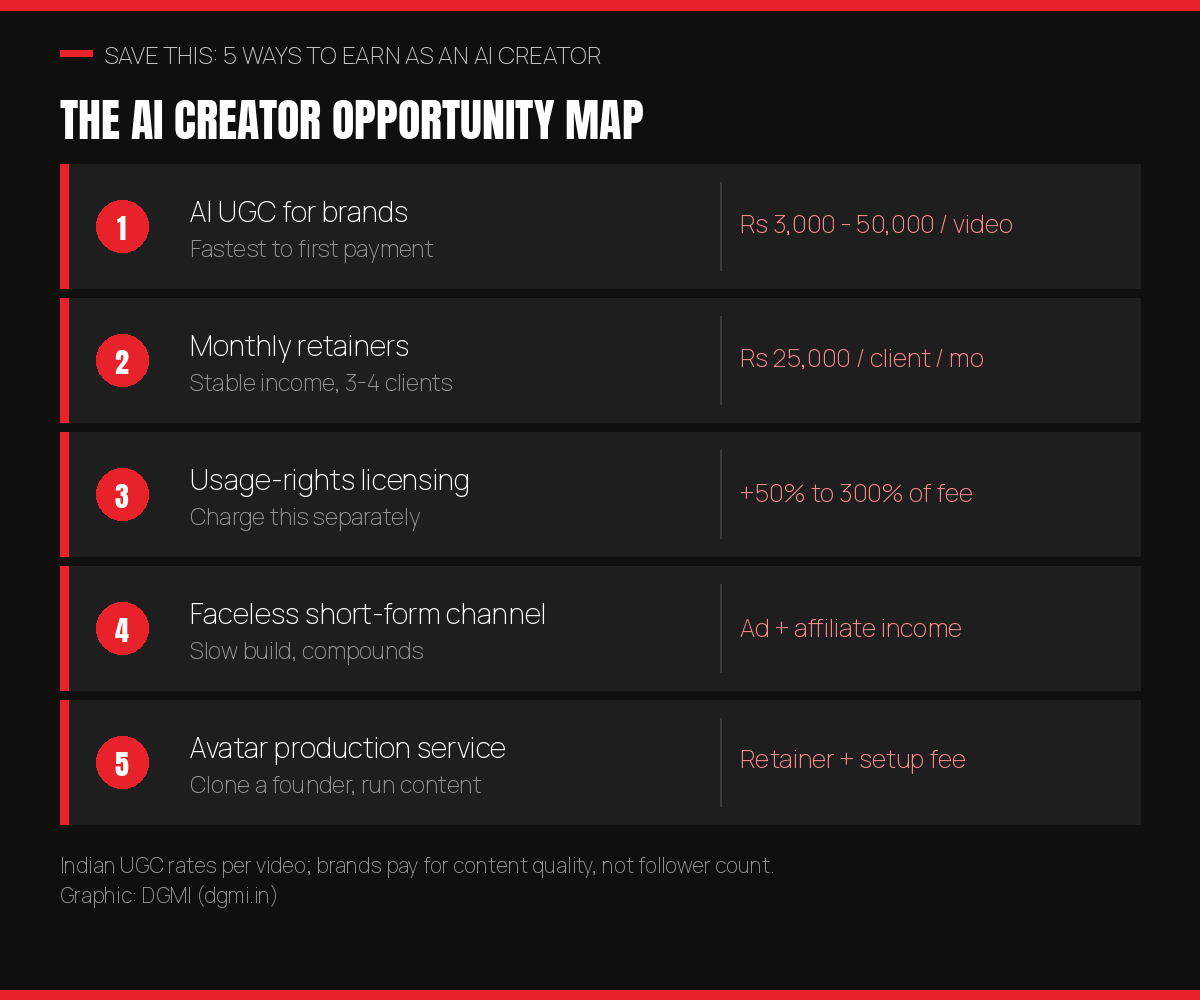
1. AI UGC for brands. You make ad-style videos (product demos, tutorials, testimonial-style clips) that the brand runs on its own channels. Indian UGC rates commonly run ₹3,000 to ₹50,000 per video depending on complexity and your track record, and Indian D2C brands are active buyers. Globally, beginners often start around $50 to $150 per video and experienced creators charge several hundred. This is the fastest path to a first payment because it is service work, not audience building.
2. Monthly retainers. The moment a brand likes your work, propose a monthly package instead of one-off videos. Three or four retainers at roughly ₹25,000 each puts you in the ₹75,000 to ₹1 lakh a month range, and it turns unpredictable freelancing into something closer to a salary. This is the single biggest income jump available to you, and most beginners never ask for it.
3. Usage-rights licensing. This is the professional detail nobody teaches beginners: creating a video and letting a brand run it as a paid ad for a year are two different things, and should be two different fees. Common practice is to charge extra on top of your creation fee based on how long and how widely they can use it. Always agree it in writing before delivery.
4. Faceless short-form channels. Instead of selling to brands, you build your own channel using AI voice and avatars in a niche you understand, and earn through platform monetization, affiliate links or eventually your own product. Slower to first rupee, but the back catalogue keeps working while you sleep.
5. Avatar production service. The most interesting model in 2026: you help a real person scale. A doctor, founder, coach or local business owner sits for a short recording once, and you handle their ongoing content using their approved avatar and voice. You are not replacing a human here, you are multiplying one, with their consent, which sidesteps most of the ethical problems entirely.
6. Your 30-Day Beginner Plan to Start
You do not need a following, a camera or expensive software. You need a portfolio and one clear niche. Here is the plan I would give a student starting today:
- Days 1-5 · Pick a niche and study winning ads. Choose two or three product categories you genuinely understand: skincare, gadgets, fitness, food, fintech apps. Then collect 20 short video ads in that niche that stopped your scroll, and write down what happens in the first two seconds of each. That swipe file teaches you more than any tutorial.
- Days 6-15 · Learn the hook, then the tools. The hook matters more than the software, so practise writing ten different openings for the same product. Then learn one AI video tool and one editing app well rather than five badly. Free and low-cost options are plenty at this stage, and our AI tools guide covers which does what. Use our 100 prompts library (the social and Reels section) to script faster.
- Days 16-22 · Build 5 spec samples. Pick real products you like and create sample videos for them, unpaid, as portfolio pieces. Nobody hires from promises; everybody hires from samples. Five strong samples in one niche beat twenty scattered ones.
- Days 23-30 · Pitch 20 brands, properly. Message small and mid-size D2C brands whose ads you have studied, and lead with a specific observation plus one sample made for THEIR product, not a generic “I offer UGC services.” The outreach method in our freelance clients guide applies exactly. Expect your first paid gig within a few weeks of consistent, targeted pitching.
One thing to protect fiercely as you do this: keep your own judgment in the loop. The people who will struggle are those who generate a hundred generic videos and spam brands with them. The people who will do well are those who understand the audience, write the hook themselves, and use AI to produce it fast. If you want the foundation under all of this, start with our audience research guide, because knowing who you are talking to is what separates a video that sells from a video that merely exists.
7. The Disclosure Rules You Must Follow
This part is short but non-negotiable, and following it is genuinely good for business.
Label AI content. TikTok applies its own label automatically to Symphony output, and other platforms have their own disclosure requirements. Undisclosed synthetic content gets suppressed on YouTube, and unoriginal content sees reduced reach across Meta’s platforms. Disclosure is not a penalty, it is the price of distribution.
Never fake a real person. Do not clone a voice or likeness without clear written permission, including a client’s own face. This is both an ethical line and a legal one, and India’s IT rules on synthetic media have been tightening.
Do not fake testimonials. An avatar saying “this product changed my life” when no customer said it is a false claim, whoever generated it. Use AI for demonstrations, explanations and scripted brand messages; use real humans for genuine testimonials. That boundary keeps you on the right side of consumer-protection rules and, conveniently, is also where AI performs best anyway.
The same principle governs written content, where Google’s 2026 data was blunt: original, human-verified work gained visibility while unoriginal AI output collapsed. Our E-E-A-T guide explains why platforms converged on this rule.

8. FAQ
Can I use TikTok Symphony from India?
No. TikTok has been unavailable in India since 2020, so you cannot access Symphony or run TikTok ads from here. You can still build the AI creator skill using other tools and sell it to Indian brands for Instagram Reels and YouTube Shorts, or to overseas clients who advertise on TikTok. The skill transfers completely; only the platform changes.
Do I need followers to become an AI creator?
No, and this is the most encouraging part of this whole shift. UGC and AI-UGC work pays for the content itself, which the brand runs on its own channels and ads. Brands are buying video quality and conversion ability, not your reach. Plenty of people earning from this have a few hundred followers or none at all. What you do need is a portfolio of samples in a clear niche.
How much can a beginner realistically earn in India?
Indian UGC rates commonly run ₹3,000 to ₹50,000 per video depending on complexity, niche and proof of results, with the lower end typical for early work. The bigger jump comes from retainers: three or four clients at around ₹25,000 a month each puts you in the ₹75,000 to ₹1 lakh range. Treat early low-paid projects as portfolio investments, then raise rates once you can show results rather than just samples.
Will AI avatars completely replace human creators?
Not completely, and the evidence points to a split rather than a takeover. Avatars perform well for product explanations, demos and repetitive informational content. They perform poorly where trust and emotion drive the sale, which is exactly why testimonials and personality-led content still go to humans. Mandatory AI labelling reinforces that split, since viewers know what they are watching. The realistic future is mixed: AI for volume and variations, humans for trust and originality.
Is it ethical to make AI content for brands?
Yes, within clear limits. Making a labelled AI demo video for a product is straightforward advertising with a new production method. Cloning a real person without written consent, faking a customer testimonial, or hiding that content is synthetic when a platform requires disclosure are all over the line. The simple test: would the viewer feel deceived if they learned exactly how this was made? If yes, do not publish it. The avatar-production model in section 5, where a real person consents to their own AI likeness, is the cleanest version of this work.
What skills matter most if the tools do the work?
Three, in this order: understanding the audience well enough to know what they fear and want, writing hooks that earn the first two seconds, and judging which output is actually good enough to spend money behind. Tool operation is the easiest part and the fastest to become worthless. This is why we teach fundamentals alongside AI workflows rather than tool tutorials alone, and why the specialization question is worth thinking through using our lane-finder guide.
🚀 Be the Creator Who Directs the AI
DGMI’s 3-month Digital Marketing + AI Course (₹29,999) covers the full 2026 stack: audience research, ads, SEO and GEO, content and social strategy, plus AI tools, prompting and agents, taught live and 1:1 on real projects with worldwide-recognized certification. Start with a free practical crash course class.
Questions? Contact us · hello@dgmi.in · +91 96940 03464
Sources: TikTok Newsroom: Symphony updates · MarketingTech News: TikTok pushes AI ads that look just like real creators · MediaPost: TikTok expands Symphony with Dreamina video model (April 2026) · Canva research on consumer attitudes to AI ads (May 2026) · TikTok: Symphony Digital Avatars announcement
Keep learning: the AI and marketing jobs guide · the AI tools stack · the 100 AI prompts library · the audience research guide · the platform algorithms guide · the freelance clients guide · the E-E-A-T guide · discuss in the DGMI Community.