
I use AI prompts every single working day: for DGMI’s content, for client campaigns, for the ads and audience research behind our own free classes. It has roughly halved my production time in twelve years of doing this work, and I say that as someone who checks every output like an editor. But here is what I have learned watching hundreds of students use ChatGPT: the difference between “AI gave me something generic” and “AI just saved me two hours” is never the tool. It is the prompt. So this is the library I wish existed when I started: 100 prompts I would actually use, organized by marketing discipline, each one built on the same 5-part formula, with blanks marked in [BRACKETS] for your details. Copy, customize, verify, ship.
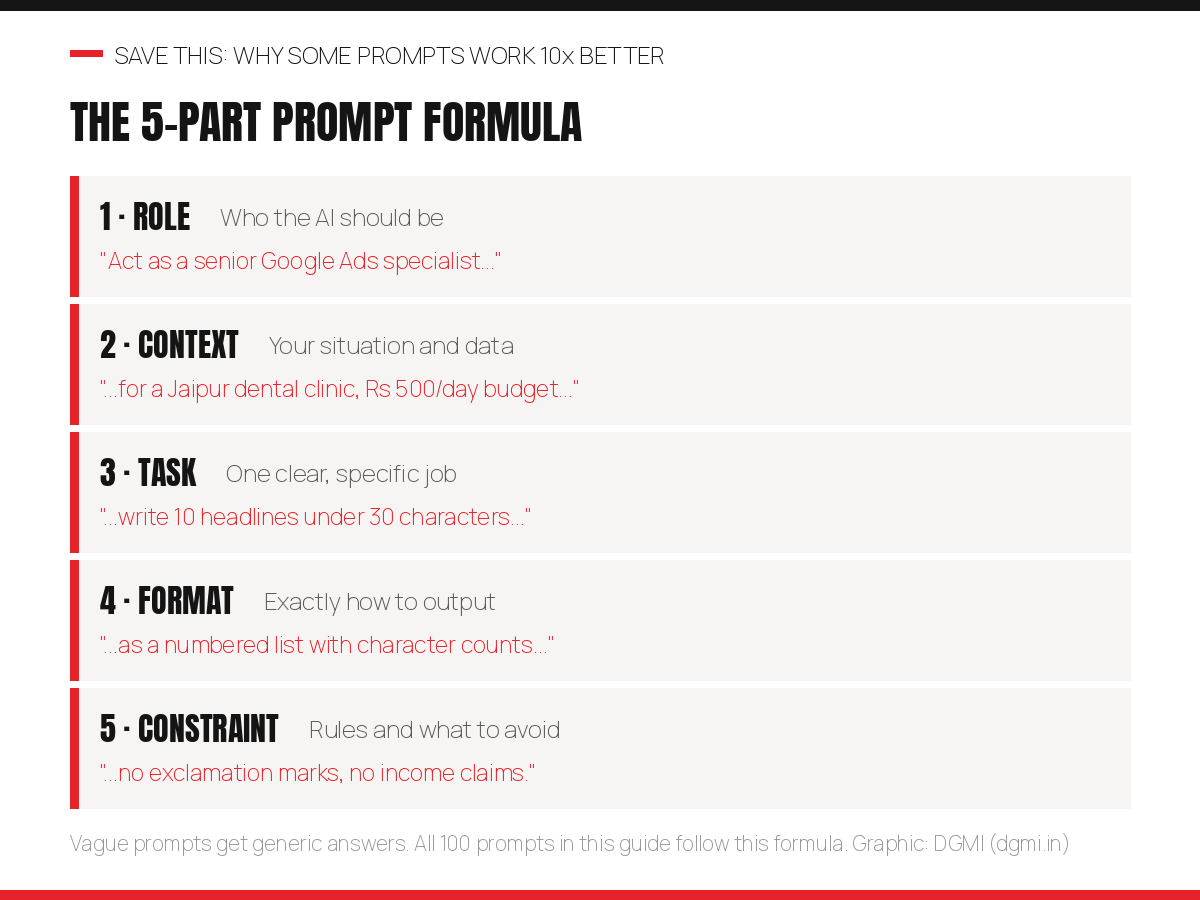
Effective marketing prompts follow a 5-part formula: Role (who the AI should act as), Context (your business, audience and data), Task (one specific job), Format (exactly how to output), and Constraint (rules and what to avoid). “Write me an ad” gets generic filler; “Act as a senior Google Ads specialist writing for a Jaipur dental clinic with a ₹500/day budget, give me 10 headlines under 30 characters as a numbered list with character counts, no exclamation marks” gets usable work. All 100 prompts below follow this structure, and every output still needs one human step: verify, add your first-hand details, and rewrite in your voice before publishing.
• 88% of marketers now use AI in their daily work (HubSpot 2026, 1,500+ marketers surveyed)
• AI-fluent marketers earn a 25 to 40% salary premium across every specialization
• The quality line is measurable: original human-verified content gained +22% visibility in Google’s March 2026 core update while lazy AI paraphrase lost 71% of traffic (SE Ranking)
• Translation: prompting well is valuable, publishing raw AI output is expensive. This guide teaches both halves.
The 5-Part Formula (Read This First)
Every prompt below follows one structure, and once you see it, you can improve any prompt on the internet, including these. Give the AI a Role so it borrows the right expertise, Context so it works on your reality instead of averages, one clear Task, an exact output Format, and Constraints that block the failure modes you have seen before. The blanks in [BRACKETS] are where your details go, and the more real detail you put in, the less generic the output comes back. This is not a trick; it is simply giving a capable assistant a proper brief, the same way you would brief a junior colleague.
Two power moves that upgrade every prompt in this library: first, paste your real data (your page text, your ad stats, your reviews) wherever a prompt says [PASTE], because AI reasoning about YOUR numbers beats AI guessing about averages. Second, iterate: the first output is a draft, so reply with “make option 2 more specific to [AUDIENCE]” or “now write it at half the length” instead of starting over. Prompting is a conversation, not a slot machine.
Audience Research Prompts (1-10)
Audience research is the skill under every other skill, so the library starts here. These pair with the full process in our target audience guide.
“Act as an audience researcher. My business is [BUSINESS] in [CITY] solving [PROBLEM]. Build a target audience profile in 4 layers: demographics, psychographics, behaviour (including likely search phrases), and pain plus intent in the customer’s own words. Format as a table. Mark every guess that I should verify with real data.”
“Act as a qualitative researcher. Here are competitor reviews: [PASTE 20-30 REVIEWS]. Extract the recurring desires, fears, objections and trigger events. Quote the exact customer phrases verbatim under each theme, then list the 5 phrases most usable as ad headlines.”
“My business [BUSINESS] could serve these segments: [LIST SEGMENTS]. Score each 1 to 5 on ability to pay, urgency of need, and reachability for a small budget. Show a table with totals, recommend ONE segment to start with, and explain the tradeoff in 3 sentences.”
“Using this research [PASTE NOTES, PHRASES, KEYWORD LIST], write a one-paragraph persona: name, age, job, city, trigger situation, desired outcome, biggest fear, exact search phrases, platforms, and the emotion they need to feel to choose us. Use only what the evidence supports.”
“Act as a skeptical buyer of [PRODUCT/SERVICE] at [PRICE]. List the 10 objections running through your head before purchasing, ranked by how often they kill the sale. For each, write the one-line reassurance a website should give, without overpromising.”
“Design 8 open-ended customer interview questions for [BUSINESS] that uncover trigger events, search behaviour, near-objections and desired outcomes. Avoid yes/no phrasing and leading questions. Add a one-line reason each question earns its place.”
“Here are my raw interview notes: [PASTE]. Cluster them into recurring patterns, count how many interviewees expressed each, pull the single most quotable verbatim line per pattern, and flag anything that contradicts my draft audience profile: [PASTE PROFILE].”
“List 20 questions people realistically ask on Reddit, Quora and Google about [TOPIC/PROBLEM], grouped by journey stage: just realized the problem, comparing options, ready to buy. Phrase them the casual way real people type, not the way marketers write.”
“Here is my persona: [PASTE]. Here is my draft homepage headline and first paragraph: [PASTE]. Critique it strictly from the persona’s point of view: what feels relevant, what feels generic, what fear is left unaddressed? Then rewrite it twice: once safer, once bolder.”
“Define the anti-persona for [BUSINESS]: the customer we should NOT target because they churn, haggle or mismatch our offer. List their tell-tale signals in enquiries and the polite one-line ways to disqualify early. Keep it respectful, no stereotypes.”
SEO Prompts (11-20)
Pair these with our SEO checklist. Remember: AI suggests, Search Console decides.
“Act as an SEO strategist. Here is my keyword list with volumes: [PASTE]. Cluster into informational, comparison and transactional intent, map each cluster to ONE page type (blog, category, service page), and flag keywords that would cannibalize each other if given separate pages.”
“Write 5 title tags (under 60 characters) and 5 meta descriptions (under 155) for a page targeting [KEYWORD] for [AUDIENCE]. Include the keyword naturally, one benefit and one differentiator. Show character counts. No clickbait promises the page cannot keep.”
“I want to rank for [KEYWORD]. Here are the H2s of the top 3 ranking pages: [PASTE]. Build an outline that covers the topic MORE completely, adds 2 sections they all missed, and lists where my first-hand experience [DESCRIBE] should appear to differentiate. Do not copy their headings.”
“Act as an on-page SEO auditor. Target keyword: [KEYWORD]. Here is my draft: [PASTE]. Check title, headings, first 100 words, keyword variants, internal link opportunities and missing subtopics. Return a prioritized fix list, most impactful first, with the exact edit for each.”
“Here are my site’s pages with one-line descriptions: [PASTE LIST]. Design an internal linking map: for each page, which 2 to 3 pages should it link to, with suggested anchor text that is descriptive, varied and natural. Identify the one page that should become the hub.”
“From this page content [PASTE], pick the 5 questions users most plausibly ask, write concise 40-60 word answers, and output valid FAQPage JSON-LD schema I can paste into the page. Answers must only contain facts present in the content.”
“Act as an SEO analyst. Here is my Search Console data comparing two periods: [PASTE QUERIES, CLICKS, IMPRESSIONS, POSITIONS]. Identify whether the decline pattern suggests lost rankings, zero-click/AI Overview effects (impressions steady, clicks down), seasonality, or specific page issues. Give the 3 most likely explanations ranked, and what evidence would confirm each.”
“Review this article [PASTE] against E-E-A-T. List every claim that needs a cited source, every place first-hand experience could be added (suggest what kind), and whether the author presentation builds trust. Output as a checklist I can action, ordered by impact.”
“My site covers these topics: [PASTE LIST]. My competitor covers these: [PASTE LIST]. Identify content gaps worth filling for a business serving [AUDIENCE], rank by likely commercial value, and mark any competitor topics NOT worth copying because they are off-intent for us.”
“Outline a location landing page for [SERVICE] in [CITY/AREA] that avoids thin doorway-page patterns: include locally specific proof elements, area-specific FAQs, pricing context, and where to place genuine photos and reviews. Flag what would make Google treat it as spam.”
GEO and AI-Search Prompts (21-30)
Getting cited by AI answers is the new page one. Full strategy in our GEO playbook.
“Rewrite this section [PASTE] to be citation-friendly for AI search: a direct 40-60 word answer first, then supporting detail with one named statistic and its source. Keep every fact from the original; add nothing unverified.”
“Here are my article’s H2s: [PASTE]. Convert each into the natural question a user would ask an AI assistant, keeping keyword relevance. Return old vs new in a table and mark which conversions genuinely improve clarity versus which were fine as-is.”
“Generate 15 questions a potential customer of [BUSINESS] in [CITY] might ask ChatGPT, Gemini or Google AI Mode, from generic to very specific. I will test which answers mention us. Group them by buying stage and phrase them conversationally.”
“Read this draft [PASTE]. Identify 5 claims that would be stronger with a statistic, and for each tell me what TYPE of stat to find and where credible sources likely exist (official reports, industry surveys). Do NOT invent numbers; leave [STAT NEEDED] placeholders.”
“For the topic [TOPIC], list the entities, subtopics and related terms an authoritative page would naturally mention. Compare against my draft [PASTE] and show what is missing, grouped by importance. Ignore anything that would be padding.”
“Explain in plain language what llms.txt does and does not do in 2026 (note: Google Search ignores it), whether my robots.txt [PASTE] blocks AI crawlers I might want, and what a sensible access policy looks like for a small business that wants AI visibility.”
“Create an honest comparison table of [MY OFFERING] vs the common alternatives [LIST], on the criteria buyers actually weigh. Fill only cells I can defend; mark uncertain cells for me to complete. Structured comparisons are what AI answers love to cite.”
“Here is my generic-sounding section: [PASTE]. Interview me: ask 5 questions about my real experience with this topic that, once answered, would make this section impossible for a content mill to replicate. Then show where each answer should slot in.”
“My page answers [QUERY] and AI Overviews now capture many clicks. Suggest 5 elements that give searchers a reason to click through anyway (tools, templates, calculators, personal data, community) ranked by effort vs impact for a small team.”
“Design a monthly 30-minute routine to track my brand’s AI-search visibility: which questions to test, which AI tools to check, what to log in a simple sheet, and what change signals action. Output as a checklist with a sheet column structure.”
Google Ads Prompts (31-40)
These pair with our Google Ads and keyword research guide. Always verify character limits before pasting into the platform.
“Act as a Google Ads copywriter. Business: [BUSINESS] in [CITY]. Offer: [OFFER]. Audience: [AUDIENCE]. Write 15 responsive search ad headlines under 30 characters across 4 angles (benefit, urgency, trust, question), plus 4 descriptions under 90. Show character counts. No exclamation marks, no unverifiable claims.”
“I sell [PRODUCT/SERVICE] at [PRICE POSITIONING] in [LOCATION]. Generate 40 negative keywords grouped by theme: freebie seekers, DIY intent, job seekers, wrong location, wrong product, informational-only. Explain any non-obvious inclusions in one line.”
“Here is my search terms report: [PASTE TERMS WITH CLICKS/COST/CONVERSIONS]. Sort into: add as exact keyword, add as negative, monitor. Estimate wasted spend from the negatives group, and tell me the single biggest leak in one sentence.”
“Walk me through break-even math for ads: my average sale profit is [₹X], my lead-to-sale rate is [Y%], my landing page converts [Z%] of clicks to leads. Calculate maximum profitable CPC and CPA, show the formula at each step, then tell me what the numbers say I should fix first.”
“Here is my ad copy [PASTE] and my landing page above-the-fold text [PASTE]. Score the message match out of 10, list every promise in the ad that the page does not immediately confirm, and rewrite the page’s headline and first line to close the gap.”
“Meta’s delivery system rewards genuinely different creative angles. For [OFFER] targeting [AUDIENCE], develop 5 distinct psychological angles (e.g. pain, aspiration, social proof, contrarian, urgency), each with a hook line, a 60-word primary text, and the image/video concept in one sentence.”
“Here is my current campaign structure: [DESCRIBE CAMPAIGNS, AD GROUPS, KEYWORDS, BUDGETS]. Critique it for 2026 best practice: consolidation vs fragmentation, match types, budget split, and conversion tracking gaps. Give me the revised structure as a simple tree.”
“For [BUSINESS] with landing page [URL/DESCRIBE], write a full assets pack: 6 sitelinks (25 char titles + 2 x 35 char descriptions), 8 callouts under 25 characters, and structured snippets. Only include pages and claims that actually exist.”
“Create a 30-minute weekly Google Ads optimization routine for a small account (₹[X]/day): what to check in what order, the decision rule at each step (when to pause, when to bid down, when to do nothing), and what to log. Format as a checklist.”
“My campaign stats: [PASTE IMPRESSIONS, CTR, CPC, CONV RATE, CPA over time]. Diagnose the weakest link in the chain (visibility, ad appeal, landing page, or offer), explain the reasoning from the numbers, and give the 3 highest-leverage fixes in order.”
🎯 Prompts Save Hours. Skills Build Careers.
These prompts work best when you understand the marketing underneath them, which is exactly what DGMI’s Digital Marketing + AI Course builds: fundamentals plus AI workflows, live and 1:1 on real projects. Experience the teaching first with a 100% practical crash course class, FREE this week.
Social Media and Reels Prompts (41-50)
Built for 2026’s real ranking signals: watch time, sends and originality. Background in our platform algorithms guide.
“Act as a short-form video strategist. Topic: [TOPIC]. Audience: [AUDIENCE]. Write 3 Reel scripts of 30 to 45 seconds, each opening with a hook that earns the first 3 seconds (bold claim, question, or pattern interrupt), with on-screen text lines and a send-worthy ending. Label the hook type of each.”
“Instagram’s strongest growth signal is sends per reach. Review this content idea [DESCRIBE]: who exactly forwards it, to whom, and what does the sender look like for sharing it (funny, smart, caring)? If the answer is weak, suggest 3 twists that make it genuinely forwardable.”
“Build a 30-day Instagram calendar for [BUSINESS]: 8 Reels, 12 feed posts, 20 story prompts, mixed across education, proof, personality and offer (max 20% offer). One-line concept per item, tied to audience pains: [PASTE TOP 5 PAINS]. Format as a week-by-week table.”
“Write an Instagram caption for [POST DESCRIPTION]: hook line first (it shows before ‘more’), value in short lines, one question to drive comments, natural keywords for Instagram search ([KEYWORDS]), and 5 relevant hashtags only. Conversational, no emoji spam.”
“Turn this article [PASTE OR LINK SUMMARY] into an 8-slide carousel: slide 1 a scroll-stopping hook, slides 2-7 one idea each in under 20 words, slide 8 a save/share CTA. Write the exact slide text plus a caption. Keep the strongest statistic on slide 2.”
“Here are comments from my recent posts and competitors’ posts: [PASTE]. Extract every question, objection and repeated theme, then convert the top 10 into content ideas with a suggested format each (Reel, carousel, story poll). Quote the triggering comment under each.”
“Write a LinkedIn post in my voice based on this insight: [PASTE INSIGHT + ANY DATA]. Structure: 1-line hook, short lines, one concrete example, a clearly stated opinion, and a closing question. 150 to 220 words. No hashtag walls, no ‘Agree?’ bait, link goes in first comment.”
“Design a 5-frame Instagram Story sequence for [GOAL, e.g. demo class signups]: frame-by-frame text, which sticker each frame uses (poll, question, slider, link) and why, ending on the link frame. Keep each frame under 15 words.”
“For a video about [TOPIC] aimed at [AUDIENCE], write 8 title options under 60 characters that create curiosity WITHOUT overpromising (satisfaction surveys punish clickbait), plus 3 thumbnail text ideas of 3 words max with a visual concept each.”
“Take this one piece of content [PASTE] and design the full repurposing chain: LinkedIn post, X thread outline, 2 Reels concepts, 5 story frames, a newsletter section and 3 quote graphics. Adapt tone per platform; never copy-paste identical text across them.”
Content and Blogging Prompts (51-60)
Remember the golden workflow: AI drafts, you verify, you add first-hand value. Our E-E-A-T guide explains why this is now a ranking requirement.
“Create a complete content brief for an article targeting [KEYWORD] for [AUDIENCE]: search intent, working titles, outline with H2/H3s, questions to answer, data points to source, internal links from my site [LIST PAGES], and where my experience [DESCRIBE] must appear. One page max.”
“Write a first draft from this outline and these notes: [PASTE OUTLINE + BULLET NOTES INCLUDING MY EXAMPLES]. Use my examples verbatim where marked. Plain, confident language at a grade-8 reading level. Mark any claim you were not given evidence for as [VERIFY].”
“Edit this draft [PASTE] to sound like a specific human wrote it: vary sentence length, cut filler phrases (‘in today’s world’, ‘delve’, ‘landscape’), replace generic examples with placeholders for my real ones [MARK THEM], and keep facts unchanged. Show a diff-style summary of what you changed.”
“For this article [PASTE SUMMARY], write 8 headline options across 4 styles (how-to, data-led, contrarian, question) and 3 opening paragraphs: one story-led, one stat-led, one problem-led. Under 60 characters for headlines meant as title tags; mark which ones are.”
“List every factual claim, number and named source in this draft [PASTE] as a table: claim, current source (if any), risk level if wrong, and what I should check before publishing. Do not tell me claims are true; tell me what needs verification.”
“This article was published in [YEAR]: [PASTE]. Identify everything likely outdated in 2026 (stats, tools, screenshots, advice made obsolete by AI search changes), what sections to add, and whether to refresh or rewrite. Output as an action plan with effort estimates.”
“Interview me to build a story bank: ask me 10 questions, one at a time, about client wins, failures, surprises and lessons from my work in [FIELD]. After my answers, summarize each story in 3 lines with tags for which content topics it can support.”
“Outline a genuinely useful ‘[X] vs [Y]’ article for [AUDIENCE]: decision criteria that matter to THEM, an honest verdict framework (‘choose X if… choose Y if…’), a comparison table structure, and the FAQ set. Flag where fake neutrality would weaken it.”
“Rewrite this technical explanation [PASTE] for a complete beginner: one everyday analogy, no jargon without a plain-word bracket, short sentences, and a ‘in one line’ summary at the end. Accuracy beats simplicity wherever they conflict; flag those spots.”
“Design a topic cluster around the pillar [TOPIC] for [BUSINESS]: the pillar page scope, 8 supporting article ideas with target queries, and the internal linking pattern between them. Prioritize by commercial value and rank-ability for a newer site.”
Email and WhatsApp Prompts (61-70)
“Design a 4-email welcome sequence for new [SUBSCRIBERS/LEADS] of [BUSINESS]: goals per email, subject line (under 45 chars) + preview text, full body copy in a warm human voice, and one CTA each. Day 1 delivers immediate value before any pitch.”
“For this email [PASTE BODY OR SUMMARY], write 12 subject lines across styles: curiosity, benefit, question, number, personal. Under 45 characters each. Then pick your top 2 for an A/B test and explain the hypothesis each tests. No spam-trigger words.”
“Write a re-engagement email to subscribers inactive for 90+ days from [BUSINESS]: honest acknowledgment, one genuinely useful thing (not a discount by default), and a soft ‘stay or leave’ choice that cleans my list. 120 words max, human tone.”
“Write 6 WhatsApp quick replies for [BUSINESS]: new enquiry greeting, pricing question, ‘let me think’ follow-up (single, polite), booking confirmation, day-before reminder, and no-show recovery. Warm, brief, one emoji max each, each ending with an easy next step.”
“Draft this week’s newsletter for [AUDIENCE] from these raw inputs: [PASTE LINKS/NOTES/WINS]. Structure: one insight explained simply, one practical tip, one recommended resource, one soft CTA. My voice sample: [PASTE A PARAGRAPH I WROTE]. Match it.”
“Design a 3-touch recovery sequence (email or WhatsApp) for people who [STARTED ACTION BUT DID NOT FINISH, e.g. filled the form but did not book]: timing for each touch, the psychological job of each message, and full copy. Helpful tone, zero guilt-tripping.”
“My list of [SIZE] contains [DESCRIBE MIX]. Propose a practical segmentation (max 5 segments) based on data I actually have [LIST FIELDS/BEHAVIOURS], what each segment should receive differently, and the simplest automation rules to maintain it.”
“Write a WhatsApp broadcast for my opted-in list about [OFFER/UPDATE]: under 60 words, leads with value to THEM, one clear CTA, sendable without feeling like spam. Then write the version for Status. Note: my audience blocked-rate must stay near zero.”
“Tear down this email [PASTE]: subject, preview, first line, structure, CTA clarity, and mobile readability. Score each /10 with one-line reasoning, then rewrite the weakest two elements. Judge it for [AUDIENCE] specifically, not generic best practice.”
“Convert this long guide [PASTE OR SUMMARIZE] into a 5-day email mini-course: daily lesson focus, subject lines, 150-word lessons that each end with one tiny action, and a day-5 bridge to [OFFER]. The course must be valuable even if nobody buys.”
Analytics and Reporting Prompts (71-80)
“Act as a marketing analyst. Here is my GA4 data: [PASTE CHANNELS, SESSIONS, ENGAGEMENT, CONVERSIONS FOR TWO PERIODS]. Tell me the 3 most important changes, the most likely explanation for each, what to check to confirm, and the one action the data supports. Plain language, no dashboard jargon.”
“My business goal is [GOAL, e.g. 30 demo bookings/month]. Build the KPI tree: the north-star metric, its 3 to 4 driver metrics, and the input activities under each. Mark which numbers I should check daily, weekly and monthly, and what ‘healthy’ roughly looks like.”
“Turn these campaign numbers [PASTE] into a client report narrative: what we did, what happened, why, and next month’s plan. Lead with business outcomes (leads, cost per lead) not vanity metrics. Honest about what underperformed. 200 words + a 5-row summary table.”
“For a website whose goals are [LIST ACTIONS: form, WhatsApp click, call click], design the conversion tracking plan: events to create, GA4 vs Google Ads conversion mapping, and a test checklist to confirm each fires. Assume GTM is installed; keep it beginner-executable.”
“Metric [METRIC] moved [X%] on [DATE RANGE]. Context: [ANY CAMPAIGNS/CHANGES/SEASON]. List the 6 most plausible explanations ranked by likelihood, the data that would confirm or kill each, and which explanations require NO action. Teach me the elimination order.”
“Design a one-screen weekly dashboard for [BUSINESS/ROLE]: the 8 metrics that belong on it (and 5 tempting ones to exclude, with reasons), layout order by decision importance, and the question each metric answers. Tool-agnostic; I will build it in Looker Studio or Sheets.”
“I want to test [ELEMENT, e.g. landing page headline]. Design the A/B test: hypothesis in ‘if/then/because’ form, success metric, minimum sample logic explained simply for my traffic of [X/month], how long to run, and the mistakes that invalidate results.”
“Explain, for a non-technical owner, why [CHANNEL] shows different conversion numbers in GA4 vs the ad platform, what each is measuring, and a practical rule for which number to trust for which decision. Use my numbers: [PASTE]. End with a 3-line summary.”
“Here is my monthly leads and customers data by source: [PASTE]. Analyze which source produces customers who [RETAIN/BUY AGAIN/SHOW UP], not just leads. Show the comparison as a simple table and tell me where the next ₹10,000 of budget should go.”
“Translate these marketing metrics [PASTE] into one paragraph a CEO cares about: money in, money out, trajectory, and the single decision needed from them. No acronyms without translation. Then give me the 2-line WhatsApp version.”
Local Business and GBP Prompts (81-90)
“Act as a local SEO specialist. Here is my Google Business Profile info: [PASTE CATEGORIES, DESCRIPTION, SERVICES, ATTRIBUTES, PHOTO COUNT, POST FREQUENCY, REVIEW COUNT/RATING]. Audit against 2026 best practice (GBP now feeds Google’s AI recommendations) and give a prioritized fix list with exact copy where needed.”
“Write review replies for [BUSINESS]: 3 for five-star reviews (varied, mention the service naturally), 2 for mixed reviews, and 2 for unfair negative reviews (calm, factual, solution-offering, no arguing). Under 60 words each, owner’s warm voice, no keyword stuffing.”
“Design an ethical review-generation system for [BUSINESS]: the exact moment to ask, the in-person ask script, the WhatsApp follow-up message with link, and a monthly rhythm. Include what NOT to do (incentives, gating, fake reviews) and why it backfires.”
“Create 8 Google Business Profile posts for [BUSINESS] for the next month: mix of updates, offers and educational tips. Each: headline under 58 characters, 60-100 word body, CTA button choice, and image suggestion. Local, specific, zero fluff.”
“Explain the 10 directories/citations that matter for a [TYPE] business in India, the exact NAP format I should keep identical everywhere (here is mine: [PASTE NAME, ADDRESS, PHONE]), and a checklist to find and fix inconsistencies in an afternoon.”
“Outline a service page for [SERVICE] in [CITY] that converts local searchers: above-the-fold promise + proof + CTA, the questions locals actually ask, pricing transparency approach, trust elements, and the WhatsApp-first contact flow common in India.”
“Here is my top local competitor’s visible presence: [PASTE THEIR GBP DETAILS, REVIEW THEMES, OFFERS]. Identify why they likely outrank/outconvert us, the 3 gaps we can realistically exploit in 60 days, and the one thing NOT to copy.”
“Plan a [FESTIVAL/SEASON] campaign for [LOCAL BUSINESS]: offer concept that protects margin, GBP post, WhatsApp broadcast, 2 Instagram creatives concepts, and timing calendar for the 2 weeks around it. Budget under ₹[X] total.”
“List the 12 local-intent queries someone in [CITY/AREA] types before choosing a [BUSINESS TYPE], then map each to the asset that should answer it (GBP field, website page, FAQ, post). Mark which 3 to build first for fastest impact.”
“Design the offline-to-online capture system for [SHOP/CLINIC]: the counter QR offer that earns a WhatsApp opt-in, the first automated message, and the monthly value-message rhythm that brings customers back without annoying them. Include the printed sign copy.”
Freelance and Client Prompts (91-100)
The business side of marketing skill. Full client-getting system in our freelance clients guide.
“Write a 60-word outreach message to [BUSINESS TYPE] whose website/profile shows this specific issue: [DESCRIBE WHAT YOU FOUND]. Lead with THEIR problem and a free useful observation, not my services. End with a low-pressure question. No ‘I hope this finds you well.'”
“Give me 10 discovery call questions for a potential [SERVICE] client that uncover: real business goal, past attempts, decision process, budget reality and urgency, phrased naturally. Order them, and mark the 2 answers that should disqualify the client.”
“Turn these discovery notes [PASTE] into a one-page proposal: their goal in their words, my recommended scope in 3 phases, deliverables, timeline, investment of ₹[X] with 50% advance, and what is NOT included. Confident, simple language, no legalese.”
“A client asked for [EXTRA REQUEST] outside our agreed scope [PASTE SCOPE]. Write a friendly reply that appreciates the idea, clarifies it is an addition, offers it as a priced option (₹[X]) or a swap, and protects the relationship. 80 words.”
“Write a 3-message payment follow-up ladder for an invoice [X] days overdue: gentle reminder, firmer second notice referencing agreed terms, and final notice pausing work, each professional and relationship-preserving. WhatsApp-length versions too.”
“Interview me about a client project, one question at a time: situation, my diagnosis, actions, obstacles, numbers before/after, client quote. Then write it as a 300-word case study in Problem-Action-Result format with a scannable results box.”
“A prospect said my ₹[X]/month retainer is expensive versus a ₹[Y] quote. Write my reply: reframe from cost to outcome using their numbers [PASTE THEIR GOAL/VALUES], explain what cheap usually omits (honestly, without trashing competitors), and hold the price while offering a smaller starting scope.”
“Draft my monthly client update from these notes [PASTE WINS, ISSUES, DATA]: 5-line summary a busy owner reads fully, wins with numbers, honest flags with my fix plan, and next month’s focus with any approvals needed. Attachable report optional; this message must stand alone.”
“Write a testimonial request to a happy client: reference our specific result [PASTE], make it 2-minute easy by offering 3 guiding questions, ask permission to use name/company, and include a gracious no-pressure exit. Email + WhatsApp versions.”
“Act as my business coach. Every Friday I will paste: pipeline status, hours by client, money in/owed, and wins/issues. Analyze trends, flag feast-famine risks early, tell me which client or activity deserves more/less of me, and give me Monday’s top 3. Start by asking for this week’s data.”
The 5 Rules for Using Every Output
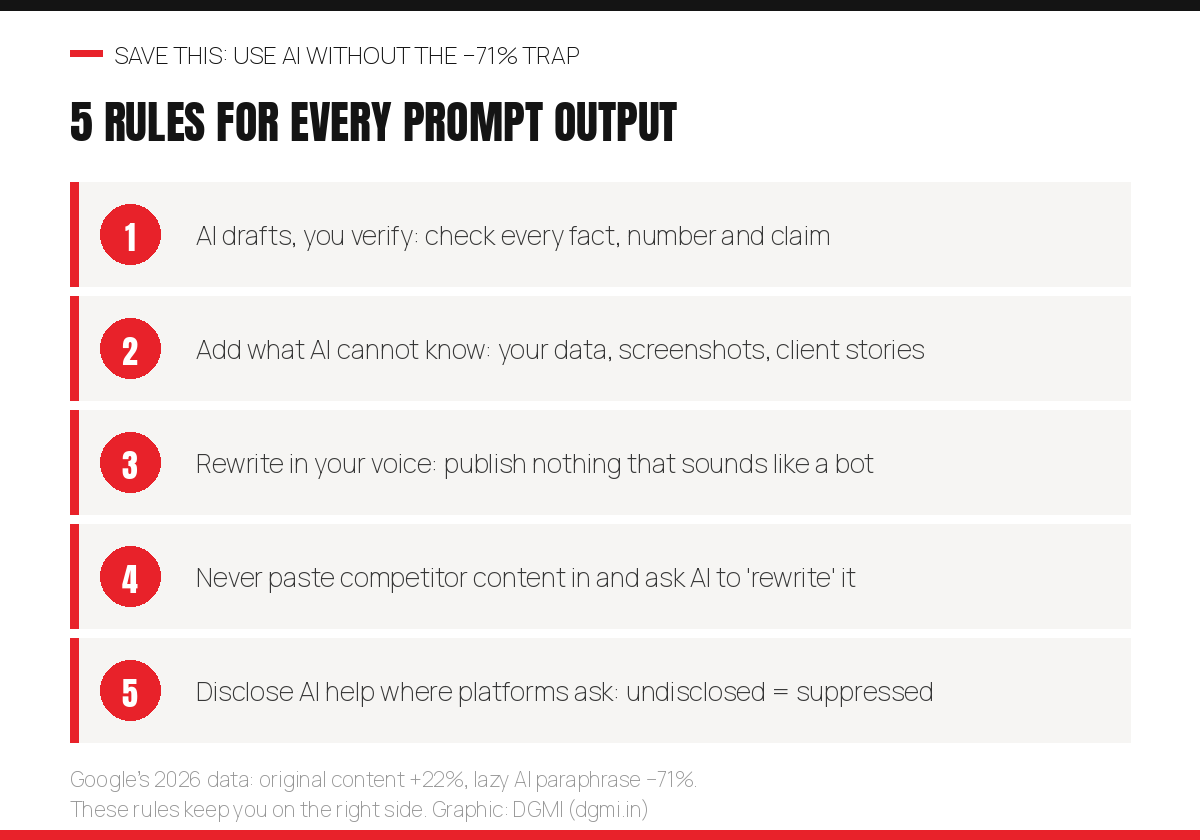
One hundred prompts can produce a lot of output fast, and that speed is exactly where careers and websites get hurt. Google’s March 2026 core update drew the line in data: original, human-verified content gained about 22% visibility while lazy AI paraphrase lost 71% of its traffic. Every platform now enforces some version of the same rule. So these five rules apply to every single output from every prompt above, no exceptions:

FAQ
Do these prompts work in Gemini, Claude and other AI tools, or only ChatGPT?
All of them. The 5-part formula (role, context, task, format, constraint) is model-agnostic: it works in ChatGPT, Gemini, Claude, Copilot and whatever launches next, because it is simply a complete brief. Outputs will differ slightly in style between tools, so pick one primary assistant, learn its personality, and keep a second for comparison on important work. Our AI tools guide covers which tool fits which job.
Will Google penalize content I create with these prompts?
Not for using AI; only for publishing unoriginal, unverified output. Google’s own guidance says production method does not matter, and its 2026 updates proved it can measure originality: +22% for first-hand content, minus 71% for AI paraphrase. Follow the 5 rules section (verify, add your experience, rewrite in your voice) and these prompts make you faster on the rewarded side of that line. The full explanation is in our E-E-A-T guide.
How do I customize these prompts for my business?
Replace every [BRACKET] with your specifics, and the more real detail the better: actual numbers, actual city, pasted data instead of descriptions. Then iterate on the first output (“more specific to X”, “half the length”, “give me a bolder option 3”) instead of accepting or abandoning it. For repeated use, save your customized versions of your top 10 prompts in a note; that personal library becomes a genuine productivity asset within a week.
Which prompts should a complete beginner start with?
Start with the audience research set (1 to 10), because every other category depends on knowing who you are talking to, then the category matching your chosen lane (our specialization guide helps you pick one). A perfect first week: prompts 1, 4 and 8 to build an audience profile, then prompts 51 and 53 to create your first properly-briefed content. That sequence alone puts you ahead of most working marketers.
Can prompts replace learning digital marketing?
No, and the reason is visible inside the prompts themselves: the best ones work because they contain marketing judgment (intent clustering, break-even math, message match, send-worthiness). AI executes the thinking you bring to it; skill is what tells you which output is good and what to do with it. That is why AI-fluent marketers earn a 25 to 40% premium while prompt-only operators compete with everyone who can copy-paste. Prompts are the accelerator; fundamentals are the engine. We teach both together at DGMI.
🚀 Become the Marketer Who Directs the AI
DGMI’s 3-month Digital Marketing + AI Course (₹29,999) teaches the complete 2026 stack: fundamentals, SEO and GEO, ads, content, analytics, plus AI workflows, prompting and agents, all live and 1:1 on real projects with worldwide-recognized certification. Start with a free practical crash course class.
Questions? Contact us · hello@dgmi.in · +91 96940 03464

Sources for quoted data and further reading: HubSpot 2026 State of Marketing (AI adoption) · SE Ranking: March 2026 core update analysis · OpenAI prompt engineering guide · Google: creating helpful, people-first content
Go deeper: the AI tools stack · the free AI agents build (prompts that run themselves) · the audience research guide · the SEO checklist · the GEO playbook · the Google Ads guide · the platform algorithms guide · the AI and jobs guide · the freelance clients guide · discuss in the DGMI Community.
[…] · the keyword research guide · the audience research guide · the SEO vs GEO vs AIO guide · the 100 AI prompts library (analytics section) · the specialisation guide · the start an SEO business checklist · discuss […]
[…] by neighbours, not marketing departments. If writing is the bottleneck, prompts 81 to 90 in our 100 prompts library are built for exactly this, including a full GBP posts calendar prompt, and our audience research […]
[…] the salary guide · the interview questions guide · the SEO checklist · the AI tools guide · the 100 AI prompts library · the freelance clients guide · the SEO vs GEO vs AIO guide · discuss in the DGMI […]