
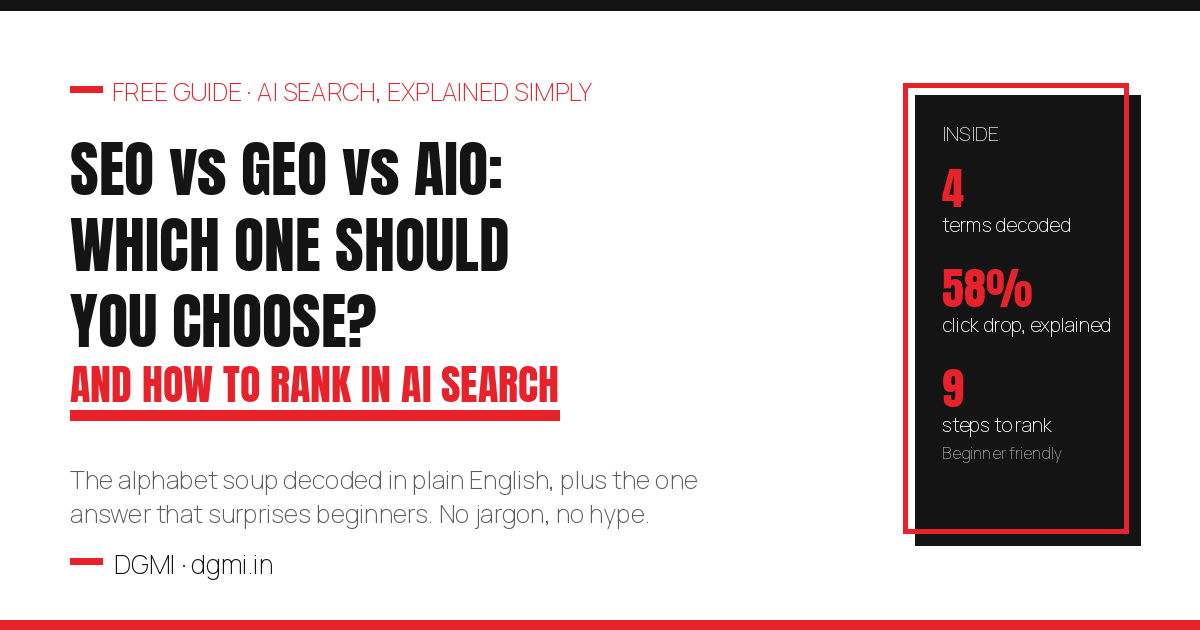
A student messaged me last month, genuinely stressed: “Sir, I just started learning SEO and now everyone is saying SEO is dead and I should learn GEO. Or is it AIO? Or AEO? Have I already wasted three months?” I want to answer that as simply as I can, because the confusion is being manufactured by people selling courses on new acronyms. Here is the short version, and then I will explain every piece slowly: you are not choosing between them. They are layers of the same job, and the foundation is still SEO. Google itself confirmed as much in its 2026 guidance. Let me show you exactly what each term means, what actually changed in search, and the step-by-step way to get your website mentioned by AI tools like ChatGPT and Google’s AI answers.
You choose all of them, in order, starting with SEO. Here is why: SEO means getting found in normal search results. AEO means being picked as the direct answer. AIO means appearing inside Google’s AI Overview box. GEO means being cited by AI tools like ChatGPT, Gemini and Perplexity. These are not four competing careers, they are four views of one job, and they share the same foundation: useful, well-structured, trustworthy content on a site search engines can read. Roughly 92% of AI citations come from pages already ranking in the top ten, so if your SEO is weak, none of the newer letters can save you. Learn SEO first, then add the AI-search layer on top. Nothing you learned is wasted.
• Ahrefs found AI Overviews cut clicks to top-ranking pages by up to 58%, up from about 34.5% the previous year
• More than 60% of searches now end without anyone clicking through to a website
• ChatGPT handles around 2.5 billion prompts a day, and roughly 65% of them behave like searches
• Gartner predicted traditional search volume would fall 25% by 2026, and that has broadly played out
• But: around 92% of AI citations come from pages already ranking in Google’s top 10. Old skills, new scoreboard.
1. The Alphabet Soup, Decoded in Plain English
Let us clear the confusion first, because most of it comes from four short words that sound scarier than they are.
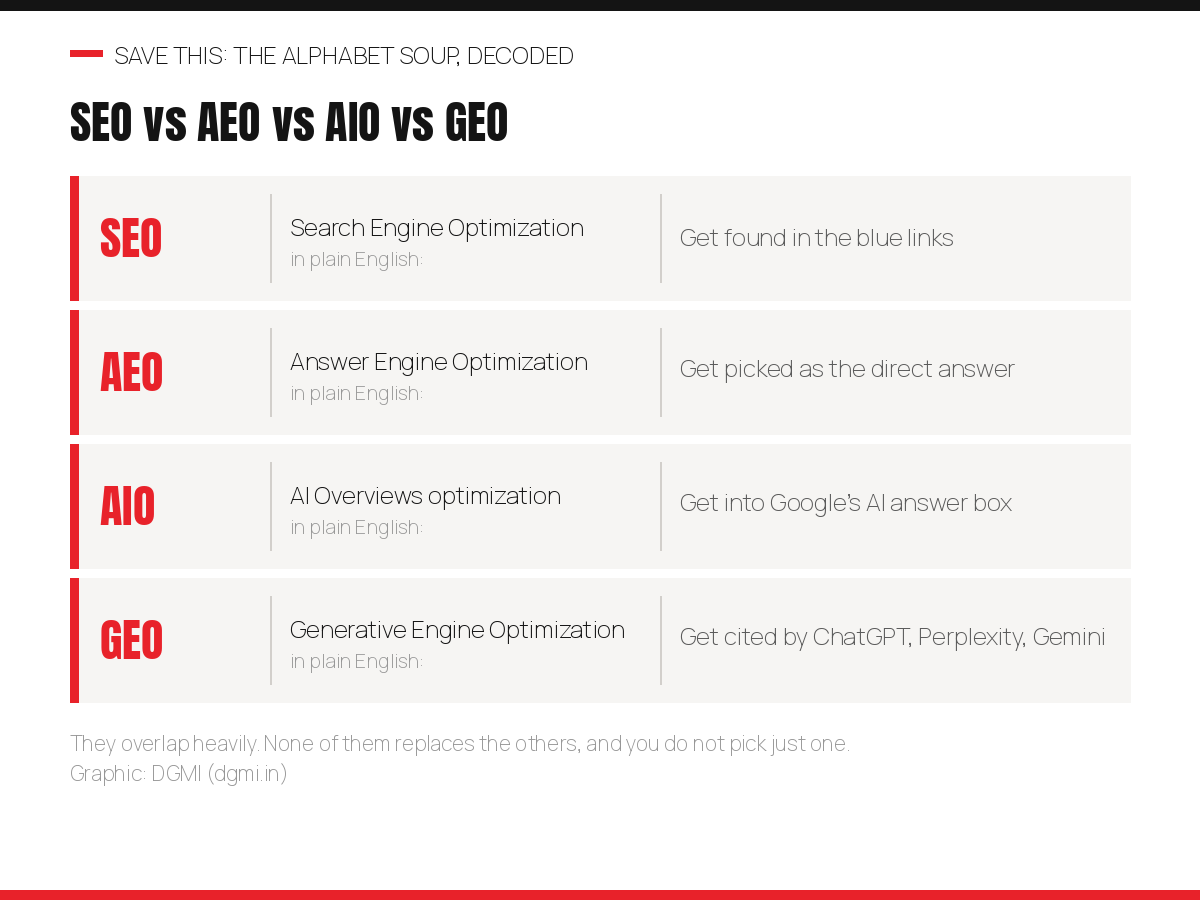
SEO (Search Engine Optimization) is the original one, and it simply means: making your website easy for Google to find, understand and trust, so it shows up when someone searches. This is the foundation everything else sits on. Our beginner SEO checklist covers it step by step.
AEO (Answer Engine Optimization) means writing your content so a machine can pull one clean answer out of it. Think of the box at the top of Google that answers your question directly. AEO is mostly about formatting: answer first, explain second.
AIO is where people get most confused, because it is used loosely. Usually it means optimizing for Google’s AI Overviews, that AI-written summary sitting above the normal results. Some people also use “AIO” to mean AI optimization generally. When someone says AIO, it is fair to ask which one they mean.
GEO (Generative Engine Optimization) is the newest and broadest: getting your brand or website mentioned and cited inside answers from AI tools like ChatGPT, Perplexity, Gemini and Claude. We have a full GEO playbook if you want to go deeper afterwards.
Here is the honest bit that a lot of “GEO courses” will not tell you: these four overlap enormously. Practitioners often use AEO and GEO to describe almost the same work. Clean structure, clear answers and genuine authority help all four at once. So the question is not “which do I pick,” it is “in what order do I build.”
2. What Actually Changed in Search (Simple Version)
Picture how search used to work. You typed a question, Google gave you ten blue links, you clicked one, and that website got a visitor. Simple, and it stayed that way for twenty years.
Now picture today. You type the same question and an AI-written answer appears at the top, often complete enough that you never click anything. Or you skip Google entirely and just ask ChatGPT, which replies in a paragraph and maybe names a few sources.
That is the whole change, and the numbers show its size. Ahrefs measured that when an AI Overview appears, clicks to the top-ranking page can drop by up to 58%. More than 60% of searches now end with no click at all. ChatGPT alone processes billions of prompts a day, most behaving like searches.
So here is what that means for you in one sentence: appearing in search results is no longer enough, because being seen and being clicked have separated. The new goal is to be the source the answer is built from, whether that answer appears in Google’s box or in a chatbot reply. If your traffic has dropped while your rankings held steady, this is almost certainly why, and our algorithm updates guide covers the related platform changes.
3. So Which One Should You Choose?
You build them in layers, and the order matters. Think of it like a house.
- Layer 1 · SEO is the foundation. Your site must be crawlable, fast, well-organised and genuinely useful. Without this, nothing above it works, because AI systems overwhelmingly cite pages that already rank well. Skip this and you are decorating a house with no floor.
- Layer 2 · AEO is the formatting. Answer the question directly, near the top, in language a machine can lift cleanly. This single habit improves your chances in featured snippets, AI Overviews and chatbot answers simultaneously. Best effort-to-reward ratio in this entire article.
- Layer 3 · GEO is the authority and reach. Being mentioned in places beyond your own website: reviews, directories, forums, comparison articles, credible publications. AI systems learn who is trustworthy partly from how often others talk about you. This layer is more strategy than technical work.
If you are a beginner, spend your first months on layers 1 and 2. They cover the vast majority of what wins in AI search anyway, and they are the skills that get you hired. Layer 3 is where you grow into.
And the reassurance my student needed: nothing you learned about SEO is wasted. Google’s own 2026 guidance says special files, chunking tricks and exotic schema are not required for AI search, and that standard best practice plus high-quality, experience-driven content remains the most reliable path. The people selling you a brand-new discipline are often repackaging fundamentals.
4. How AI Search Actually Picks Its Sources
You cannot optimize for something you do not understand, so here is the simple mental model. When you ask an AI tool a question, it usually does not answer purely from memory. It goes and fetches live web pages, reads them quickly, and assembles an answer from the best bits, sometimes naming its sources.
Which means the machine is asking three questions about your page, in this order:
“Can I find it?” If your page is not indexed, is slow, is buried, or does not rank for the topic, it will not be fetched. This is why SEO comes first, and why that 92%-of-citations-from-the-top-ten statistic matters so much.
“Can I understand it quickly?” The machine is scanning for a clear, extractable answer. A page that opens with three paragraphs of throat-clearing before reaching the point is harder to quote than one that answers in the first hundred words. Structure is not decoration here, it is machine-readability.
“Can I trust it?” Named sources, real numbers, a real author with real credentials, recent dates, and other websites talking about you. This is the same trust framework Google calls E-E-A-T, explained fully in our E-E-A-T guide, and it turns out AI systems care about very similar signals.
That is the whole game. Findable, understandable, trustworthy. Every tactic in the next section is just one of those three, made practical.
🎯 Confused by the Acronyms? Learn the Fundamentals Instead.
DGMI’s Digital Marketing + AI Course teaches SEO properly and then layers AI search on top, so you understand why things work instead of chasing every new three-letter trend. Live, 1:1, on real websites. See how we teach with a 100% practical crash course class, FREE this week.
5. The 9-Step Checklist to Rank in AI Search
Save this section. It is the practical answer to “how do I actually get cited by AI.”
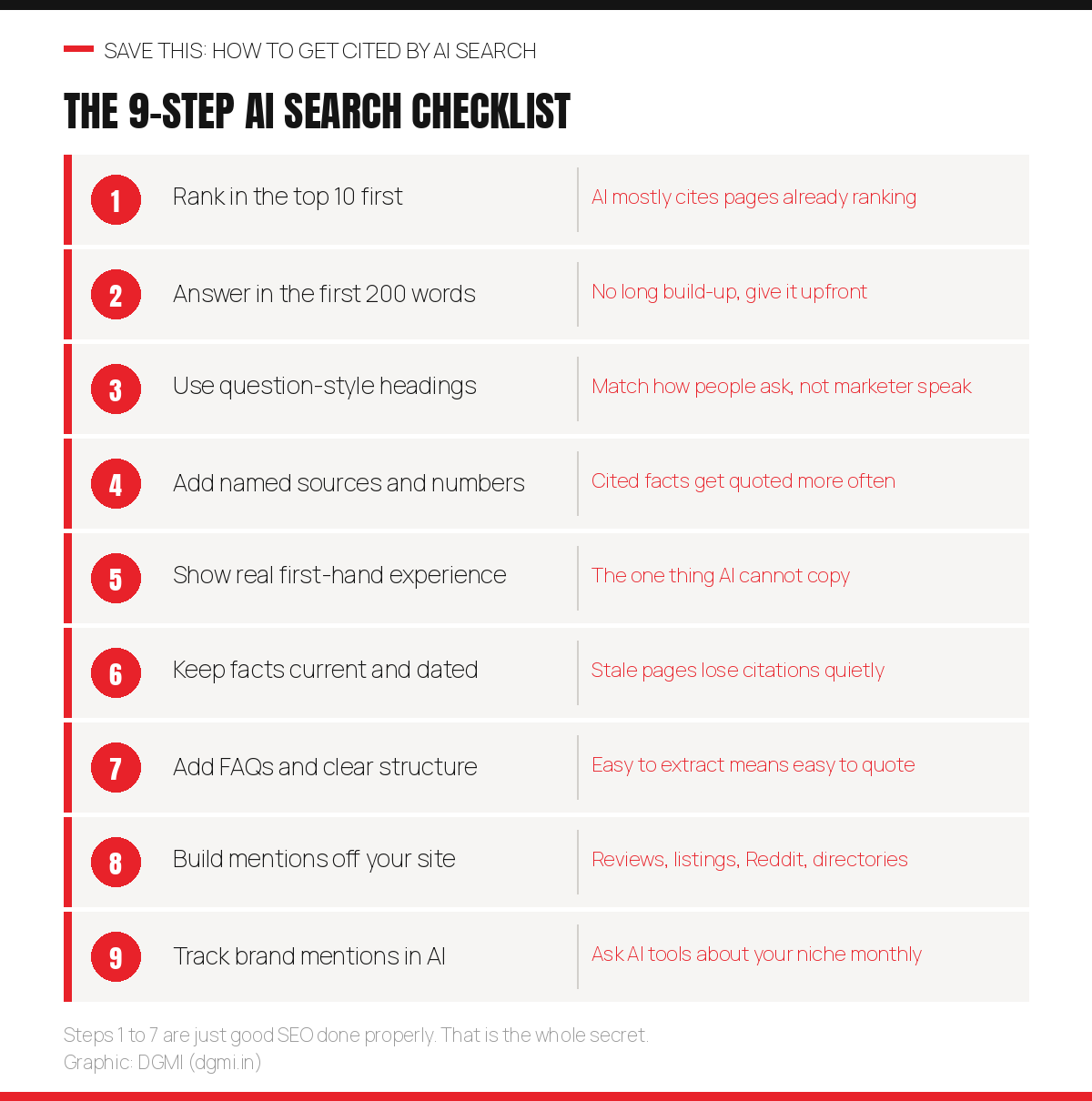
1. Rank in the top 10 first. Since roughly 92% of AI citations come from pages already ranking there, your fastest AI-search win is often just doing ordinary SEO better. Fix the basics before chasing anything exotic.
2. Answer in the first 200 words. Put the direct answer near the top, before the background and the storytelling. This is the single highest-value habit in this list, and you will notice this article does it in the grey box at the very top.
3. Use question-style headings. Write headings the way people actually ask things (“How much does an SEO audit cost?”) rather than in marketing language (“Our pricing philosophy”). Machines match questions to headings.
4. Add named sources and real numbers. “Ahrefs found clicks drop up to 58%” is quotable. “Studies show clicks are dropping” is not. Specific, attributed facts get lifted into answers far more often.
5. Show real first-hand experience. Your own results, screenshots, client stories, mistakes you made. This is the one thing no AI can generate about your business, and Google’s March 2026 core update rewarded original content with roughly 22% more visibility while AI-paraphrased content lost about 71% of its traffic.
6. Keep facts current and dated. AI systems favour fresh information for anything that changes. Revisit important pages every few months, update the numbers, and say when you updated them.
7. Add FAQs and clear structure. Short paragraphs, descriptive subheadings, bullet lists where they genuinely help, and a proper FAQ section. Easy to extract means easy to quote.
8. Build mentions off your own site. Get listed in credible directories, collect genuine reviews, answer questions in communities where your audience actually hangs out, and earn mentions in articles. For local businesses, your Google Business Profile matters enormously here, since it feeds Google’s local AI answers directly.
9. Track your brand mentions in AI tools. Once a month, ask ChatGPT, Gemini and Perplexity the questions your customers would ask (“best dental clinic in Jaipur”, “affordable SEO agency in India”) and note whether you appear. That is your new rank tracker, and it takes twenty minutes.
6. A Real Example: The Same Page, Rewritten
Theory is easy to nod along to, so let me show you the actual difference with a small business example. Imagine a Jaipur interior designer with a page about pricing.
The version that AI ignores: the page opens with “Welcome to our studio. With years of passion for design, we believe every home tells a story…” and mentions actual prices somewhere in paragraph six, vaguely, as “packages to suit every budget.” Nothing here is extractable. A machine reading it finds no answer to “how much does interior design cost in Jaipur,” so it quotes a competitor instead.
The version that gets cited: the page opens with a heading that matches the real question, “How much does interior design cost in Jaipur?”, followed immediately by a direct answer: a genuine range, what changes the price, and what a typical 2BHK project includes. Then it adds a small table of project types and price bands, a short section on how the quote is calculated, three real project examples with photos and final costs, and an FAQ answering the follow-up questions people always ask.
Same business, same honesty, wildly different outcome. The second version can be lifted into an AI answer as a complete response, so it gets named. The first cannot, so it does not. Notice that nothing in the rewrite required a new technology or a secret trick, only the discipline of answering the question you claim to answer. If you want to find the exact questions your customers ask, that process is in our audience research guide, and you can speed up the drafting using the SEO and GEO sections of our 100 prompts library.
7. Five Myths That Waste Beginners’ Time
- ✗ 1. “SEO is dead, learn GEO instead.” Wrong, and expensively so. AI cites pages that already rank. GEO without SEO is a roof without walls.
- ✗ 2. “You need an llms.txt file to rank in AI.” Google has confirmed it ignores llms.txt for Search, and its 2026 guidance says no special files or chunking tricks are required. Optional at best; we covered this in our llms.txt clarification.
- ✗ 3. “Just add more schema markup.” Schema helps machines understand structure, but it cannot make a shallow page trustworthy. Content quality outranks markup, every time.
- ✗ 4. “Publish 100 AI-written pages to feed the AI.” The exact opposite: unoriginal AI content lost around 71% of its traffic after the March 2026 core update. Volume without originality is now actively dangerous.
- ✗ 5. “There is a secret GEO trick the pros are hiding.” There is not. The advantage is boring consistency: clear answers, real experience, current facts, genuine mentions. Boring compounds.
8. How to Measure If It Is Working
This trips people up, because the old scoreboard no longer tells the whole story. Track these four things instead, all free:
Impressions versus clicks in Search Console. If impressions hold steady or rise while clicks fall, that is the zero-click effect, not a penalty. Knowing the difference stops you from panicking and breaking a healthy site.
Manual AI visibility checks. Once a month, ask the main AI tools ten questions your customers would ask, and record whether you are mentioned. Keep it in a simple sheet. Crude, free, and genuinely useful.
Referral traffic from AI tools. In GA4, check whether visits are arriving from sources like ChatGPT or Perplexity. The numbers are usually small but they are real people arriving with high intent, because they already got a recommendation.
Actual business outcomes. Enquiries, calls, form fills, bookings. This has always been the only number that pays your bills, and in a zero-click world it matters more than ever. If enquiries are steady while sessions fall, you are doing fine.

9. FAQ
Is SEO dead in 2026?
No. What is dying is lazy SEO: thin pages, keyword stuffing and content that exists only to rank. Real SEO matters more than ever because AI systems overwhelmingly cite pages that already rank well, roughly 92% of citations coming from the top ten results. What changed is the scoreboard: you now measure being cited and being contacted, not just clicks. Anyone telling you to abandon SEO for a newer acronym is selling something.
What is the difference between GEO and AEO?
In practice they describe nearly the same work, which is why even professionals use them interchangeably. The usual distinction: AEO focuses on winning direct answer slots like featured snippets and AI answer boxes, while GEO focuses on being cited inside longer AI-generated responses from tools like ChatGPT. Both rely on the same foundations, so as a beginner you do not need to agonise over the boundary. Do the work; the labels will keep shifting.
Should a complete beginner learn SEO or GEO first?
SEO, without hesitation. It is the foundation the others sit on, it is what employers and clients actually hire for today, and about 70% of what wins in AI search is simply good SEO applied properly. Once you can rank a page and understand why it ranked, adding the AI-search layer takes weeks, not months. Start with our free SEO checklist, then move to the GEO playbook.
How long does it take to appear in AI search results?
There is no fixed timeline, but the pattern is usually: fix and publish, wait for Google to re-crawl and re-rank the page, then AI systems begin picking it up once it ranks. In practice that often means several weeks to a few months, similar to SEO itself, and faster for pages that already rank and only need restructuring. Restructuring an existing top-ten page for answer-first format is the quickest win available to most sites.
Do I need paid GEO tools to do this?
No. Everything in the 9-step checklist can be done with free tools: Search Console, GA4, your own eyes, and the AI chatbots themselves for monthly visibility checks. Paid AI-visibility trackers exist and can save time once you manage many clients, but they are conveniences, not requirements. Beginners should spend their money on learning rather than on dashboards that report work they have not done yet.
Is GEO a good career skill to learn in India?
Yes, as a specialisation stacked on top of SEO rather than instead of it. SEO specialists who understand AI search are among the best-paid marketing specialists right now, with senior SEO plus GEO roles reaching roughly ₹14 to 18 lakh a year against ₹8 to 10 lakh for generalists, and the skill is scarce because it is new. The practical route is: learn SEO fundamentals, get real results on a site, then add the AI-search layer and talk about it confidently in interviews. Our specialisation guide compares the lanes with salary data.
🚀 Learn Search the Way It Actually Works in 2026
DGMI’s 3-month Digital Marketing + AI Course (₹29,999) teaches SEO from the ground up, then GEO and AI search on top, along with ads, content, analytics and AI workflows, all live and 1:1 on real projects with worldwide-recognized certification. Start with a free practical crash course class.
Questions? Contact us · hello@dgmi.in · +91 96940 03464

Sources for quoted data: Ahrefs research on AI Overviews and click-through rates · Google: creating helpful, people-first content · Google Search Central: AI features guidance · SE Ranking: March 2026 core update analysis · Gartner search volume predictions · SparkToro zero-click search research
Keep learning: the beginner SEO checklist · the GEO playbook · the E-E-A-T guide · the llms.txt clarification · the audience research guide · the 100 AI prompts library · the specialisation guide · the start an SEO business checklist · discuss in the DGMI Community.