
Update desk, July 11, 2026: a rare thing happened this month: Google settled an SEO debate in writing. After a year of hype calling llms.txt the “must-have file for AI search,” Google’s official documentation now says the file does nothing for Google rankings, in either direction. We recommended publishing an llms.txt in our own GEO playbook, so consider this the honest follow-up: what Google actually said, why so many people (including tool makers) got it wrong, what the data shows, and what the file is still genuinely useful for.
• June 15, 2026: Google added “Clarifying guidance on llms.txt files” to its official AI optimization guide
• The ruling: llms.txt files are not needed for Google Search and neither help nor hurt visibility, because Search ignores them
• The confusion: Chrome’s Lighthouse tool started checking for llms.txt in May, making it look like a Google requirement
• The data: across 137,000 domains, 97% of published llms.txt files received zero requests in May 2026 (Ahrefs)
• Still standing: Perplexity, Claude and AI coding agents can read the file; it costs nothing to keep
1. What Google Actually Said (and When)
First, quick context for beginners. An llms.txt file is a plain-text summary of your website (who you are, your key pages) placed at yoursite.com/llms.txt, proposed in September 2024 as a way to help AI systems understand sites. Over the past year it was heavily promoted as an easy “AI SEO” win, and plugins like Yoast and Rank Math added one-click generators for it.
Google has now drawn the line in three steps. On May 15, 2026, Google published its first official AI optimization guide, “Optimizing your website for generative AI features on Google Search.” On June 15, it added a dedicated subsection titled “Clarifying guidance on llms.txt files,” stating in Google’s own words that the change was made to address questions from the community. And on June 29, the wording was tightened once more. The final position is unambiguous: you do not need machine-readable AI files, Markdown versions, or llms.txt to appear anywhere in Google Search, including AI Overviews and AI Mode. Keeping such a file is fine; Google Search simply ignores it, so it neither helps nor harms your visibility.
Google’s people had been saying this informally for a year. Gary Illyes said at Search Central Live in July 2025 that Google does not support llms.txt and is not planning to. John Mueller compared it to the long-dead meta keywords tag, and when asked directly whether Google endorses the file, answered plainly: no. What changed in June is that the position moved from podcast remarks into official documentation, where agencies and tool vendors can no longer talk around it.
2. How Everyone Got Confused: The Lighthouse Mix-Up
Here is the part most coverage missed, and it explains why the hype felt so credible. On May 7, 2026, Chrome’s Lighthouse tool (version 13.3.0) promoted a new “Agentic Browsing” audit category into its default reports, and that audit checks whether your site has an llms.txt file. Suddenly, anyone running a routine PageSpeed or Lighthouse report saw Google-branded tooling flagging llms.txt. A week later, Google’s Search documentation said the file does nothing for rankings. Both were true at once, and the internet understandably short-circuited.
The resolution is simple once you see it: Lighthouse’s agentic audit is not about rankings. It measures how ready a page is for AI agents that browse and operate websites on a user’s behalf, a different concern from where you rank in Search. In the same podcast conversations, Mueller noted that standards for how agents navigate sites have not settled yet, mentioning newer proposals like WebMCP (a Chrome project that lets agents interact with a site’s functions directly), and estimated it could take six months to a year or longer for the ecosystem to pick a winner. Translation for beginners: the agent-readiness race is real, but it has not chosen its file format yet, and llms.txt is one contender among several, not a requirement.
3. What the Data Shows: The File Almost Nobody Reads
Independent measurements back Google’s position with almost comic force:
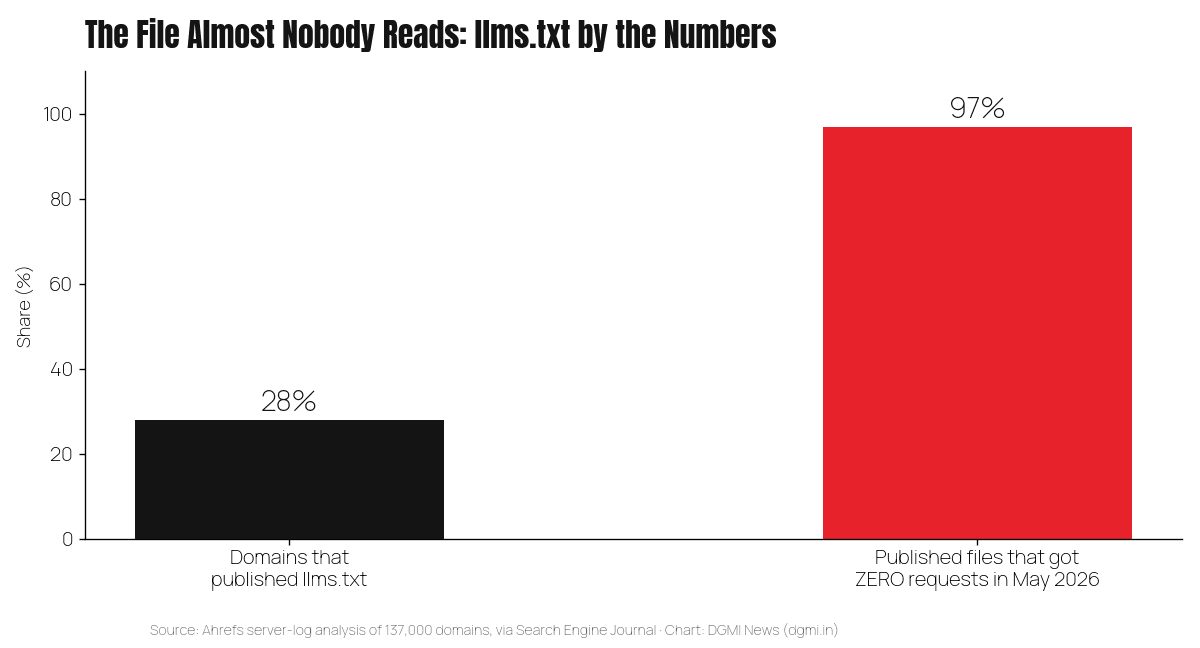
Ahrefs analyzed server logs from 137,000 domains and found that while 28% had published an llms.txt file, 97% of those files received zero requests in May 2026. Of the requests that did occur, most came from audit tools and ordinary crawlers, not AI systems. A separate SE Ranking study of 300,000 domains found no correlation between having an llms.txt file and how often a site gets cited in AI answers. Websites spent a year installing a doorbell that, in the overwhelming majority of cases, nothing has ever pressed.
4. So Is llms.txt Dead? What It Is Still For
Not quite dead: just demoted from “strategy” to “checkbox.” Here is the honest scorecard:
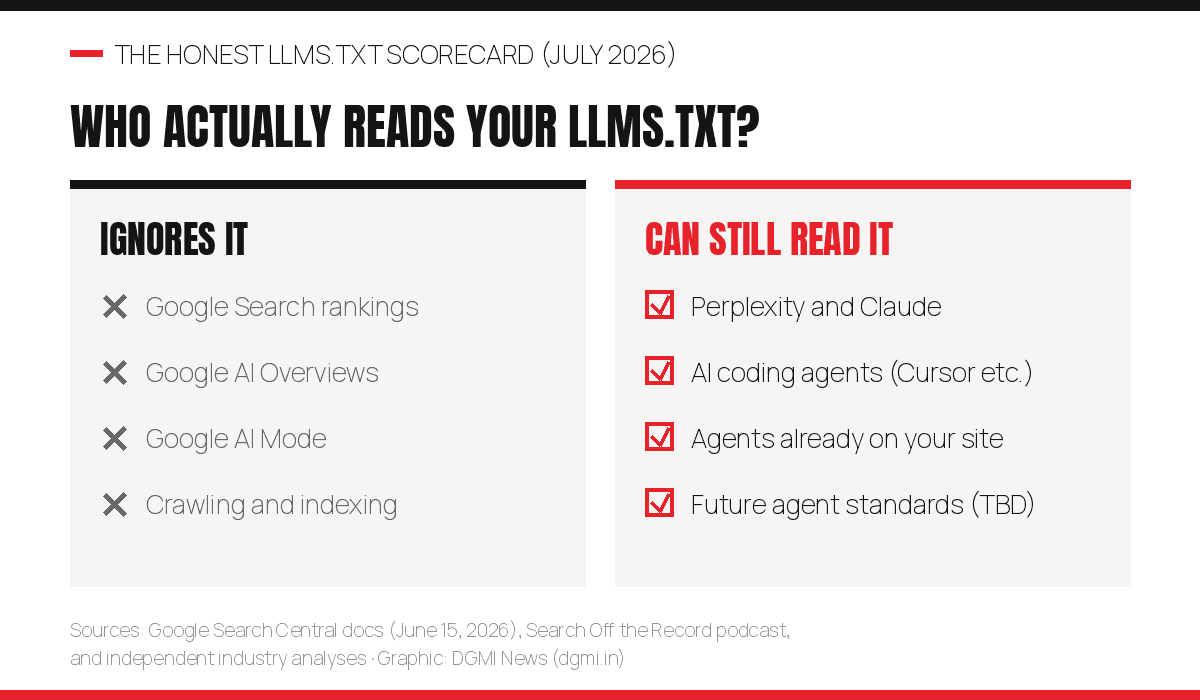
Systems outside Google can and sometimes do fetch the file: Perplexity and Anthropic’s Claude retrieve llms.txt, and AI coding assistants like Cursor and GitHub Copilot make real use of it when reading developer documentation, which is why companies like Stripe, Cloudflare and Anthropic publish one. Mueller himself carved out the legitimate case: once an AI agent is already on your website, a clean site summary can help it navigate, like a store directory for a visitor who has already walked in. What the file cannot do, by design, is convince any AI to choose your site over a competitor’s, because every site’s self-description says the same flattering things.
5. What We Are Changing on This Site, and What You Should Do
Transparency first: our own GEO playbook recommends publishing an llms.txt (step 8), and this site has one live. That advice now gets an editor’s note reflecting Google’s clarification: the file is a two-minute, zero-cost courtesy for non-Google AI systems and future agents, not a Google ranking tactic, and we have updated the guide’s wording to say exactly that. We are keeping ours. We are just done pretending it is a lever.
Your action list, honestly sized:
- ✓ Already have an llms.txt? Leave it. It costs nothing, harms nothing, and a few non-Google systems may read it.
- ✓ Don’t have one? It is optional. If your SEO plugin makes it in one click, fine; if a vendor is charging you for it as an “AI SEO service,” that is your cue to ask harder questions.
- ✓ Remove it from every Google checklist. Nothing about your Google Search, AI Overviews or AI Mode visibility depends on it. Google said so in writing.
- ✓ Redirect the saved time to what is proven: question-format headings, direct answers, sourced statistics, real authorship and schema. Google’s own AI guide points to exactly these fundamentals, and they are measurable in the new Search Console AI report as it rolls out worldwide.
- ✓ Watch the agent story, calmly. The real emerging standard to know by name is WebMCP; when it exits trials, we will cover what site owners should do about it.
📰 Get every update the day it drops
DGMI News covers every Google algorithm update and major marketing development: reported fast, explained simply, hype checked against data.
Subscribe free → earn 25 Community XP as a welcome reward 🎁
Email only. No spam, unsubscribe anytime.
6. Quick FAQ
Should I delete my llms.txt file now?
No need. Google’s guidance explicitly says maintaining one is fine and has zero effect on Search either way. Deleting it only removes the small chance that a non-Google system (Perplexity, Claude, a coding agent, a future standard) makes use of it. The correct move is not deletion; it is correcting your expectations of what the file does.
But Lighthouse and PageSpeed flag llms.txt. Doesn’t that make it a Google requirement?
No, and this is the single biggest source of confusion. Lighthouse’s “Agentic Browsing” audit measures readiness for AI agents that operate websites, a separate topic from search rankings. Google’s Search documentation is the authority on rankings, and it says Search ignores the file. A checkbox in a developer tool is not a ranking factor.
Does this mean GEO (optimizing for AI answers) is hype too?
The opposite: it sharpens what real GEO is. Google’s own AI optimization guide, the research literature and the citation data all point to the same working levers: content structured in clear, quotable passages, genuine statistics with named sources, demonstrated expertise and sensible schema. Those are measurable and confirmed. llms.txt was the one item in the toolkit that never had evidence behind it for Google, and now the record is officially straight.
How do I check what is actually reading files on my site?
Your server logs (or your host’s analytics, or a tool like Cloudflare) show every request to /llms.txt, including which bot asked for it. That is exactly how Ahrefs produced the 97% zero-requests finding. Ten minutes in your logs tells you more truth about “AI SEO” tactics than most vendor blog posts will.

Sources: Google Search Central: Optimizing for generative AI features · Search Engine Roundtable: Google’s llms.txt clarification · Search Engine Journal: Mueller on llms.txt (incl. Ahrefs data) · Digital Applied: the Lighthouse Agentic Browsing audit · eCorpIT: who still reads llms.txt
← All news & updates · Related: AI Mode hits 1 billion users · The proven levers for AI visibility: the GEO playbook and the E-E-A-T guide.