
In 12 years of hiring, training and placing digital marketers, I have sat on both sides of the salary conversation hundreds of times. I have watched a fresher with a strong portfolio out-negotiate a candidate with double the “experience,” and I have watched talented people undersell themselves by lakhs simply because they never saw the real numbers. This guide fixes that. Every figure below is sourced from large public datasets (AmbitionBox, Glassdoor and industry reconciliations, mostly updated May 2026), cross-checked, and explained in plain language: what people actually earn, why the same job title pays ₹6L to one person and ₹18L to another, and exactly how to position yourself for the top of every band.
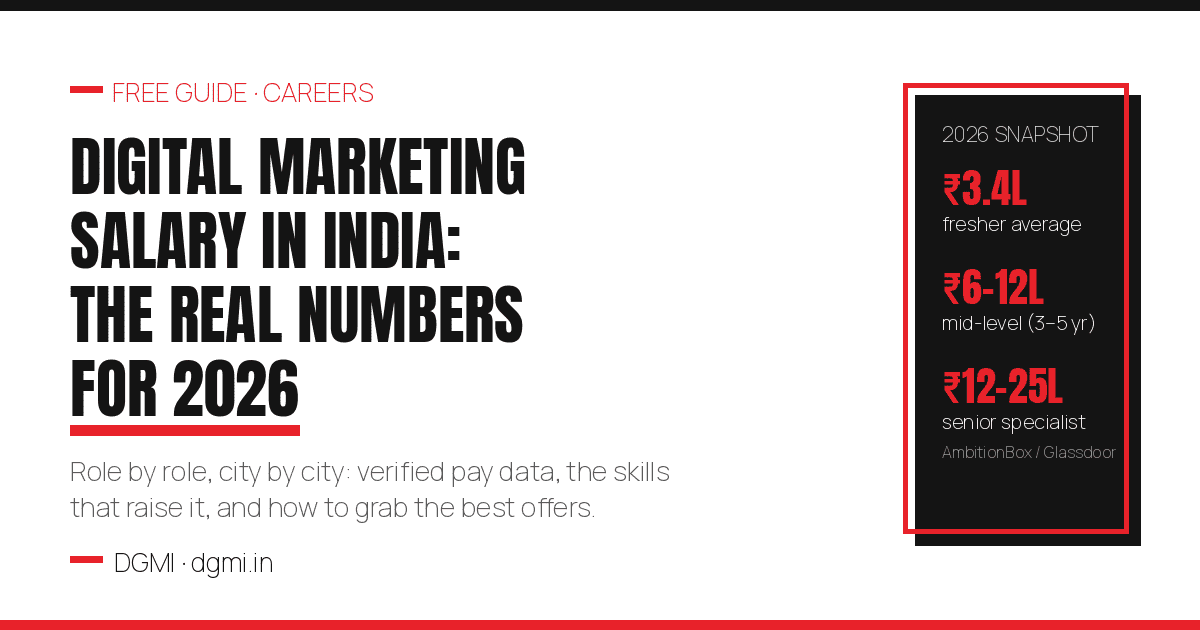
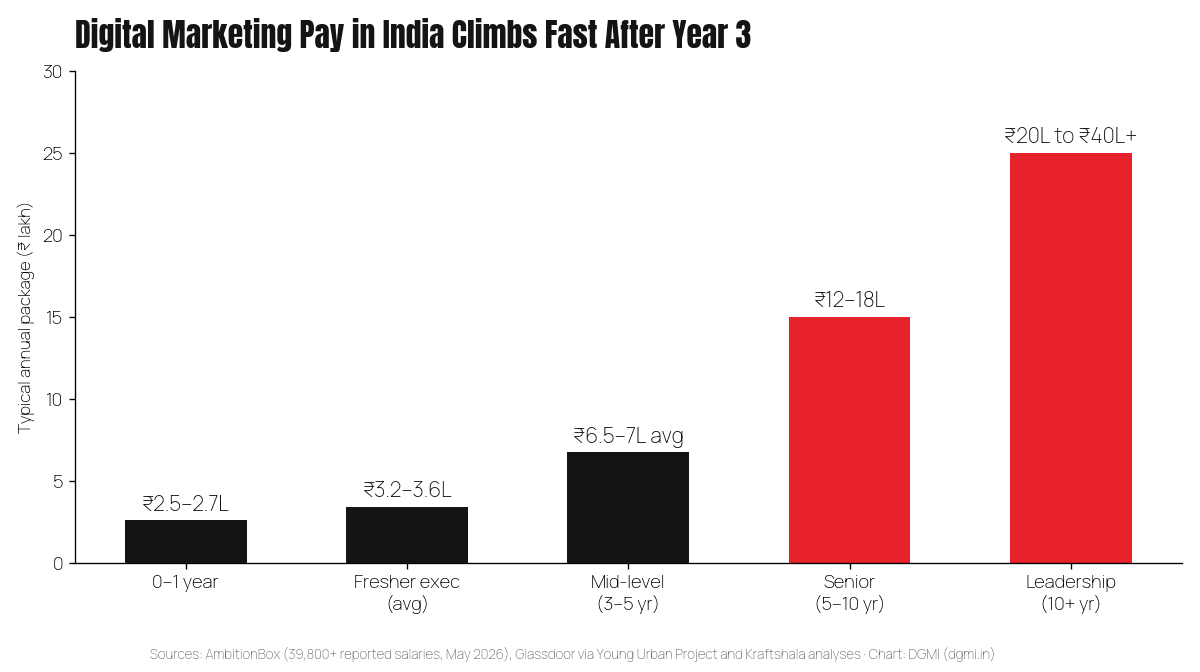
Freshers typically start at ₹3.2 to ₹3.6 lakh per year (about ₹27,000 to ₹30,000 per month), based on 39,800+ reported salaries on AmbitionBox as of May 2026. Mid-level professionals with 3 to 5 years of experience average ₹6.5 to ₹7 LPA, senior specialists earn ₹12 to ₹18 LPA, and leadership roles run ₹20 to ₹40 LPA and beyond. Specialization, city, and provable results decide where you land within each band.
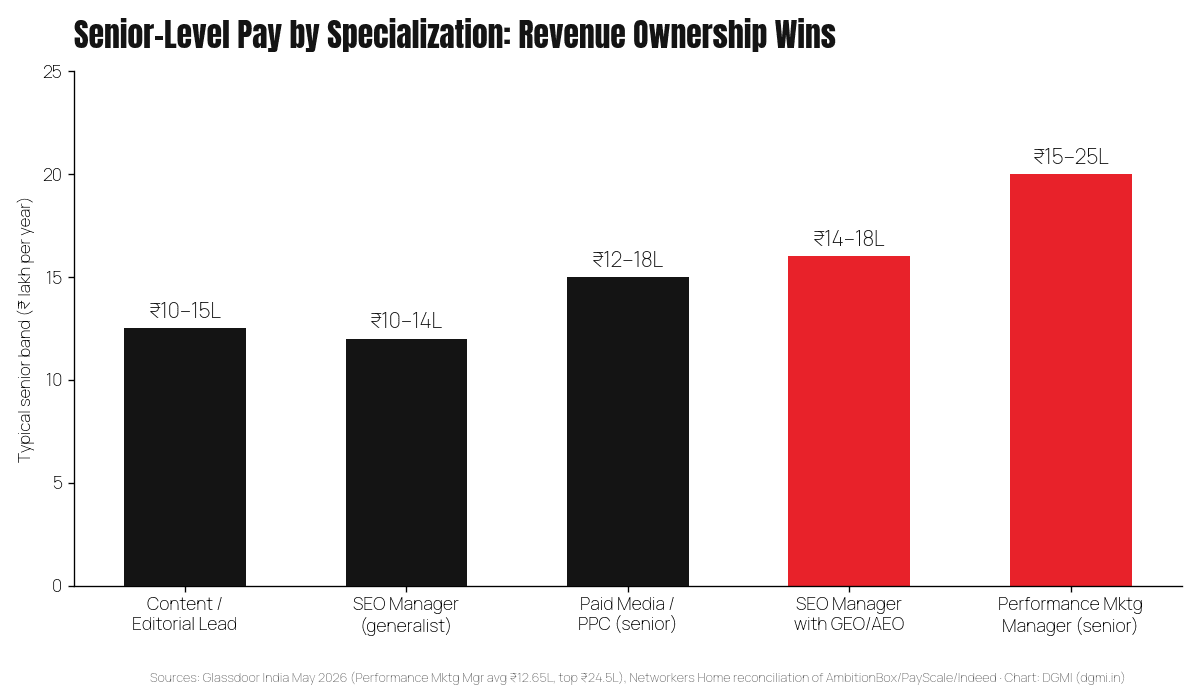
• Highest-paying specialization: Performance Marketing, averaging ₹12.65 LPA at manager level with top earners at ₹24.5 LPA (Glassdoor India, May 2026)
• AI-skilled marketers earn a 25 to 40% premium over peers without AI fluency
• SEO managers with GEO/AEO (AI-search) skills earn ₹14–18 LPA vs ₹8–10 LPA for generalists (Networkers Home, May 2026)
• The demand engine: India’s digital ad market crossed ₹49,000 crore in FY25, growing ~20% a year, with 8,00,000+ openings annually (E&ICT Academy, IIT Kanpur)
1. Salary by Experience Level (The Master Table)
Experience is the biggest single factor, but notice the shape of the curve: pay grows slowly for the first two years, then accelerates sharply once you can own outcomes independently. The 3-to-5-year mark is the single largest jump in the entire career.
| Stage | Typical annual package | Per month (approx.) | What the role looks like |
|---|---|---|---|
| 0–1 year | ₹2.5–2.7 LPA | ₹21,000–22,500 | Executing tasks under supervision: posting, basic reports, research |
| Fresher executive (avg) | ₹3.2–3.6 LPA | ₹27,000–30,000 | SEO/Social/Content Executive; skilled freshers at funded startups reach ₹5–6L |
| Mid-level (3–5 yr) | ₹6.5–7 LPA avg (₹6–12 band) | ₹55,000–1,00,000 | Independent channel ownership; specialists reach the top of the band |
| Senior (5–10 yr) | ₹12–18 LPA | ₹1–1.5 lakh | Strategy, budgets, team leadership, revenue accountability |
| Leadership (10+ yr) | ₹20–40 LPA+ (VP/Head roles beyond) | ₹1.7–3.3 lakh+ | Owning the function; top digital heads at unicorns cross ₹40L, a few reach ₹1 crore |
One honesty note before you benchmark yourself: these are market-wide medians and bands, blending agencies, startups, MNCs and small businesses across all of India. Individual offers routinely sit above or below them, and the rest of this guide is about the factors that decide which side of the average you land on.
2. Salary by Role and Specialization
Here is the uncomfortable truth the averages hide: the gap between generalists and specialists is widening every year. Two people with the same years of experience can differ by ₹10 lakh based purely on what they specialized in and whether their work connects visibly to revenue.
| Role | Entry | Mid | Senior |
|---|---|---|---|
| SEO Specialist | ₹1.8–3.5L | ₹5–8L (technical SEO higher) | ₹8–14L; ₹14–18L with GEO/AEO skills |
| PPC / Paid Media | ₹3–4L | ₹6–10L | ₹12–18L (₹1 crore+ monthly budgets) |
| Performance Marketing | ₹6–9L | ₹10–15L | ₹15–25L (avg ₹12.65L, top ₹24.5L, Glassdoor) |
| Social Media | ₹2.5–4L | ₹5–8L | ₹9–14L; higher when owning paid social budgets |
| Content Marketing | ₹3.5–5L | ₹6–9L | ₹10–15L with editorial/SEO leadership |
| Digital Marketing Manager | n/a | ₹8–9L avg | ₹5–18L full range; revenue owners at the top |
| GEO / AEO (AI-search) Specialist | emerging | premium over SEO peers | ₹15–25L; global remote roles $100k+ for India-based seniors |
| Marketing Automation / Analytics | ₹4–6L | ₹8–12L | ₹12–20L; scarce supply keeps this high |
Three patterns explain the whole table. First, revenue proximity pays: performance marketing tops the charts because its impact on sales is measured daily in ROAS and CAC. Second, scarce skills pay: analytics, automation and the new AI-search specializations command premiums because supply is thin. Third, the newest wedge: an SEO manager with AEO/GEO fluency earns ₹14–18 LPA against ₹8–10 LPA for a generalist, and senior AI-search specialists are being hired into global remote roles paying $100,000+. If you want to understand that skill, our complete GEO playbook is the free starting point.
3. Salary by City (and the Remote-Work Effect)
Bengaluru and Gurugram lead the market. AmbitionBox’s location data (22,500+ manager salaries, May 2026) puts Performance Marketing Managers at ₹15.9–17.6 LPA in Bengaluru and ₹15.2–16.8 LPA in Gurugram, with SEO Managers in Bengaluru at ₹11.5–12.7 LPA. Mumbai pays comparably for brand and agency roles, with Delhi NCR strong in e-commerce and performance. As a rule of thumb, metros pay 20–30% above Tier-2 cities and 35–45% above Tier-3.
But the defining feature of 2026 is that geography matters less than it ever has. Remote-first hiring lets professionals in Jaipur, Indore or Kochi earn metro packages without metro rent, especially in SEO, performance and analytics roles where output is fully measurable online. Practically, that means a Tier-2 candidate’s smartest move is not relocation; it is building the portfolio and specialization that make remote employers comfortable hiring them. Every section below serves that goal.
4. The Fresher Deep-Dive: Your First Offer, Honestly
If you are starting out, here is the truthful picture. The median fresher offer is ₹3.2–3.6 LPA, and your very first role (0–1 year) may start at ₹2.5–2.7 LPA. That number stings less when you understand two things about it.
First, the spread at fresher level is enormous, and it is not random. The same market pays some freshers ₹5–6 LPA at funded startups. What separates them is rarely the degree; it is proof of work: a website they built and ranked, a small ad campaign they ran (even ₹2,000 of their own budget), a portfolio document showing numbers. Employers pay premiums for de-risked hires, and proof is de-risking. Second, the low entry point is the toll, not the destination. Look again at the experience chart: the market roughly doubles your pay between year 1 and year 4 if you specialize. Digital marketing’s real financial story is the slope, not the starting point.
Where should a fresher apply? Agencies pay moderately but compress five years of exposure into two (many clients, many channels); startups pay slightly better and hand you real ownership early; large MNCs pay best but hire fewer freshers and move slower. The classic high-ROI path, visible across thousands of career trajectories: agency for 2–3 years for breadth, then in-house at a growing brand for depth and compensation. Both paths converge around ₹12–18 LPA at the 5-year mark for strong performers. For the full role-by-role starting map, pair this section with our complete career roadmap.
🎯 Want to Be the ₹5–6 LPA Fresher, Not the ₹2.5 LPA One?
The difference is proof of work, and that is exactly what DGMI’s Digital Marketing + AI Course builds: a real website you rank, real campaigns you run, and a portfolio of 9+ projects, live and 1:1 with a mentor of 12 years. See the teaching style first with a 100% practical crash course class, FREE this week.
5. The Multipliers: Skills That Raise Pay 25 to 40%
Across every dataset we reviewed, the same skill stack keeps appearing above the salary averages:
- ✓ 1. AI fluency: the biggest premium of 2026. Professionals skilled in GA4, Looker Studio, HubSpot-style automation and AI tools for marketing command 20 to 40% higher salaries. AI is commoditizing execution work while paying premiums to people who direct it.
- ✓ 2. Performance marketing with a ROAS track record. Managing real budgets against revenue targets is the single most reliably paid skill in the field. Learn the foundation with our Google Ads keyword research guide.
- ✓ 3. Analytics depth. GA4 fluency separates strategists from executors; adding SQL for marketing analysis carries its own 20–30% premium at product companies.
- ✓ 4. GEO/AEO: the early-mover premium. AI-search optimization is 2026’s scarcest skill, already splitting SEO salaries by ₹4–8 LPA at manager level and opening global remote doors.
- ✓ 5. Specialization itself. The data is blunt: generalist executives plateau around ₹6–7 LPA while specialists keep climbing. Pick a lane by year 2.
And one myth to retire: certifications alone do not raise salaries. Certified freshers with portfolios command 20–40% premiums; the certificate validates, but the demonstrable results do the negotiating. Treat any certification as the receipt for skills, never the substitute.
6. Freelancing Income vs a Job (With Rate Card)
The honest comparison: the average freelancer earns less than the average employee, and the top freelancers out-earn almost everyone. AmbitionBox puts average freelance digital marketers at ₹4.2–5.4 LPA, with the top 10% above ₹8L and the top 1% beyond ₹13.6L. Meanwhile, experienced specialists with India-based clients report ₹1–3 lakh per month, and those serving foreign clients ₹2–10 lakh per month. Freelancing amplifies whatever you already are.
| Freelance service | Standard Indian market rate (2026) |
|---|---|
| SEO audit & setup | ₹15,000–50,000 per project |
| Social media management (small business) | ₹20,000–40,000 per month per client |
| Google Ads management | 10–15% of ad spend, or ₹15,000+ monthly retainer |
| Content writing | ₹1–3 per word, quality dependent |
| Consulting | ₹2,000–5,000 per hour |
Rate card source: Digital Vidya market-rate compilation, 2026. Three retainer clients at ₹25,000 each equals a ₹9 LPA job, without the commute; the trade is that you also become your own sales team.
7. The 10-Year Career and Salary Timeline
Years 0–1 (₹2.5–3.6L): executive role, absorb everything, build your first proof of work. Years 1–2 (₹3.5–5L): pick your specialization; start documenting wins with numbers. Years 2–4 (₹5–9L): own a channel end to end; this is where specialists and generalists split forever. Years 4–6 (₹9–15L): senior specialist or first manager title; you now negotiate on revenue impact, not tasks. Years 6–9 (₹12–20L): lead a team or function; agency-to-brand movers cash in here. Year 10+ (₹20–40L+): Head of Digital, Growth Head or VP tracks; a handful of operators reach ₹50L to ₹1 crore at unicorns and global remote roles. The slope is real, and every stage’s jump is triggered by the same thing: measurable outcomes you can prove.
8. How to Actually Grab the Best Offers (Practical Guide)
- 1. Build proof before you apply. One live website you rank, one small campaign you ran, one analytics report you can walk through. This single move shifts you from the ₹2.5L pile to the ₹4–6L conversations.
- 2. Document wins as numbers, not duties. Never “managed social media.” Always “grew organic engagement 40% in 6 months” or “cut cost per lead from ₹210 to ₹95.” Keep a running wins file from day one; it becomes your negotiation ammunition forever.
- 3. Target the right employers for your stage. Freshers: agencies and funded startups (volume of openings, speed of learning). Mid-career: product/SaaS companies and D2C brands, which consistently pay above agencies for the same title. High-CLV industries (SaaS, fintech, e-commerce, edtech) run 20–30% above market.
- 4. Apply where the jobs actually are: LinkedIn (set alerts, engage publicly with your specialization), Naukri, Wellfound for startups, and the hidden market: agencies’ own career pages and founder DMs with a 3-line pitch plus your proof link. A public portfolio converts cold applications into interviews.
- 5. Interview on outcomes. Prepare three stories in problem → action → number format. Bring one insight about their digital presence (a quick audit finding). Candidates who audit the interviewer’s website are remembered.
- 6. Negotiate with data, politely. A script that works: “Based on AmbitionBox and Glassdoor data for this role and city, the band runs ₹X to ₹Y. Given my [specific proven result], I am looking at ₹[upper-middle]. Is there room to work toward that?” Benchmarks turn negotiation from confrontation into a shared fact-check.
- 7. Re-benchmark yearly. The market moves ~20% a year in places; loyalty without a data check is how people end up ₹4L under market by year 5. Internal raises average 10–15%; strategic switches at the 2–3 year mark commonly deliver 30–50%.
9. Why Salaries Keep Rising: The Demand Math
Salary trends follow money flows, and the money flow here is one-directional. India’s digital advertising market crossed ₹49,000 crore in FY25 and is growing roughly 20% a year; the broader ad market (PMAR 2026) stands at ₹1.55 lakh crore with about 60% already digital. Against that spending, the E&ICT Academy at IIT Kanpur estimates 8,00,000+ digital marketing openings every year, and industry projections suggest India needs 1–2 million digital marketers, a demand-supply gap that keeps upward pressure on pay. Add the AI transition (which is repricing skills rather than removing them: execution work commoditizes while strategy, analytics and AI direction earn premiums) and the conclusion is straightforward: the field’s salary ceiling is rising faster than its floor.
10. What We See From the Hiring Side
A first-hand note to close the data. At DGMI we sit unusually close to this market: we train beginners, we run campaigns for real businesses, and employers and agencies regularly ask us for candidates. Three patterns repeat. Employers ask for skills, not degrees: the requests we receive specify “can run Google Ads independently” or “knows GA4,” almost never an educational qualification. Portfolios end debates: when a beginner shows a live site they ranked and a campaign report they produced, the salary conversation starts noticeably higher; it is the single highest-leverage asset a fresher controls. And the AI-skills premium is visible in real requests: over the past year, “comfortable with AI tools” moved from a nice-to-have line to a default requirement in the briefs we see, exactly matching the 25–40% premium the public data reports. Everything we teach, and everything in our free guides, is reverse-engineered from those three patterns.
11. FAQ
What is the highest-paying digital marketing job in India?
Among specializations, performance marketing leads: managers average ₹12.65 LPA with top earners at ₹24.5 LPA (Glassdoor India, May 2026), and senior operators at funded companies reach ₹15–25 LPA. Among titles, leadership roles pay the most: Head of Digital and VP Marketing positions run ₹25–40 LPA and can exceed ₹50 LPA at unicorns. The emerging exception is AI-search (GEO/AEO) specialization, where senior India-based operators are landing global remote roles at $100,000+.
Can I earn a good digital marketing salary without a degree?
Yes, and this field is one of India’s clearest examples. Hiring runs on demonstrable skills: live projects, campaign results, analytics fluency. A degree can help at some MNCs and for visa-linked roles, but the salary data splits on specialization and proof of work, not qualification. The practical path is skills plus portfolio plus an entry role, then let documented results drive every jump after.
What salary can I expect right after a 3-month course?
Be wary of anyone promising a number. A course alone changes little; a course that leaves you with proof of work changes the conversation. Realistically, a well-trained beginner with a live portfolio targets ₹3–4.5 LPA in most markets and ₹5–6 LPA at funded startups, versus ₹2.5–3 LPA for candidates with certificates but no proof. The course’s job is to manufacture that proof; the salary follows the portfolio.
Is digital marketing a good career in India in 2026?
By the numbers, yes: a ₹49,000+ crore digital ad market growing ~20% yearly, 8,00,000+ annual openings, salary bands rising at the specialist end, and remote work opening metro pay to every city. The caveat is equally clear: the field increasingly rewards specialists who own measurable outcomes, while pure generalists plateau. Enter with a specialization plan and the trajectory is among the best available to non-engineers in India.
Will AI reduce digital marketing salaries?
The data says AI is redistributing pay, not reducing it. Execution-heavy tasks (basic content, scheduling, entry-level reporting) are commoditizing, while professionals who direct AI (strategy, analytics, automation, AI-search optimization) earn 25–40% premiums. The safest position is the one the market is already paying for: marketing fundamentals plus AI fluency. Our algorithm history guide and GEO playbook show exactly where that shift is heading.
Which city should I move to for the best salary?
If maximizing raw package is the only goal, Bengaluru and Gurugram lead, with Mumbai close behind for brand and agency roles. But run the full math before moving: metros pay 20–30% more and often cost more than that to live in. In 2026, the higher-leverage move for most people is specialization plus remote-friendly proof of work, which earns metro-level pay from any city. Relocate for a specific role worth relocating for, not for geography alone.
🚀 Build the Skills the Top of Every Salary Band Is Paying For
DGMI’s 3-month Digital Marketing + AI Course (₹29,999) is built around the exact multipliers in this guide: SEO, GEO, Google & Meta Ads, GA4 analytics and AI workflows, practiced on a real website with live 1:1 mentorship and a worldwide-recognized certification. Start with a free practical crash course class and judge the teaching yourself.
Questions? Contact us · hello@dgmi.in · +91 96940 03464

Sources: Kraftshala salary analysis (AmbitionBox 39,800+ salaries, May 2026) · Young Urban Project role-by-role guide (Glassdoor May 2026 data) · Networkers Home 2026 salary reconciliation (AmbitionBox/Glassdoor/PayScale/Indeed) · WsCube Tech market report (AI premium, freelance data) · Digital Vidya freelance rate card
Continue building: the career roadmap · the 25-point SEO checklist · the Google Ads keyword guide · the GEO playbook (the salary wedge of 2026) · industry moves on the DGMI News desk · share your offer experiences in the DGMI Community.