
NEWS ANALYSIS · Published September 28, 2026 · Last updated September 28, 2026 · Status: rollout in progress
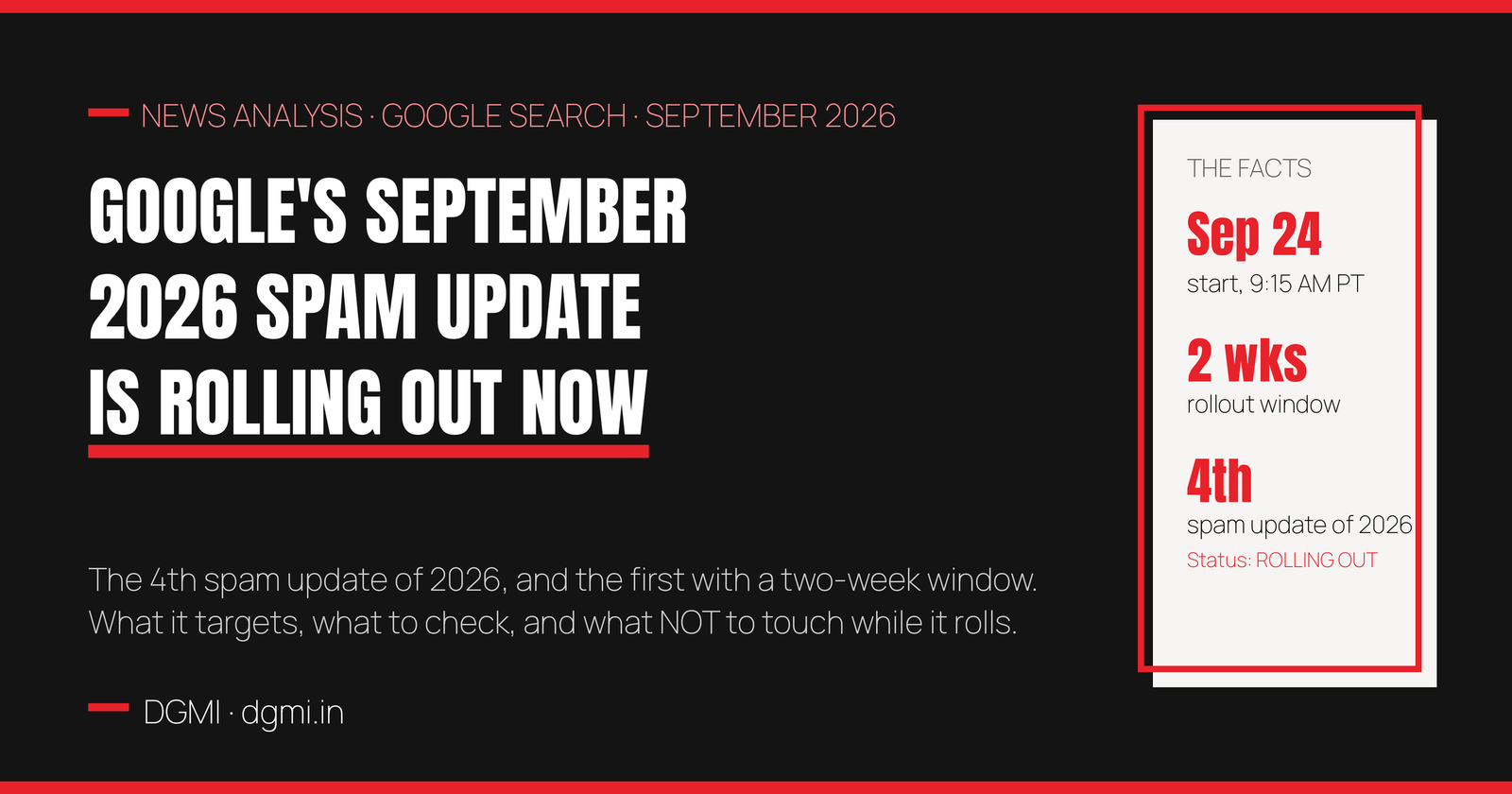
On Wednesday, September 24 at 9:15 AM Pacific time, Google switched on its fourth spam update of 2026, and buried in the two-line announcement is the detail that made every SEO in the world sit up: the rollout “may take up to two weeks to complete.” That sounds boring until you know that March’s spam update finished in 19.5 hours, June’s in about two days, and August’s in two days and sixteen hours. When Barry Schwartz of Search Engine Roundtable asked Google’s John Mueller whether two weeks was a typo, Mueller confirmed it was not. So as you read this, rankings worldwide are being reshuffled by a spam-detection system Google considers significant enough to need fourteen days, and if your traffic graph does something strange this week, this update is the first suspect to rule in or out. Here is what a spam update actually is in beginner language, what this one targets, what to check today, and, just as important during a live rollout, what not to touch. We will update this post the day Google marks it complete.
Google launched the September 2026 spam update on September 24 at 9:15 AM Pacific. It applies globally, in all languages, and Google says the rollout may take up to two weeks, several times longer than any of 2026’s three earlier spam updates. A spam update improves Google’s automated systems for catching sites that violate its published spam policies (mass-produced junk pages, parasite content, bought links, cloaking); it is not a core update, and no new policies were announced. If you make honest content for real people, the correct response is to check Search Console calmly, note the dates, and change nothing in panic. If your rankings drop and stay dropped after completion, the recovery path is fixing violations, then waiting months, not days.
• Started: September 24, 2026, 9:15 AM Pacific, per Google’s Search Status Dashboard; announced by Google Search Central on X
• Scope: global, all languages; rollout window “up to two weeks”, versus 19.5 hours (March), ~2 days 1 hour (June) and 2 days 16 hours (August)
• Confirmed longer on purpose: John Mueller of Google confirmed to Search Engine Roundtable that the longer window is not a typo
• 4th spam update of 2026 (March, June, August, September): the most spam updates in a calendar year since 2021
• No new spam policies announced; manipulation aimed at AI Overviews and AI Mode already falls under the existing policies Google clarified in May
1. What a Spam Update Is (And Is Not)
Google runs different kinds of updates, and mixing them up is where beginner panic starts. A core update is Google recalibrating how it judges quality across the whole web; everyone is graded again, and ordinary sites move up or down without doing anything “wrong.” A spam update, like this one, is narrower: Google improving the automated systems (its spam-fighting AI is called SpamBrain) that detect sites violating its published spam policies. Think of a core update as the examiner changing the marking scheme for everyone, and a spam update as the examiner getting better at catching copied answer sheets.
Two beginner-critical consequences follow. First, if your site does not do the things in section 4, a spam update is mostly weather: rankings can wobble during the rollout as spammy competitors fall and the results reshuffle, and wobble is not a penalty. Second, if a site is caught, the effect is lasting and recovery is slow, which is why the honest half of this industry treats spam updates as good news: every junk page that drops makes room for a real one. For the full family tree of Google’s update types with every major update since the beginning, our algorithm updates history is the reference, and the August 2026 spam update analysis is this post’s direct predecessor.
2. Why “Up To Two Weeks” Is the Real Story
Every 2026 spam update before this one got a rollout estimate of “a few days” and finished inside three. This one gets “up to two weeks,” and when Search Engine Roundtable’s Barry Schwartz, the person who has tracked Google updates longer than almost anyone alive, checked with Google’s John Mueller whether that was an error, Mueller confirmed: it is likely to take longer than the previous ones. Google has not said why, and we will not pretend to know; what a longer window means for you is knowable, and it is three things.
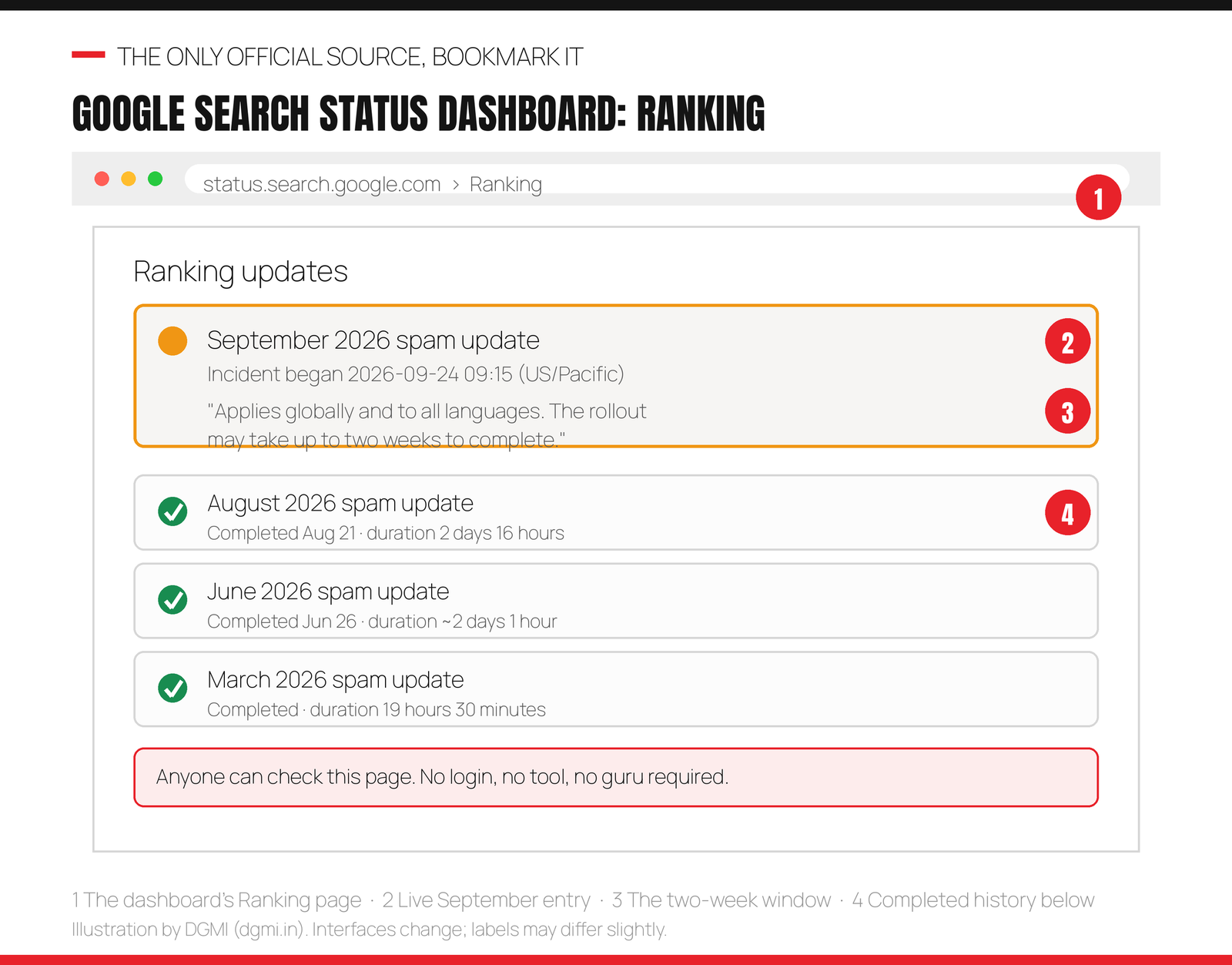
Volatility lasts longer. During a rollout, changes are applied progressively, so rankings can swing, swing back, and settle somewhere else entirely; with a two-week window, that unsettled period stretches across up to fourteen days of your Search Console graphs. Verdicts come slower. A drop on day two can recover by day nine; nothing is final until the Search Status Dashboard says “complete,” which is why section 7’s rules exist. And speculation fills the gap. A long rollout is a content opportunity for every “Google just KILLED these sites” video; your defense is knowing that Google discloses targets rarely, completion dates always, and everything else you hear mid-rollout is guessing. The dashboard below is the only referee.
3. 2026 So Far: Four Spam Updates and Counting
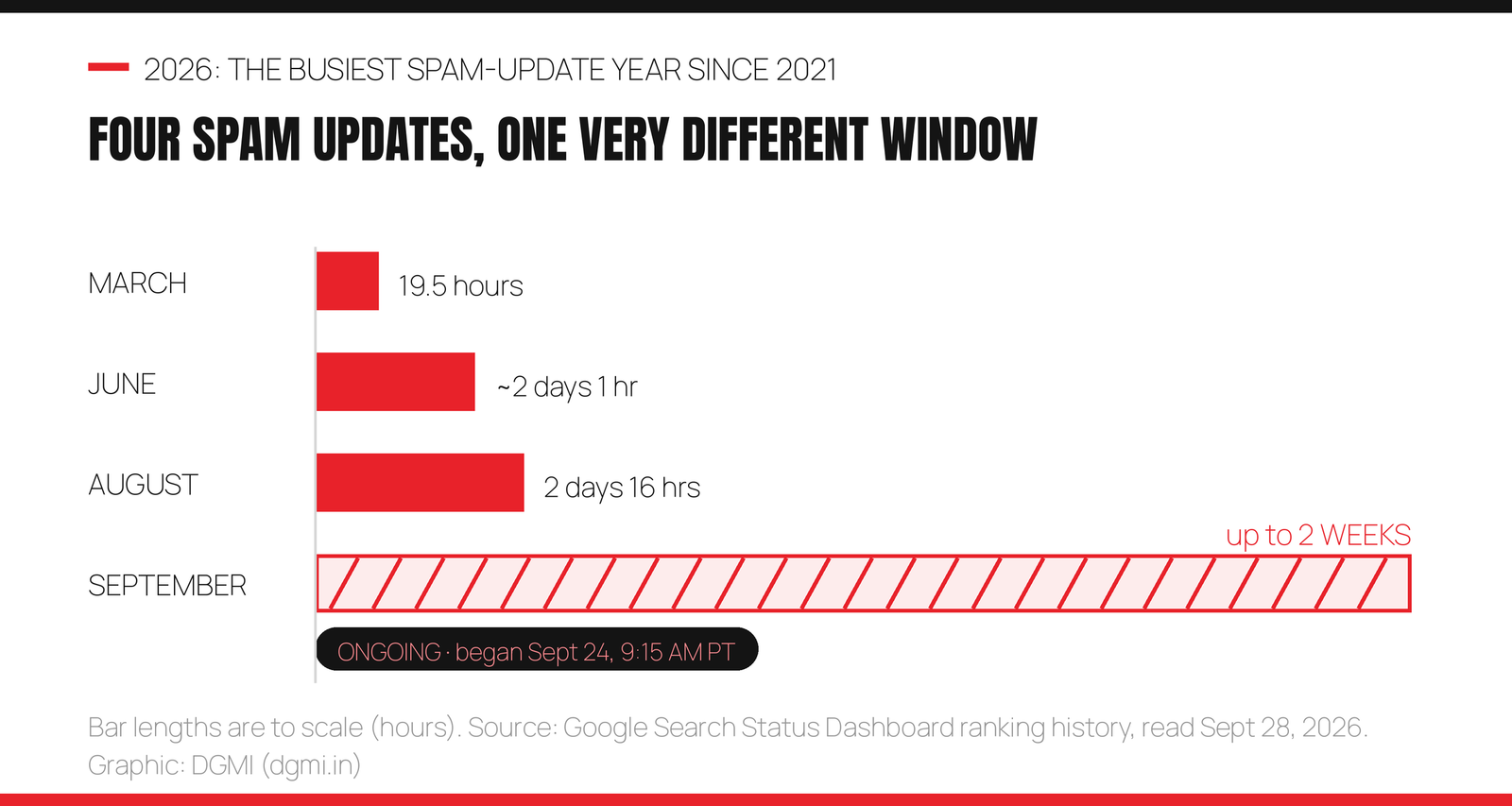
Four spam updates in one year (March, June, August, now September) is the busiest spam-update calendar since 2021, and the spacing has been almost metronomic: roughly one per quarter, accelerating to back-to-back months in August and September. Add the two core updates (March and May) and the pattern of 2026 is unmistakable: Google is cleaning its index more often, in smaller, named batches, rather than in rare earthquakes. For site owners this is genuinely better; frequent updates mean mistakes are caught and corrected faster in both directions.
The elephant in this timeline is what is missing: there has been no broad core update since May, which is the longest core-update gap of the year, and industry analysts have spent September expecting one. Nobody outside Google knows the schedule, but a two-week spam rollout ending in early October, with a core update plausibly behind it, makes this a season to have your Search Console habits sharp, which is exactly what the next sections build. We track every confirmed update as it lands in our rolling algorithm updates tracker.
4. What Spam Updates Go After, in Plain Words
Google has not said what this specific update targets; it never does mid-rollout, and often not after. What it has published, permanently, is the list of spam policies these systems enforce, and every named spam update is a better net for the same fish:
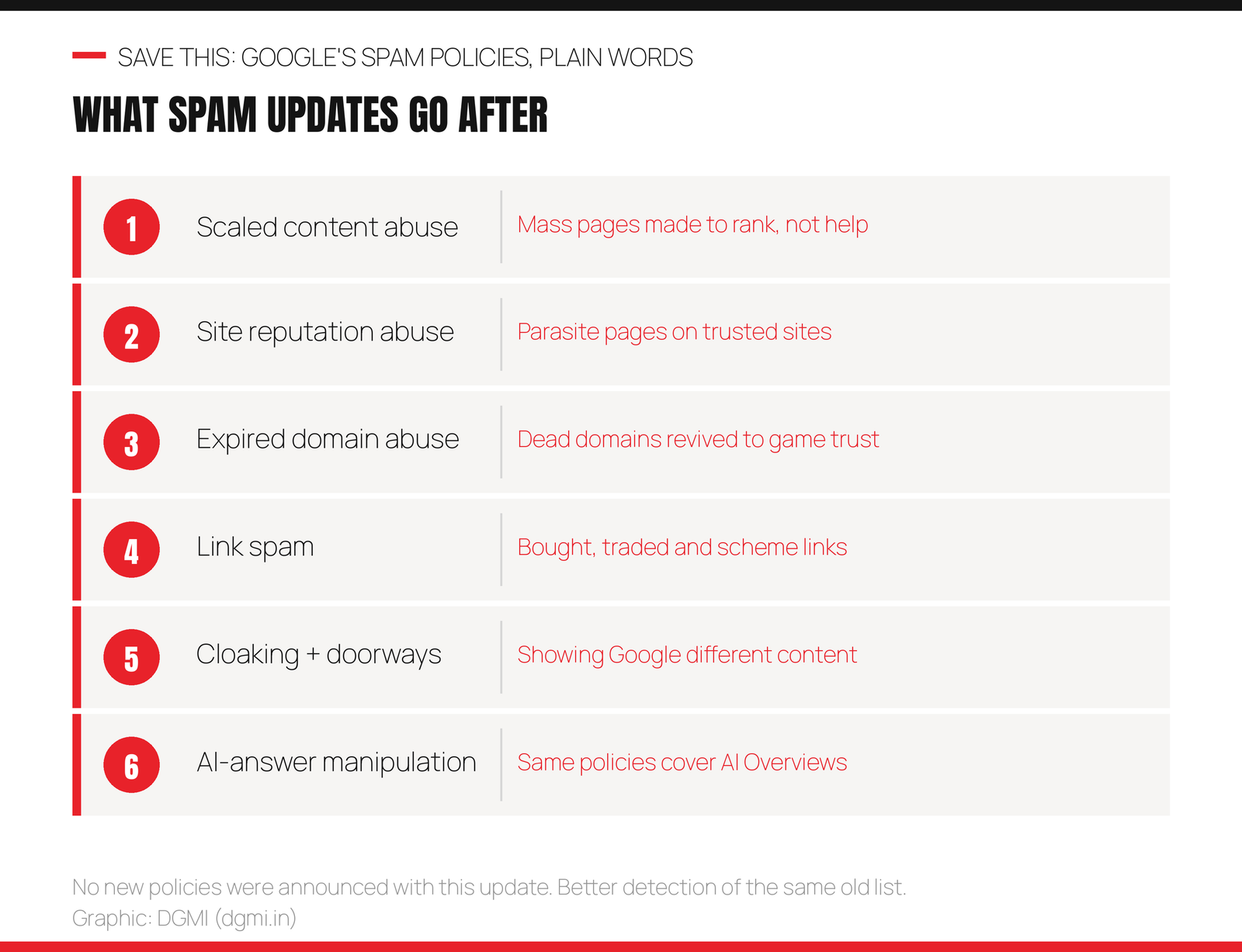
Scaled content abuse is publishing masses of pages, AI-generated or human-outsourced, whose purpose is ranking rather than helping; the key word is purpose, not tool, and Google’s policy explicitly says using AI is fine while mass-producing unhelpful pages with it is not. Site reputation abuse (“parasite SEO”) is renting a trusted site’s authority to host unrelated commercial content, an area where Google visibly tightened enforcement through 2026. Expired domain abuse is buying dead domains to exploit their old reputation. Link spam covers bought, traded and scheme-built links, including the “guest post packages” still sold openly on Indian freelancing groups. Cloaking and doorways show Google different content than users see. And since May, Google has been explicit that manipulating AI-generated answers (AI Overviews, AI Mode) falls under these same policies; there is no separate rulebook for the AI surfaces, a point we unpacked in the August analysis and that matters more every month as GEO becomes a discipline.
5. Who Should Worry (And Who Genuinely Should Not)
Every update week, my agency’s inbox fills with the same two kinds of messages, and they need opposite answers. You should genuinely not worry if you write for real readers, on topics you actually know, with links you earned rather than bought: a coaching institute’s site, a CA’s blog, a student portfolio built through our SEO checklist. Sites like these can still see small ranking movement during the rollout as the spam around them collapses and the results re-settle, which is reshuffling, not punishment, and it frequently ends in a net gain: after the March core update’s crackdown on copied content, original reporting saw significant visibility gains while paraphrased aggregation lost badly.
You should take this seriously if any of section 4 describes your site, even a little: the 800 AI-generated “best X in every city” pages published in a weekend, the ₹5,000 link package from a Telegram group, the affiliate content wing rented on someone else’s trusted domain. The uncomfortable conversation I have with one or two prospective clients every quarter is that they already know which list they are on. If that is you, the recovery path in section 8 is real, but it begins with removal, not with hoping the update misses you; four spam updates a year means the net passes over everyone regularly now.
🎯 Learn SEO That Survives Every Update
DGMI students learn the boring, durable kind of SEO: real content, earned authority, clean technical setup, and how to read Search Console during weeks exactly like this one, on their own live websites with 1:1 guidance. See it in a 100% practical crash course class, FREE this week.
6. What to Check Right Now, Step by Step
Step 1: Search Console, Performance report. Open Search Console (if your site is not connected yet, that guide fixes it in fifteen minutes), set the date range to the last 7 days and compare with the previous 7. You are looking at clicks, impressions and average position, and you are looking for a step change that begins on or after September 24, not the ordinary daily wiggle every site has. Screenshot today’s numbers; future-you will thank present-you.
Step 2: the Status Dashboard. Bookmark Google’s Search Status Dashboard and check whether the rollout is still marked as ongoing before interpreting anything. A drop while the update runs is provisional; the same drop two weeks after completion is a verdict.
Step 3: one honest self-audit. Read Google’s spam policies page once, top to bottom, asking one question per policy: does anything on my site do this? For 95% of readers the answer is a clean no, and that no is worth having in writing (a note to yourself dated today) the next time a guru tells you an update “targeted sites like yours.”
Step 4: note the dates and stand down. Write down: rollout started Sept 24, expected up to Oct 8. Check the Performance report every two or three days, not hourly; nothing you see hourly is actionable. That is the whole job during a rollout, and doing exactly this, calmly, is what separates professionals from the panicked, which is also precisely the skill that makes update weeks a business opportunity for freelancers: while others sell fear, the person who can open a client’s Search Console and say “here is what actually happened, here is the official dashboard, here is why we wait until completion” wins audits without discounting. The 30-minute settings audit from our WordPress SEO settings guide plus this section is that service.
7. What NOT to Do While It Rolls
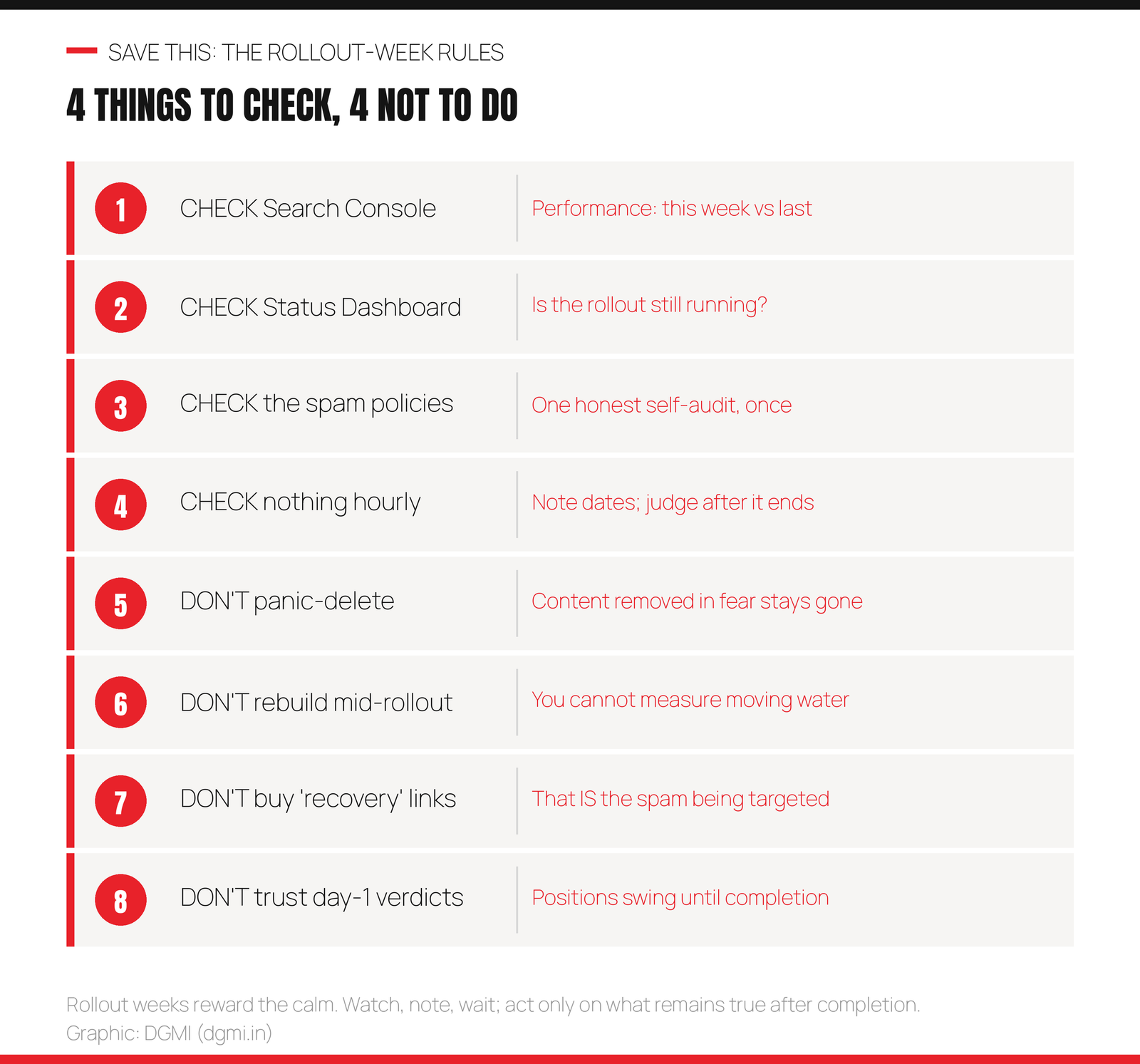
The four don’ts deserve their reasons. Don’t panic-delete content: every update, site owners bulk-delete pages some tool labeled “thin,” and content deleted in fear is gone whether or not the update ever touched it; deletions should follow diagnosis, after completion. Don’t rebuild mid-rollout: if you change your site while rankings are being progressively re-scored, you can never know which change caused what; you have destroyed your own experiment. Don’t buy “recovery” services or links: update weeks are harvest season for sellers of exactly the link schemes this update exists to catch, and the irony writes itself. Don’t trust day-one verdicts, your own included: with a two-week window, the site that “died” on Thursday may be fine on the Tuesday after next, and Google itself notes that legitimate sites can fluctuate during spam rollouts without being the target.
8. If Your Traffic Drops: The Honest Recovery Path
Suppose the rollout completes, the dashboard says done, and your drop did not bounce back. Here is the truth-first playbook. First, confirm attribution: compare your drop’s start date against the rollout window, and rule out the boring causes (a noindex toggle or settings accident, a broken page, seasonality, a tracking change from a recent analytics edit). Second, diagnose against the policy list, honestly, per section 4; if you find violations, the fix is removal and disavowal-level cleanup of what you did, not decoration around it. Third, understand the timeline Google itself gives: improvements after a spam-related drop show over months, often only after further updates run, because the systems need to re-evaluate your changed site. There is no form to file, no fee to pay, and anyone selling a faster guarantee is selling weather.
And if you were hit despite doing nothing on the list, which happens at the edges of every rollout, the recovery is the ordinary one: keep publishing genuinely useful content, strengthen the E-E-A-T signals that separate you from the spam you were briefly confused with, and let the next update, and there is always a next update, re-grade you. Sites built the honest way have compounding luck across updates; that is not motivation-poster talk, it is what four-updates-a-year mathematically rewards.
9. The Bigger Picture: Spam Updates in the AI Search Era
Step back from this one rollout and the shape of 2026 becomes visible. AI Overviews now appear on roughly four in ten desktop searches and AI Mode keeps expanding, which means Google’s answers increasingly synthesize the index rather than just list it, and a synthesized answer built on spam is poison in the well. Four spam updates in a year is what an index-cleaning program looks like when the index has become the raw material for AI answers. The May policy clarification (manipulating AI Overviews and AI Mode falls under the same spam rules) and this September’s two-week deep-clean are the same project seen from two angles.
For DGMI students and every beginner reading, the career translation is simple and genuinely hopeful: the tricks are being industrially removed, quarter after quarter, which means the value of knowing the durable skills, content that answers real questions, clean technical foundations from the settings level up, measurement you can trust, and now GEO for the AI surfaces, compounds every time Google runs one of these. You are not competing with spam for much longer; you are competing with the other people who learned to do it right. Be early to that group.

10. FAQ
What is the Google September 2026 spam update?
It is Google’s fourth confirmed spam update of 2026, launched September 24 at 9:15 AM Pacific, applying globally and to all languages. Spam updates improve Google’s automated systems for detecting violations of its published spam policies, such as scaled content abuse, site reputation abuse, link spam and cloaking. Google has not announced new policies or specific targets, and says the rollout may take up to two weeks, notably longer than the year’s earlier spam updates.
How long will the September 2026 spam update take?
Google’s official estimate is up to two weeks from the September 24 start, so completion by roughly October 8, though updates often finish before their window. For comparison, 2026’s earlier spam updates finished in 19.5 hours (March), about 2 days 1 hour (June) and 2 days 16 hours (August). John Mueller of Google confirmed the longer estimate is intentional. The Search Status Dashboard will show the exact completion time.
My traffic dropped this week. Was I hit by the spam update?
Not necessarily. During a rollout, legitimate sites can fluctuate as spammy results fall and rankings re-settle; drops can also come from unrelated causes like settings accidents, broken pages or seasonality. Check whether your drop began on or after September 24, wait for the dashboard to mark the rollout complete, and only then treat a sustained change as the update’s verdict. If it persists, run an honest self-audit against Google’s spam policies before changing anything.
What is the difference between a spam update and a core update?
A core update broadly re-evaluates content quality and relevance across all sites; ordinary sites commonly move up or down without violating anything. A spam update specifically improves detection of sites breaking Google’s spam policies; it mainly affects violators, plus some reshuffling around them. September 2026’s release is a spam update. Notably, there has been no core update since May 2026, and many analysts expect one soon.
Does this update target AI-generated content?
Google has not named targets for this update. Its standing policy is that using AI to produce content is acceptable while mass-producing unhelpful content, by any method, is scaled content abuse. Since May 2026, Google has also been explicit that attempts to manipulate AI Overviews and AI Mode answers fall under the existing spam policies. So the question that matters is not “did AI write it” but “was it made to help readers or only to rank.”
How do I recover from a Google spam update?
Identify which spam policy your site violates, remove the violating content or links (removal, not disguise), and then continue publishing genuinely helpful content. Google says improvement after spam-related drops typically shows over months, often as subsequent updates re-evaluate the site; there is no reconsideration form for algorithmic actions and no legitimate paid shortcut. If a manual action is involved (visible in Search Console), fix the issue and file a reconsideration request there.
Should I pause publishing or make changes during the rollout?
Keep publishing normal, helpful content; a rollout is not a reason to go silent. What to avoid is reactive change: bulk deletions, redesigns, link buying or “recovery services” made in response to mid-rollout ranking swings, because you cannot measure cause and effect while scores are still moving. Note your dates, keep your routine, and make deliberate decisions after Google confirms completion.
Where can I check the update’s official status?
Google’s Search Status Dashboard at status.search.google.com, under Ranking, is the single official source: it lists the September 2026 spam update’s start time and will record its completion, alongside the full history of past updates and their durations. It requires no login or tools. Treat everything else you read mid-rollout, including confident videos about what the update “targets,” as speculation until that page or Google’s documentation says it.
🚀 Four Updates a Year. One Skillset That Survives All of Them.
DGMI’s 3-month Digital Marketing + AI Course (₹29,999) teaches SEO, GEO, content, ads and analytics the durable way, live and 1:1 on your own website, with 9+ real projects and worldwide-recognized certification, so update weeks become the weeks you look smart. Start with a free practical crash course class.
Questions? Contact us · hello@dgmi.in · +91 96940 03464

Sources: Google Search Status Dashboard (official rollout status) · Google Search Central: spam policies · Search Engine Journal: September 2026 spam update rollout · Search Engine Roundtable: rollout report and John Mueller confirmation · Google Search Central: debugging drops in Search traffic
Keep learning: the August 2026 spam update analysis · the Google algorithm updates history · the rolling platform updates tracker · the SEO checklist for beginners · the E-E-A-T guide · the WordPress SEO settings audit · the SEO vs GEO vs AIO guide · discuss in the DGMI Community.