
On Tuesday morning I did what I always do when Google confirms an update: opened Search Console for every client account before opening my tea. Google has started rolling out the August 2026 spam update, its third spam update this year, and if you run a website or you are learning SEO, your feed is probably already full of panic posts and screenshots of falling graphs. So let us do the opposite of panic. In this post I will explain what actually happened, what a spam update really is in plain language, exactly which practices Google’s spam policies ban, the AI question everyone is asking, and the calm five-step response I use on real client sites. If your website is honest, this update is closer to good news than bad, and I will show you why.
On August 18, 2026, at 9:27 a.m. Pacific, Google’s Search Status Dashboard logged the start of the August 2026 spam update. It applies worldwide, to all languages, and Google says the rollout may take a few days. It is the third spam update of 2026, after March (the fastest confirmed rollout ever, finished in under 20 hours) and June (about 48 hours). Google announced no new spam policies with it and published no companion blog post: the existing spam policies remain the rulebook, and Google has clarified this rollout does not specifically target link spam or site reputation abuse. Translation for beginners: Google refreshed its spam-detection systems to catch rule-breakers better. If you are not breaking the rules, your job this week is to watch your data calmly, not to change anything in a hurry.
• Third spam update in eight months: March took 19.5 hours (fastest ever confirmed), June took about 48 hours, August is expected to take a few days
• It arrives after roughly 7.5 weeks with no confirmed update, during which trackers recorded unexplained ranking volatility around August 1-3 and August 12-13. Google indicated that earlier movement was not this update
• Since May 15, 2026, Google’s spam policies officially cover attempts to manipulate AI answers in Search (AI Overviews and AI Mode), though Google has not said whether this update enforces that specifically
• Google’s own documentation warns that recovery from a spam update can take months, because automated systems need time to re-trust a site
1. What Exactly Is a Spam Update? (Plain English)
Think of Google as a librarian managing the world’s biggest library. A core update is the librarian rethinking which books deserve the front shelves: quality judgments, applied to everyone. A spam update is different: it is the librarian upgrading the security system that catches people sneaking fake books onto the shelves. It is not a new opinion about your writing; it is better detection of cheating.
The detection system has a name, SpamBrain, and it is itself an AI. Every spam update is essentially Google retraining that AI to recognise tricks it previously missed. That is why Google announces no “new rules” with these updates: the rules were already written, and the update simply enforces them better.
Two details from this rollout are worth understanding. First, the timing pattern: SEO trackers had recorded strange ranking movement in early August and again around August 12-13, weeks before this announcement, and Google indicated that earlier volatility was not this update. So if your traffic wobbled in early August, this update did not cause it. Second, the speed trend: spam updates used to take two to four weeks to roll out; in 2026 they finish in hours or days. Google is refreshing its spam systems faster and more often, and the most likely reason is obvious once said aloud: AI tools made junk content nearly free to mass-produce, so the filter needs sharpening more frequently. We track all of these changes in our Google algorithm updates history and the cross-platform updates guide.
2. What Google’s Spam Policies Actually Ban
Here is the part most panic posts skip: the actual rulebook. If none of these describe your website, this update is not aimed at you. Read the list honestly, because a few of these are things beginners do without realising they are violations.
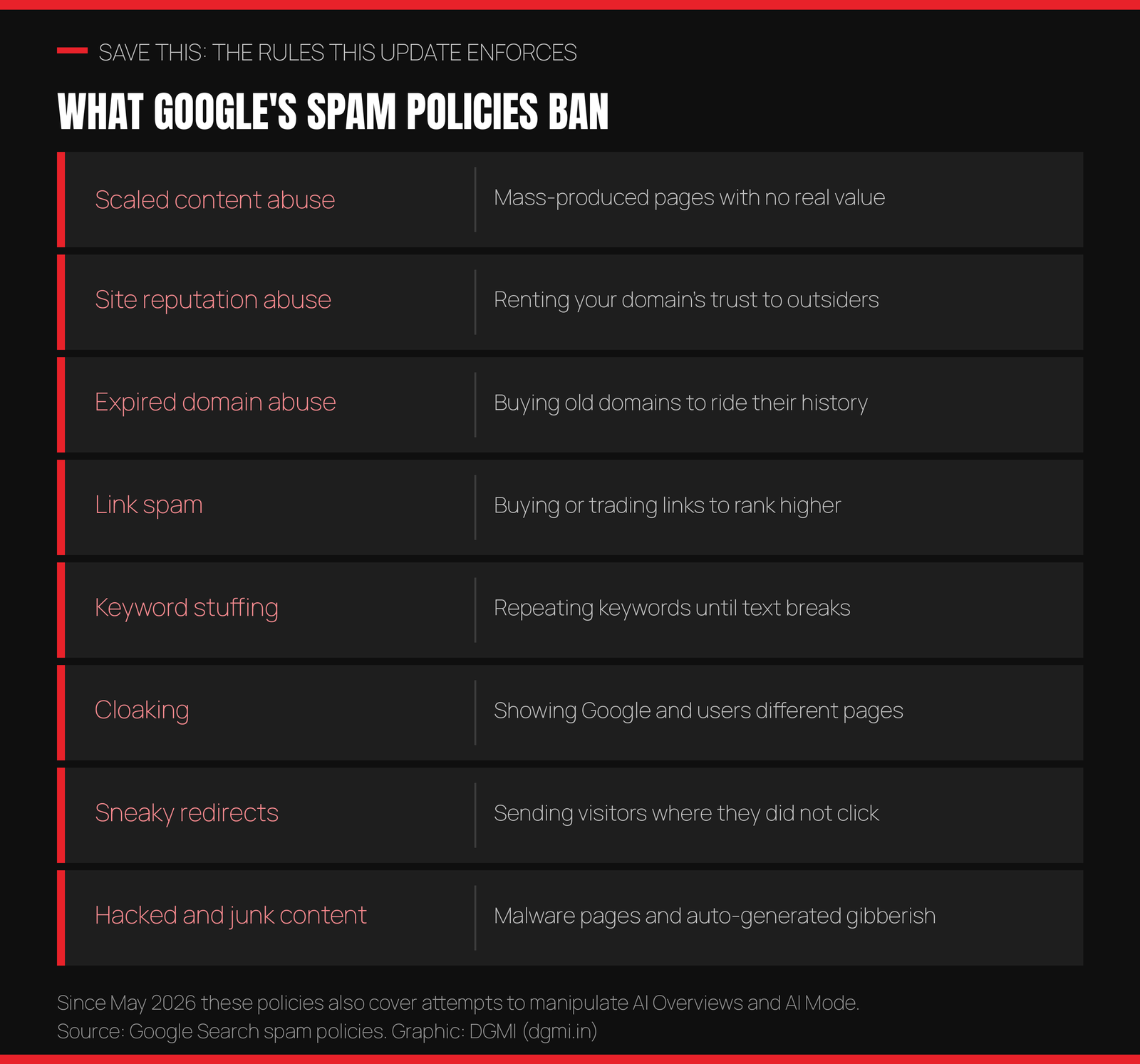
Three of these deserve a beginner-friendly translation, because they are the ones that catch ordinary site owners:
Scaled content abuse is publishing large volumes of pages that exist to rank rather than to help: a hundred thin AI-written articles, auto-generated city pages (“plumber in [every city in Rajasthan]”), or stitched-together content copied from other sites. The test is not whether AI touched it; the test is whether each page would be worth publishing if Google did not exist.
Site reputation abuse, sometimes called parasite SEO, is hosting third-party content on your trusted domain mainly to exploit that trust, like a news site renting out a subfolder for coupon or casino pages. Beginners meet this from the other side: if someone offers you money to publish their “guest post” full of commercial links, this policy is the risk you are being paid to take.
Link spam covers buying links, trading links at scale, and automated link schemes. The awkward truth every beginner eventually learns: those ₹500 “high DA backlink” packages on freelancing marketplaces are precisely what this policy describes. They are cheap because they are worthless, and after an update like this, worse than worthless.
3. The AI Question: Is AI Content at Risk?
This is the question every student asks me first, so let us answer it precisely rather than emotionally.
Using AI is not a spam policy violation. Google has said repeatedly that how content is produced matters less than whether it is helpful and original. I use AI in my own workflow daily and teach my students to do the same. That has not changed this week.
What is a violation is what lazy AI use produces: scaled, unoriginal, unverified content published at volume. The March 2026 core update already drew this line in data, rewarding original content with about 22% more visibility while unoriginal AI paraphrase lost roughly 71% of its traffic. Spam updates are the enforcement arm of the same philosophy, aimed at the extreme end: sites publishing hundreds of valueless pages because AI made it cheap to do so.
And there is a newer wrinkle worth knowing. Since May 15, 2026, Google’s spam policies explicitly cover attempts to manipulate its AI answers, meaning AI Overviews and AI Mode. Tricks designed to force your brand into AI answers through engineered bait rather than genuine quality now carry the same demotion risk as any other spam. Google has not said whether this August update enforces that provision specifically, but the direction is unmistakable: the same honesty rules now apply to the AI layer of search. This matters if you are learning GEO, and it is exactly why our GEO playbook and SEO vs GEO vs AIO guide teach citation-worthiness through quality, not tricks. Getting recommended by AI because you are genuinely the best answer is GEO; engineering fake signals to fool the AI is now, officially, spam.
🎯 Updates Stop Being Scary When You Understand Them
Every DGMI student learns SEO the durable way: the fundamentals Google keeps rewarding, the AI workflows that speed you up, and the judgment to tell the difference. Live, 1:1, on real websites. See it yourself with a 100% practical crash course class, FREE this week.
4. Am I Affected? Your 5-Step Response Plan
Here is the exact sequence I follow on client accounts during any confirmed rollout, in order, with the reasoning spelled out.
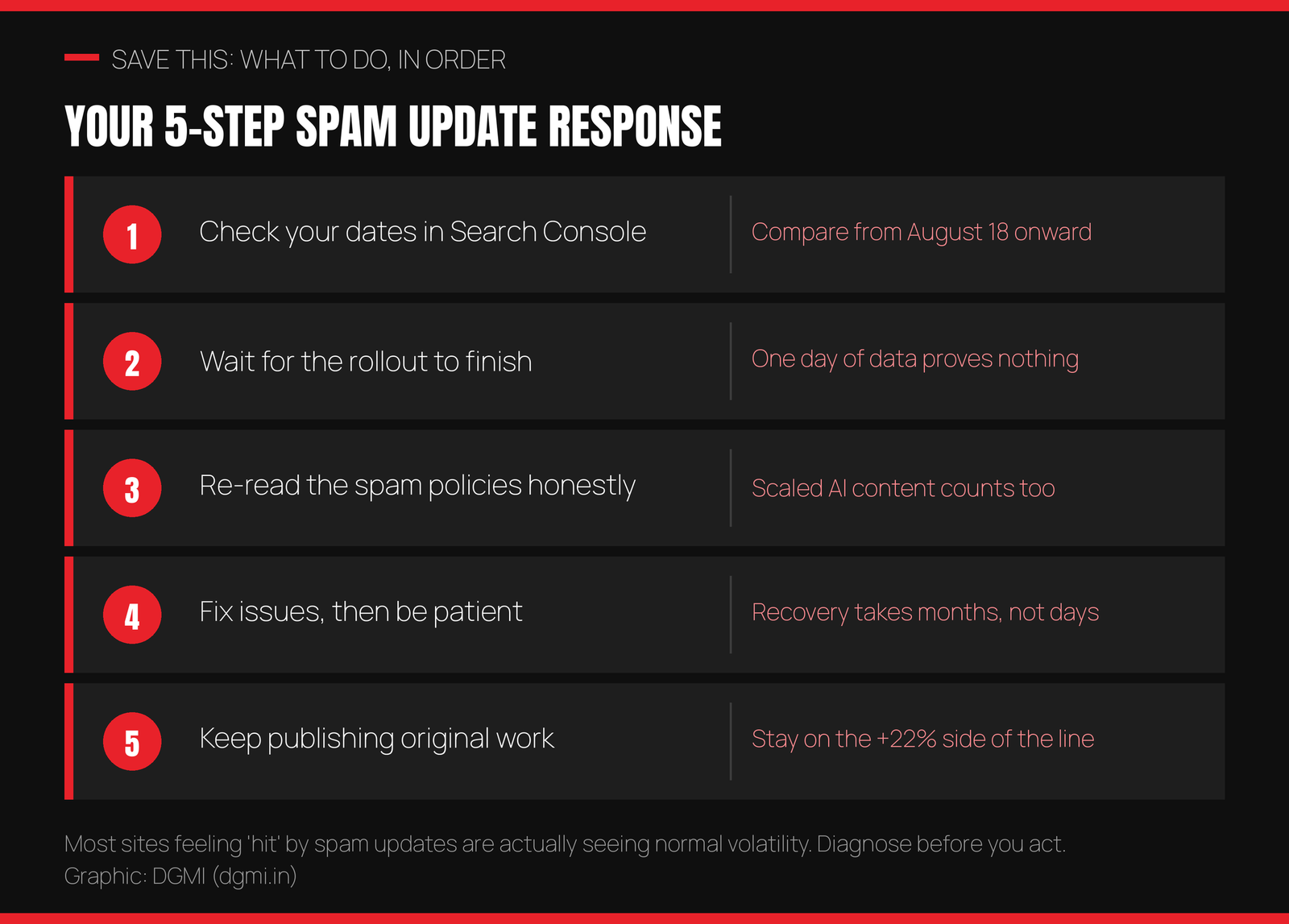
Step 1: check your dates. Open Search Console, Performance report, and compare August 18 onward against the weeks before. The date matters: a drop that started August 5 or August 13 is not this update, whatever a panicked Facebook group tells you. Our GA4 and Search Console guide shows exactly where to look if these reports are new to you.
Step 2: wait for the rollout to finish. Rankings genuinely bounce during a rollout, sometimes dipping and recovering within days. Judging your site, or worse, “fixing” it, on day-one data is like judging a cricket match at the third over. Google will mark the rollout complete on its Search Status Dashboard; until then, observe and note, do not act.
Step 3: re-read the spam policies honestly. If a decline persists after completion, go through the list in section 2 as if auditing a stranger’s website. The most common honest finding for small sites is accidental scaled content: dozens of thin pages published for rankings, not readers.
Step 4: fix what you find, then be patient. Remove or genuinely improve violating pages, disavow nothing in panic, and understand the recovery timeline: Google’s own documentation says months, because automated systems need sustained evidence that a site now follows the rules. Anyone selling you “guaranteed recovery in two weeks” is selling exactly the kind of service this update punishes.
Step 5: keep publishing original work. The single best protection during any update is a publishing pattern that looks nothing like spam: real experience, verified facts, and pages a human would thank you for. That is the entire E-E-A-T philosophy, covered fully in our E-E-A-T guide and applied step-by-step in the beginner SEO checklist.
5. If You Were Genuinely Hit: The Honest Recovery Path
Suppose the rollout completes, your decline persists, and your honest audit found real violations. Here is the truth about recovery, without the sugar.
First, there is no quick fix and no one to email. Spam updates are algorithmic, not manual penalties, so there is no reconsideration request to file. Recovery means removing the violation, then waiting for Google’s systems to observe your site behaving well over time. Google says this can take months, and in my experience with genuinely spammed sites, it does.
Second, fix causes, not symptoms. Deleting fifty thin pages while continuing the process that produced them just schedules your next penalty. If cheap bulk content got you here, the fix is a new content standard, not a cleanup.
Third, rebuild on the boring fundamentals. Every recovery I have watched succeed followed the same unglamorous path: fewer pages, dramatically better; real expertise made visible; patience measured in quarters. The sites that recover are the ones that stop trying to trick the librarian and start writing books worth shelving.
6. The Opportunity Hiding in Every Spam Update
Here is the reframe nobody panicking on social media mentions: when spam falls, something rises to fill the space. Search results are a ranked list; every junk page demoted means an honest page moves up without doing anything new. If you have been building original content while competitors bought links and mass-produced AI pages, weeks like this one are when the ledger settles in your favour. Watch your Search Console this fortnight not just for drops, but for gains.
And if you are building SEO skills or an SEO business, weeks like this are demand spikes. Every confirmed update sends worried business owners searching for someone who can tell them, calmly and correctly, whether they were hit and what to do. The person who can diagnose “your drop started August 5, so it is not the spam update, and here is what it actually is” earns trust instantly, because everyone else is selling panic. That diagnostic skill is exactly what section 4 taught you, it is the foundation of the audit service in our SEO business checklist, and update weeks are the best client-acquisition weeks of the year for people who have it.

7. FAQ
My traffic dropped this week. Was it the spam update?
Check the date first. This update began August 18, so a decline starting earlier, including the volatility trackers recorded around August 1-3 and 12-13, has a different cause. If your drop does align with August 18 onward, wait for the rollout to complete before concluding anything, because rankings fluctuate during rollouts and often settle back. Only a persistent post-completion decline, combined with actual spam policy violations on your site, points to this update.
Does this update punish websites that use AI content?
Not for using AI; for abusing it. Google’s position is that production method does not matter, but scaled, unoriginal, unhelpful content does, however it was made. AI-assisted content that you verify, enrich with real experience, and edit into genuine usefulness is fine and remains our recommended workflow. Hundreds of unedited AI pages published for rankings is scaled content abuse, which is precisely what spam systems hunt. The 5 rules in our 100 prompts library keep you on the right side.
What is the difference between a spam update and a core update?
A core update changes how Google judges quality and relevance for everyone; it is a re-ranking of the whole library. A spam update improves the systems that detect policy violations; it targets rule-breakers specifically. That is why spam update advice is compliance-focused (check the policies) while core update advice is quality-focused (improve the content). Worth noting: observers point out Google has often followed spam updates with core updates, so keep watching the dashboard in the coming weeks.
How long will recovery take if my site was hit?
Google’s documentation says recovery can take months, and that matches real-world experience. There is no manual review to request for an algorithmic spam update: you remove the violations, sustain clean behaviour, and Google’s automated systems gradually restore trust, often visibly only after a subsequent update. Treat any promise of guaranteed fast recovery as a red flag, since no honest provider can control Google’s timeline.
Should I stop building backlinks because of this update?
No, but be clear about which kind you are building. Earned links, from genuinely useful content, digital PR, partnerships and real relationships, are what Google’s systems are designed to reward. Bought link packages, link exchanges at scale and automated schemes are what the link spam policy bans. Notably, Google clarified this particular update does not specifically target link spam, but that is a description of this rollout, not permission: link schemes remain violations that any future update can catch.
Why is Google releasing spam updates so frequently now?
Three in eight months is a fast rhythm by historical standards, and the rollouts themselves have compressed from weeks to hours or days. The most credible explanation is the AI content flood: generation became nearly free, so low-value sites multiplied, and Google is retraining SpamBrain more often to keep pace. Expect this cadence to continue, and expect enforcement to keep extending into the AI answers layer, as the May 2026 policy clarification signalled. For a beginner, the practical takeaway is stability itself: the fundamentals rewarded after every update are the same ones we covered in the SEO checklist.
🚀 Build the SEO That Survives Every Update
DGMI’s 3-month Digital Marketing + AI Course (₹29,999) teaches durable SEO, GEO, ads, analytics and AI workflows, live and 1:1 on real projects with worldwide-recognized certification, so algorithm news becomes opportunity instead of anxiety. Start with a free practical crash course class.
Questions? Contact us · hello@dgmi.in · +91 96940 03464

Sources: Google Search Status Dashboard · Google Search spam policies (official) · Google: spam updates documentation · Search Engine Journal: August 2026 spam update coverage · Search Engine Roundtable: rollout details and update history
Keep learning: the Google algorithm updates history · the cross-platform updates guide · the E-E-A-T guide · the beginner SEO checklist · the GEO playbook · the SEO vs GEO vs AIO guide · the GA4 and Search Console guide · the SEO business checklist · discuss in the DGMI Community.
[…] · the SEO vs GEO vs AIO guide · the SEO business checklist · the freelance clients guide · the August 2026 spam update coverage · discuss in the DGMI […]
[…] Hacked and abandoned sites, incidentally, are a Google spam policy violation, as we covered in the August 2026 spam update post, so that fifteen minutes protects your rankings […]