
Every single week, a student asks me some version of this question, usually quietly, at the end of a class: “Sir, honestly, by the time I learn all this, won’t AI just do it?” It deserves a real answer, because the people asking are about to invest months of effort and real money into a career. I am in an unusual position to give that answer: I train marketers at DGMI, I hire marketers and freelancers for my own projects, and I personally use AI to automate parts of marketing work every day, including work that juniors used to do. So I see all three sides: the fear, the hiring table, and the automation itself. This guide is the answer I give my own students, with the data attached. No comforting lies, and no doom-selling either.
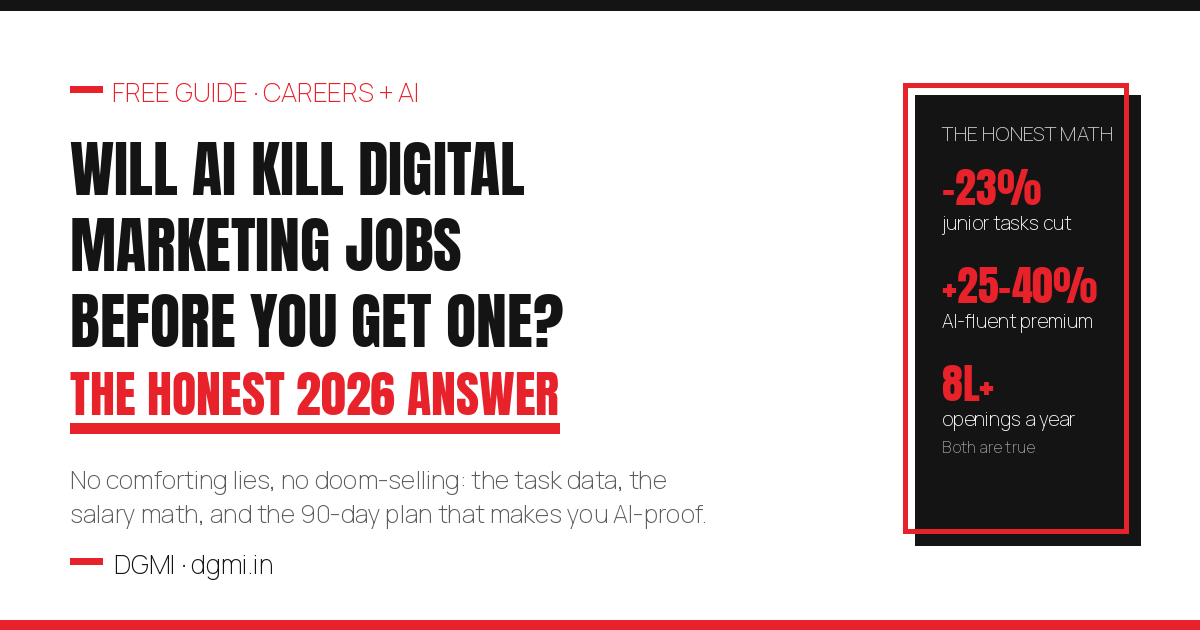
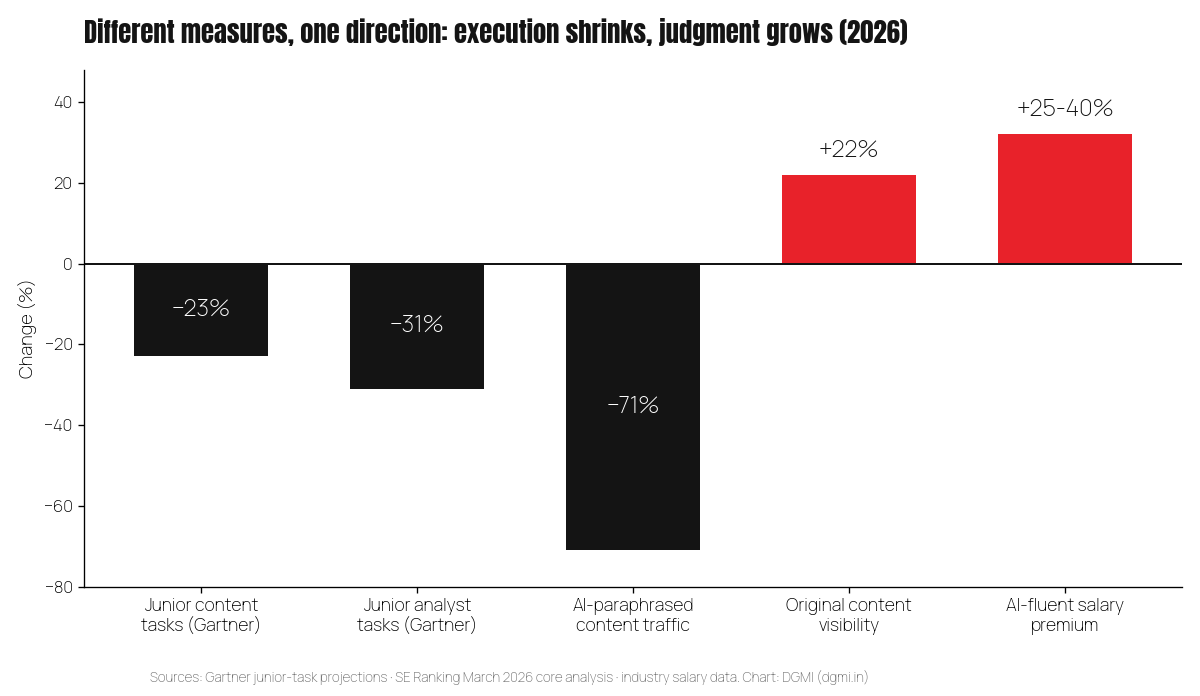
AI is eliminating tasks, not the field. Gartner projects 23 to 31% cuts in junior execution tasks like basic content generation and routine reporting, and that pain is real for people whose only skill is execution. But India still posts 8,00,000+ digital marketing openings a year, AI-fluent marketers earn a 25 to 40% salary premium, and Google’s own data shows original human-verified work gaining visibility (+22%) while lazy AI substitution collapses (−71%). The entry-level rung has not vanished; it has moved, from “person who does tasks” to “person who directs, verifies and improves AI-assisted work.” If you learn for the old rung, you should worry. If you learn for the new one, you are early.
• Gartner projects 23 to 31% of junior marketing execution tasks being automated or cut
• Meanwhile India posts 8,00,000+ digital marketing openings a year (E&ICT Academy, IIT Kanpur)
• 87 to 88% of marketers now use generative AI, and AI-fluent marketers command a 25 to 40% pay premium
• The quality line is measurable: original content +22% visibility, AI-paraphrased content −71% traffic (March 2026 core update, SE Ranking)
1. The Honest Answer, in Three Sentences
Yes, AI is killing a specific set of marketing jobs: the ones that were really just repeatable tasks wearing a job title. No, it is not killing digital marketing as a career; demand for people who can direct AI and own outcomes is rising, and being paid a premium. It depends entirely on which version of the career you prepare for: the 2020 version (execute tasks) is contracting exactly as fast as the 2026 version (direct, verify, decide) is expanding.
Everything below is the evidence for those three sentences, because you should not take career advice on faith, mine included. The chart shows the shape of it: different measures, one direction.
2. What AI Is Actually Killing (The Task Autopsy)
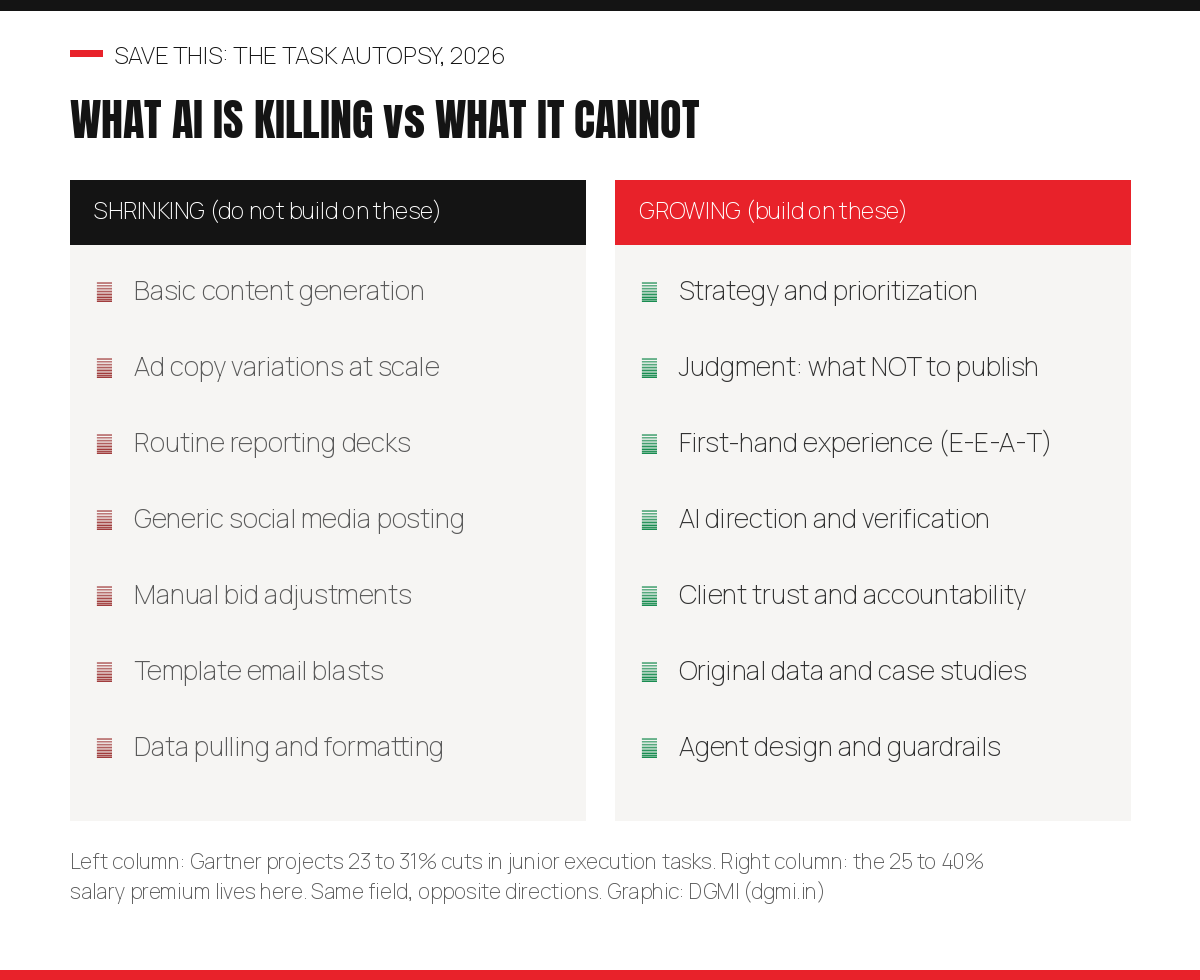
Let us be specific instead of scary. AI in 2026 reliably does these things at near-zero cost: generate acceptable first-draft content, produce dozens of ad copy variations, assemble routine performance reports, schedule and caption generic social posts, adjust bids inside guardrails, and pull data into formatted decks. If a job consisted mainly of those tasks, that job is genuinely contracting. Gartner’s projections of 23 to 31% cuts in junior execution tasks describe exactly this layer, and I will not pretend otherwise: I have personally automated report drafting and first-pass content that, three years ago, I would have hired a junior to do.
Notice what every task on that list has in common: each one has a defined input, a defined output, and no consequences attached to the person doing it. That is the precise shape of work AI eats. It is also, uncomfortably, the precise shape of work that most “digital marketing courses” still teach as the whole job: post on social media, write basic content, make a report. The crowded, lowest-paid corner of the field and the AI-automated corner are the same corner. If your plan was to occupy it, this article just saved you a painful discovery.
3. What AI Cannot Kill, and Why
Now the right-hand column, and the reasons it is safe are structural, not sentimental.
- 1. Accountability. A business can fire a marketer who wastes ₹50,000 of ad budget. It cannot fire ChatGPT. Someone must own the outcome, sign off the spend, and answer for the result, and companies pay real salaries for exactly that ownership. AI produces output; humans carry consequences.
- 2. Judgment about what NOT to do. AI will generate anything you ask. Knowing which campaign not to run, which claim not to make, which trend not to chase: that negative judgment comes from experience and context AI does not have about your specific business, market and moment.
- 3. First-hand experience, now algorithmically enforced. This is the beautiful irony of 2026: Google’s own systems reward Experience (the first E of E-E-A-T) and punish substitution. Original, lived, verified content gained 22% while AI-paraphrased content lost 71%. The platforms themselves made human experience a ranking factor. Machines flooded the market with average; the market repriced authentic. Our E-E-A-T guide covers this in depth.
- 4. Trust and relationships. Clients hire people they trust with their money. Students book classes with mentors, not prompts. Sales conversations, negotiations, and the “I know this person delivers” factor remain stubbornly human, especially in India’s relationship-driven business culture.
- 5. Directing the AI itself. Somebody writes the instructions, sets the guardrails, checks the output and improves the system. That is a skill, it is teachable, and it is currently scarce: which is why it carries the 25 to 40% premium. We teach the practical version in our free AI agents guide: the golden rule “agents draft, humans send” is literally a job description for the new entry level.
4. The New Entry-Level: What Junior Jobs Look Like Now
Here is what changed in plain terms. The 2020 junior marketer spent their day producing: writing the posts, building the reports, setting up the campaigns by hand. The 2026 junior marketer spends their day producing WITH machines and verifying: briefing the AI, checking every fact and claim, adapting output to the brand and the law, watching the automation’s logs, and escalating judgment calls to seniors. Less typing, more deciding. Lower volume of hands-on-keyboard, higher expectations of quality per hour, which honestly also means the pressure moved up the value chain rather than disappearing.
A concrete example from my own hiring: when I evaluate a fresher or freelancer now, I no longer ask “can you write a blog post?” AI writes drafts. I ask three different questions. Can you take an AI draft and tell me what is wrong with it? Can you show me one thing you published or launched that produced a number? And can you explain what you would NOT automate, and why? The candidates who answer those well get hired at better pay than the 2020 version of the same role, because one of them now does the work that used to take three people. That is the entire deal of 2026 in one sentence: fewer pure-execution seats, better-paid judgment seats. The path into them is proof of work, which is why portfolio candidates already start 20 to 40% higher than certificate-only candidates (full numbers in our salary guide).
🎯 Learn the 2026 Version of the Career, Not the 2020 One
DGMI’s Digital Marketing + AI Course was rebuilt for exactly this shift: fundamentals plus AI workflows, agents and verification skills, trained live and 1:1 on real projects so you graduate with the proof of work the new entry-level demands. Experience the teaching style first: a 100% practical crash course class, FREE this week.
5. Who Is Actually at Risk (The Uncomfortable List)
Honesty requires naming who should genuinely worry, because “AI won’t replace you, a person using AI will” is comforting but incomplete. Based on the task data and what I see across hiring and client work, the real risk concentrates in four profiles:
- ✗ 1. The certificate-only candidate with no published work. The certificate market is saturated precisely because certificates certify the automatable layer.
- ✗ 2. The generic social media poster. “I make posts” was already the lowest-paid, most crowded corner, and it is the corner AI eats first. Generic posting is automated; original strategy and community are not.
- ✗ 3. The tool operator without fundamentals. People who learned button sequences (“click here, then here”) rather than why. Buttons change; AI now presses many of them. The why transfers; the clicks do not.
- ✗ 4. The AI-refuser. The experienced marketer who dismisses all of it. With 87-88% of the profession using these tools, refusing them in 2026 is like refusing Excel in 2005: a self-inflicted disadvantage that compounds monthly.
Read that list again and notice the pattern: the risk is not being junior, young, or new. The risk is being interchangeable. A fresher with one live project, an opinion about what AI got wrong in it, and a number to show is less interchangeable than a five-year veteran who only ever executed instructions. That should genuinely comfort you, because interchangeability is a choice you can un-make starting this week.
6. The 90-Day AI-Proof Plan
This is the plan I give students who ask the question that opened this article. It builds the exact right-hand-column skills, costs almost nothing, and produces proof at every step.
- Days 1-30 · Fundamentals + one lane. Learn how marketing actually works (audience, intent, offer, measurement), then pick ONE specialization using the demand data in our career roadmap. Specialists are the ones the market is starving for; generalists are the surplus.
- Days 31-60 · Build with AI, verify like an editor. Set up the free stack from our tested AI tools guide, run one real project (a friend’s business, your own niche site, a college page) and practice the loop: AI drafts, you verify, you improve, you ship. Then build your first working agent with our step-by-step agents guide. Congratulations: you now have the exact skill the premium attaches to.
- Days 61-90 · Manufacture proof and publish. Document everything as before-and-after numbers. Publish your learnings (the DGMI community gives you a public portfolio link and XP). Prepare the interview version using the PAN formula in our interview guide: when they ask about AI, you will be the rare candidate who says “here is the agent I built, here are its guardrails, here is what I refused to automate.”

7. The One Test for Any Role or Skill
Bookmark this test; it will outlive every specific prediction in this article. Before investing in any marketing skill or accepting any role, ask: “Can AI do this end-to-end, unsupervised, with someone else carrying the consequences?” If yes, the skill is a commodity and the role is a countdown; learn it only as a supporting layer. If no, because the work requires judgment, ownership, first-hand experience or trust, you have found durable ground. Run today’s examples through it: writing generic captions (yes, commodity), deciding a ₹2 lakh quarterly budget split (no, durable), formatting a report (yes), presenting it to a skeptical founder and defending the strategy (no), posting daily content (yes), building the original case study that content cites (no). The test never expires because it tracks the boundary itself, and wherever that boundary moves next, the people standing on the judgment side of it will still be employed, at better rates, managing whatever the machines learned to do that year.
8. FAQ
Should I still start learning digital marketing in 2026?
Yes, and arguably this is the best entry window in years, precisely because the fear is filtering out casual competition. Demand is intact (8 lakh+ openings a year), the AI-fluent premium is real (25 to 40%), and the skills gap sits exactly where a motivated beginner can reach in 90 days: fundamentals plus AI direction plus proof of work. The people who should NOT start are those planning to learn 2020-style execution and stop there. Start with the modern version and you are early, not late.
Which digital marketing roles are safest from AI?
Roles with heavy judgment, ownership or trust components: performance marketing management (someone must own the budget), SEO and GEO strategy (originality and E-E-A-T are literally human-experience requirements), brand and content strategy, analytics interpretation (not report generation), client-facing account roles, and the newest category, AI operations: designing, verifying and governing marketing automations and agents. The common thread is consequences: wherever a mistake costs real money or reputation, a human stays paid to prevent it.
Will AI replace SEO specifically?
AI is transforming SEO, not replacing it, and the transformation favors skilled humans. Yes, AI answers now capture many clicks (zero-click searches are rising sharply), but 92% of AI citations come from pages already ranking in the top 10, and Google’s 2026 updates explicitly reward first-hand, original, expert content: things only humans can supply. The job shifted from “rank pages” to “be the cited, trusted source,” a discipline now called GEO. SEO professionals who add GEO are among the best-paid specialists in the field; our GEO playbook is the free starting point.
Do I need to learn coding to survive AI in marketing?
No. The premium skill is directing AI in plain language: writing clear instructions, setting guardrails, verifying output, and connecting no-code tools. Our free agents guide has complete beginners building a working lead-management agent without one line of code. Basic comfort with data (spreadsheets, GA4) matters far more than programming. If you enjoy code, it is a bonus lane, not a requirement.
Is it too late if companies are already cutting junior roles?
The cuts and the shortage are happening simultaneously, in different layers. Companies are cutting execution seats while actively struggling to fill judgment seats: specialists, AI-fluent operators, and provable doers. That mismatch is your opening. A fresher who arrives with a live project, an agent they built, and numbers they can defend is competing in the shortage layer, not the surplus layer. The 90-day plan above is the bridge between the two, and 90 days from today is not too late by any measure.
🚀 Become the Marketer AI Cannot Replace
DGMI’s 3-month Digital Marketing + AI Course (₹29,999) teaches the durable side of the line: fundamentals, SEO and GEO, ads, analytics, plus AI workflows, agents and verification skills, all live and 1:1 on real projects with worldwide-recognized certification. Start with a free practical crash course class and judge the teaching yourself.
Questions? Contact us · hello@dgmi.in · +91 96940 03464

Sources for quoted data: Gartner marketing predictions (junior task automation projections) · SE Ranking: March 2026 core update analysis · HubSpot 2026 State of Marketing (1,500+ marketers) · 2026 AI marketing adoption statistics (Salesforce and industry compilations) · AmbitionBox salary data via Kraftshala (May 2026)
Build the durable side: the career roadmap · the salary guide (the premium, in numbers) · the tested AI tools stack · the free AI agents build (the premium skill itself) · the E-E-A-T guide · the interview guide (Q26 is this article in one answer) · publish your proof in the DGMI Community.
[…] zero-click effect, and using AI tools responsibly without falling into the −71% content trap. Our AI and jobs guide covers this shift in full. An SEO business that understands 2026 search is more valuable than ever; […]
[…] So the honest summary is the same one running through everything we teach at DGMI right now: AI is removing tasks, not the whole job. The task of “be a body holding a product on camera” is being automated. The work of understanding an audience, writing a hook that stops a thumb, judging which of twenty versions is actually good, and owning the result, is not. We go deep on that distinction in our AI and marketing jobs guide. […]