
Update desk, July 6, 2026: the most important marketing story of the past month isn’t a Google update — it’s Meta quietly putting an AI salesperson inside the app where India actually shops: WhatsApp. Meta Business Agent is now global, more than a million businesses are already running it, and there’s a policy catch most coverage missed. Here’s the full picture.
• Launched globally: June 3, 2026, at Meta’s Conversations event in London
• Adoption at launch: 1 million+ businesses already using it on WhatsApp & Messenger
• Scale it plugs into: 1 billion+ active daily threads across WhatsApp, Messenger & Instagram
• What it does: answers, recommends, books, captures leads, closes sales, hands off to humans
• The catch: Meta’s 2026 policy restricts general-purpose AI bots on WhatsApp — while allowing its own agent
1. What Just Happened
On June 3, 2026, at its Conversations event in London, Meta took its Business Agent — an AI that runs customer conversations on a business’s behalf — global across WhatsApp and Messenger. This wasn’t a beta announcement: Meta said more than 1 million businesses were already using it at launch, against more than a billion active daily conversation threads across WhatsApp, Messenger and Instagram.
Meta has been building toward this for a year — its 2026 ads updates show a clear pattern: click-to-WhatsApp ads feed conversations, the Business Agent runs the conversations, and commerce closes inside the thread. Ads, chat and checkout are becoming one system, and the AI sits in the middle of it.
2. What Meta Business Agent Actually Does
Think of it as a tireless junior salesperson living inside your business WhatsApp number:
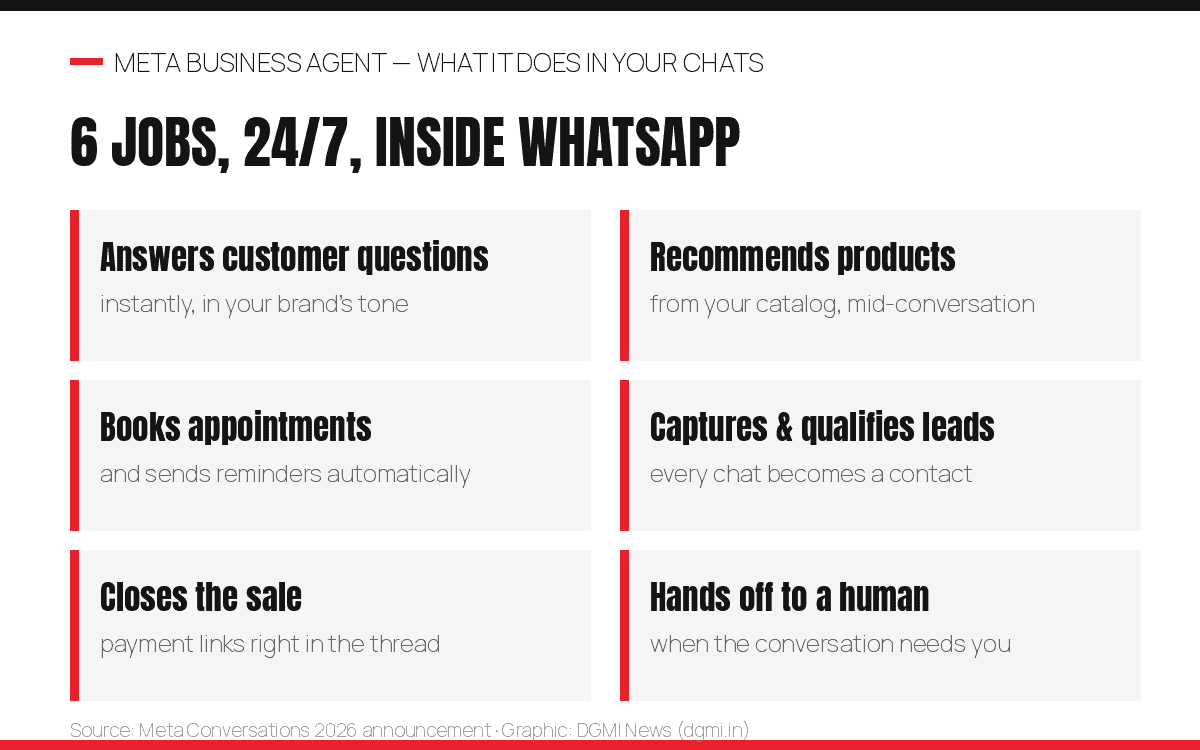
The strategically important part isn’t any single feature — it’s that the agent keeps the entire customer journey inside one thread. Someone taps your ad, asks a question at 11 PM, gets an answer, sees two product suggestions, pays, and receives the order confirmation — without your phone ever buzzing. For a small business owner who currently loses every lead that messages after closing time, that’s not an incremental improvement; it’s a different business.
3. The Policy Catch Nobody’s Talking About
Here’s the detail most coverage skipped. Earlier in 2026, Meta updated its WhatsApp business policy to restrict general-purpose, assistant-style AI bots — the open-ended, ChatGPT-style concierge — on the platform, while explicitly permitting purpose-built bots for support, booking, order tracking and surveys. (The most-cited effective date, January 15, 2026, comes via solution-provider interpretations of the policy rather than a verbatim Meta statement — the direction is well-established, the exact wording worth verifying before you rely on it.)
Read the sequence: Meta restricted everyone else’s everything-bots in January… then launched its own everything-agent globally in June. Whatever you think of that move competitively, the practical rule for businesses is now clear: narrow, task-scoped automation is safe; open-ended custom AI assistants on WhatsApp are not. If you’re building automation, build it per-task — or use Meta’s own agent.
4. Why This Matters More in India Than Anywhere
India is the world’s largest WhatsApp market — 500+ million users and hundreds of millions of business profiles, with UPI payments already flowing inside chats. WhatsApp isn’t “a channel” here; for a huge share of Indian small businesses, it is the storefront.
One cost note for context: since January 1, 2026, WhatsApp marketing template messages in India are billed per delivered message at a roughly 10% higher rate (~₹0.86 per marketing message) — while replies inside the 24-hour customer service window remain free. The economics now clearly reward businesses that get customers to message first and then convert inside the free window — which is precisely the flow an always-on agent is built for.
5. What to Do This Month — Exact Steps
- ✓ Check your eligibility. Open Meta Business Suite → look for Business AI / Business Agent options on your WhatsApp Business or Messenger channels. Rollout is staged, so don’t panic if it’s not there yet.
- ✓ Fix your inputs before switching anything on. The agent answers from your catalog, business info and FAQs — an AI reading an empty catalog sells nothing. Complete your WhatsApp Business profile and product catalog first.
- ✓ Pilot on low-stakes conversations. Let it handle FAQs and order-status questions for 2–4 weeks before trusting it with sales conversations. Review transcripts weekly — you’re training your judgment about it, not just its answers.
- ✓ Audit any custom bot you already run. If a vendor sold you an open-ended “AI assistant” on WhatsApp, ask them directly how it complies with Meta’s 2026 policy on general-purpose bots. Task-specific flows (booking, tracking, support) are fine.
- ✓ Restructure for the free window. With marketing messages at ~₹0.86 each and customer-initiated replies free for 24 hours, shift spend toward click-to-WhatsApp entry points and let conversations — not broadcasts — do the converting.
📰 Get every update the day it drops
DGMI News covers every Google algorithm update and major marketing development — reported fast, explained simply, no fluff.
Subscribe free → earn 25 Community XP as a welcome reward 🎁
Email only. No spam, unsubscribe anytime.
6. Quick FAQ
Is Meta Business Agent free to use?
Meta hasn’t published a standalone global price card for the agent itself; it plugs into existing WhatsApp Business and Messenger channels, where normal messaging economics apply — customer-initiated service conversations are free within the 24-hour window, while business-initiated template messages are billed per delivered message. Watch Meta’s official channels for monetization details as the rollout matures.
Will it replace my existing WhatsApp chatbot?
Not necessarily. Purpose-built bots for booking, order tracking, support and surveys remain fully permitted under Meta’s 2026 policy and may fit your workflows better. What’s restricted is the open-ended, general-assistant style of custom bot. Many businesses will end up running Meta’s agent for discovery and sales alongside their existing task-specific flows.
Can the AI go off-script and damage my brand?
It answers from the business information, catalog and policies you provide, and includes human handoff — but like every AI system, it can misread a question. That’s why the sensible rollout is FAQs first, sales later, with weekly transcript reviews. Treat it like a new employee on probation, not a finished product.
Does this affect marketers’ jobs?
It shifts them. Routine reply-handling is being automated, but somebody still has to design the conversation flows, write the catalog copy the AI sells from, structure the click-to-WhatsApp campaigns that feed it, and read the data it produces. Conversational commerce strategy is becoming a distinct, hireable skill — arguably one of the most underserved in Indian digital marketing right now.

Sources: Digital Applied — WhatsApp Conversational Marketing Playbook 2026 · Meta Ads Updates 2026 roundup · WhatsApp Pricing Update, Jan 2026 · WhatsApp Marketing in India 2026
← All news & updates · Related: Google’s June 2026 spam update · New to marketing? Start with our career guide and free resources.