
Three years ago, you could rank a well-optimized article with no author name, no sources and no proof anyone real wrote it. Try that today — especially after the March 2026 core update — and you won’t see page two. The framework behind that shift is called E-E-A-T, and in 12 years of doing SEO I’ve never seen Google reward it as aggressively as it does right now. This guide explains what E-E-A-T actually is (most explanations get it wrong), and then gives you the exact, do-this-then-that steps to build it — even if your site launched last month.
• Google’s Quality Rater Guidelines run 182 pages — and E-E-A-T runs through nearly every chapter
• Roughly 16,000 human raters worldwide score pages against it; their ratings train the algorithm
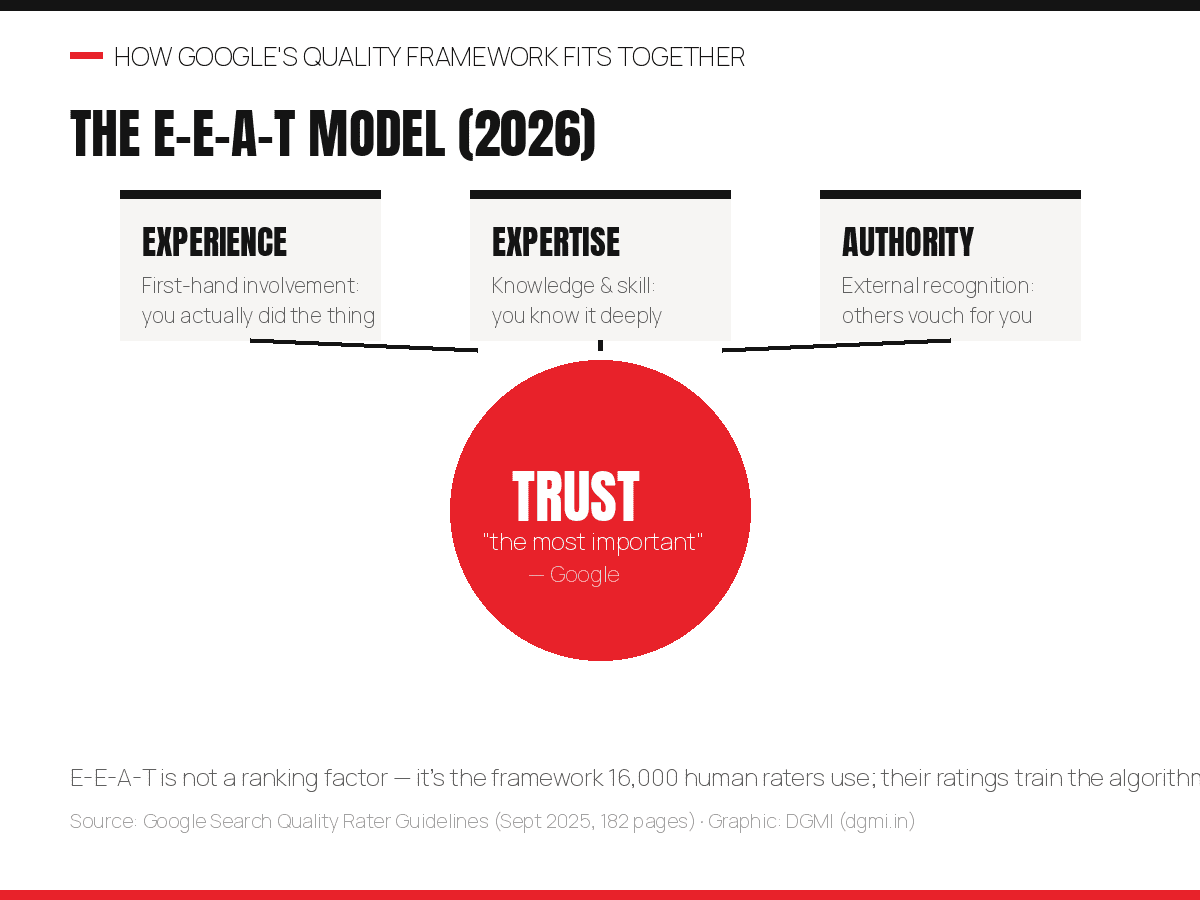
• Google’s own guidance is explicit: of the four aspects, trust is the most important
• After the March 2026 core update, sites publishing original data gained +22% visibility while AI-paraphrased content lost 71% of its traffic (SE Ranking)
1. What E-E-A-T Actually Is (and Isn’t)
E-E-A-T stands for Experience, Expertise, Authoritativeness and Trustworthiness. It comes from Google’s Search Quality Rater Guidelines — the 182-page manual that around 16,000 contracted human raters use to score real search results. The second “E” (Experience) was added in December 2022, and the current edition is the September 11, 2025 version.
Here’s the part most articles get wrong: E-E-A-T is not a ranking factor. There is no E-E-A-T score in the algorithm. Raters score pages against the framework, those human judgments become training data, and Google’s systems learn to reward the same qualities at scale. So you can’t “optimize for E-E-A-T” with a plugin — you build the observable signals the framework describes, and the algorithm finds them. That’s actually good news: the signals are concrete, buildable things, and this guide lists all of them.
2. Experience — Prove You’ve Actually Done It
Experience asks one question: has the author personally done the thing they’re writing about? A hotel review from someone who stayed there. A Google Ads tutorial from someone who has spent real budget. It’s the newest pillar — and the hardest one to fake, which is exactly why Google added it as AI-generated content flooded the web. The 2025 rater guidelines go further: fake experience claims now actively hurt your quality rating.
Do these, starting today:
- ✓ Add original screenshots to every how-to — your own dashboard, your own settings, your own results. Stock images signal zero experience; a screenshot with your account name (blurred where needed) signals everything.
- ✓ Include real numbers from real work — “when we ran this for a client, CPC dropped from ₹18 to ₹11 in three weeks” beats a paragraph of theory.
- ✓ Write “what I’d do differently” sections — mistakes and lessons are experience markers no AI paraphraser produces.
- ✓ Use first person where it’s true — “I tested,” “we audited,” “my student asked.” Then make sure the “I” is a named, real person (next section).
3. Expertise — Prove You Know It Deeply
Expertise is demonstrated knowledge — formal credentials on YMYL topics (health, finance), or provable skill everywhere else. In practice, Google reads expertise through who the author is and how the content holds up.
- ✓ Put a real, named author on every article with a 2–3 line bio stating exactly why they’re qualified (“12 years in digital marketing, 100+ students trained” — specific, verifiable claims).
- ✓ Build an author page that lists the bio, photo, credentials, social profiles and every article they’ve written — then link every byline to it.
- ✓ Add Person schema connecting the author to their LinkedIn and other profiles via
sameAs— this is how Google’s Knowledge Graph learns your author is a real entity, an increasingly important signal in 2026. - ✓ Answer the follow-up questions a real expert would anticipate — depth, edge cases and “it depends” nuance are what separate expert content from summaries.
- ✓ Keep it current — visible “Updated [date]” lines with genuinely refreshed stats. Outdated numbers quietly signal the expert left the building.
4. Authoritativeness — Get Others to Vouch for You
Here’s the uncomfortable truth about the “A”: you can’t award it to yourself. Authority is external — it exists in what other sites, platforms and people say about you. That makes it the slowest pillar to build, and the most defensible once you have it.
- ✓ Earn links from relevant, real websites — industry blogs, education directories, local press. One citation from a recognized publication outweighs dozens of random directory links. (Never buy bulk links — Google’s spam updates, like June 2026’s, exist precisely for that.)
- ✓ Collect unlinked brand mentions too — Google’s entity systems detect them, and they feed AI-search citations as well.
- ✓ Be consistently present where your industry talks — genuine answers on Quora and Reddit, quotes in roundups, podcast appearances. Recognition compounds.
- ✓ Publish something worth citing — original data, surveys, or a genuinely better resource (that’s the whole strategy behind our 25-point SEO checklist). Original assets are how small sites earn big-site links.
🎯 Want to Build All of This on a Real Website — With a Mentor Beside You?
In DGMI’s Digital Marketing + AI Course, you set up author pages, schema, E-E-A-T signals and full SEO on a real site you build yourself — live, 1:1, with a trainer of 12 years. Try the teaching style first with a 100% practical crash course class — FREE this week.
5. Trust — The Pillar That Holds It All Together
Google’s own people-first content guidance says it plainly: of the four aspects, trust is the most important. The other three exist to feed it. And 2026 gave us striking evidence of how literally Google means this: analyses of the March 2026 core update (including Lily Ray’s) found Google elevating primary sources — government agencies, nonprofits, original data owners — above heavily-credentialed publishers who merely wrote about those sources. Being trustworthy at the source level beat being expert at the commentary level.
- ✓ Cite named sources with links for every factual claim — the way this guide does. Unsourced statistics are trust leaks.
- ✓ Make your site transparent: a real About page with real people, a Contact page with working email and phone, visible Privacy Policy and Terms. Anonymous websites don’t get trusted — by users or raters.
- ✓ HTTPS, accurate titles, no bait: the page must deliver exactly what its title promises. Clickbait is a trust penalty you pay on every future article.
- ✓ Collect and respond to reviews — on Google Business Profile and anywhere your audience checks. Reputation research is a formal step in the rater process.
- ✓ Correct mistakes visibly — an honest correction note builds more trust than a silent edit.
6. The Proof: What March 2026 Rewarded — and Punished
If E-E-A-T ever felt theoretical, the March 2026 core update ended that. It was the most volatile update on record — SE Ranking measured 79.5% movement in top-3 results — and the winners and losers split along one line:
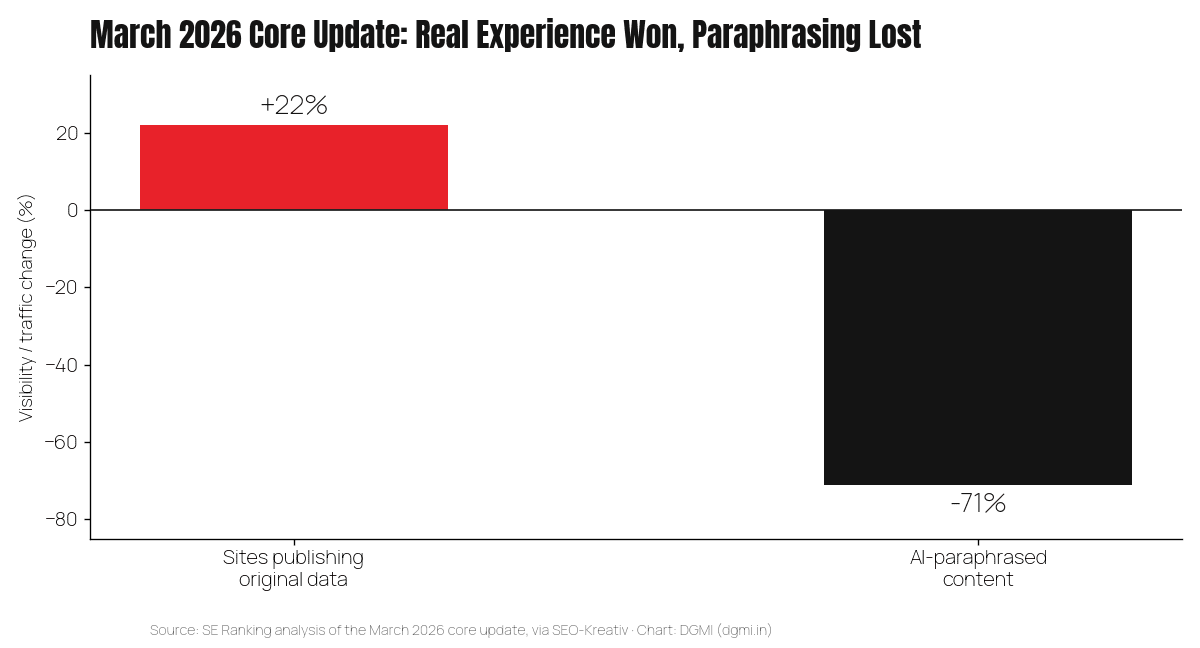
The 2025 rater guidelines updates explain why. For the first time, Google formally defined generative AI in the guidelines and instructed raters that AI-generated content with no added value gets the Lowest possible rating. Note the precision: AI-assisted content with genuine human experience, editing and original input is fine. AI-substituted content — paraphrased summaries of other people’s work — is what the −71% column is made of.
7. The Complete E-E-A-T Signals Table
Everything above, condensed into one reference. Screenshot it, or better — audit your site against it row by row:
| Level | Signals to build | Pillar served |
|---|---|---|
| Page level | Original screenshots & photos, real numbers, cited sources, named byline, visible update date, direct answers under question headings, accurate title | Experience + Trust |
| Author level | Author page with bio, photo & article list; credentials stated specifically; Person schema with sameAs → LinkedIn/socials; consistent identity across the web | Expertise |
| Site level | About, Contact (email + phone), Privacy Policy & Terms, HTTPS, Organization schema, consistent NAP, review presence, editorial corrections | Trust |
| Off-site level | Relevant backlinks, unlinked brand mentions, directory & platform profiles, quotes/appearances, original citable assets | Authoritativeness |
One extra note for YMYL topics (health, money, safety, and — since the September 2025 update — government, civics and society): raters apply their very highest standards there. If you write in those spaces, every row above is mandatory, not optional.
8. Your 30-Day E-E-A-T Action Plan
Week 1 — Identity: write your author bio, build the author page, add Person + Organization schema, and fix About/Contact/Privacy pages. This is one honest weekend of work. Week 2 — Your top 5 pages: add named bylines, update dates, cited sources and at least one original screenshot or data point to each. Week 3 — Trust surface: request 5 Google reviews from real customers/students, respond to every existing review, verify NAP consistency across your listings. Week 4 — One citable asset: publish one thing containing original experience or data — a case study, a mini-survey, a documented experiment. Then repeat Week 2’s treatment on five more pages each month. E-E-A-T isn’t a sprint metric; it’s compound interest.
9. How We Applied Every Step on This Very Website
Fair question: does DGMI practice this? Check for yourself — this site is the worked example. Every article carries a named byline linking to a full founder profile with Person schema and sameAs links (Expertise). Guides like this one and our career guide cite named external sources for every statistic, and our news desk publishes verified update coverage with primary-source links (Trust). The site has full contact details, legal pages and Organization schema sitewide (Trust again). And our checklist and data charts exist to be cited by others (Authority — a work in progress, honestly; authority is the slow pillar for everyone). We built it this way deliberately, and it’s exactly the setup we teach students to replicate on their own projects.
10. FAQ
Is E-E-A-T a ranking factor?
No — and Google says so directly. There’s no E-E-A-T score in the algorithm. It’s the framework human quality raters use to judge pages; their judgments become training data that teaches the algorithm which observable signals (authorship, sourcing, reputation, transparency) to reward. Build the signals and the rankings follow the long way around.
Can a brand-new website have E-E-A-T?
Yes — three of the four pillars are fully in your control on day one. Experience (original proof), Expertise (real authorship + schema) and Trust (transparency, sourcing, honest pages) can all be built before your first visitor arrives. Only Authority takes time, because it lives on other people’s websites. New sites that launch with the first three tend to earn the fourth much faster.
Does using AI to write content kill my E-E-A-T?
Not if you use it correctly. The 2025 rater guidelines target AI content with no added value — paraphrased, unverified, experience-free output gets the Lowest rating. AI-assisted content where a real, named human contributes the experience, verification, examples and judgment is explicitly acceptable. The test: could this page only have been written by someone who actually does this work? If yes, you’re safe.
How long until E-E-A-T work shows results?
Page-level and author-level fixes typically start reflecting within one to two core updates — so expect the clearest read at the next major update after your changes (2026’s cadence suggests one lands roughly every quarter). Authority signals take 6–12 months of consistent earning. That timeline is exactly why the sites that started in 2024 look untouchable in 2026 — and why the best day to start is today.
🚀 Learn SEO the Way Google Actually Rewards It
DGMI’s 3-month Digital Marketing + AI Course (₹29,999) has you build a real website and implement everything in this guide hands-on — E-E-A-T, technical SEO, content, schema — plus Google & Meta Ads, Analytics, AI workflows and GEO. Live 1:1 classes, worldwide-recognized certification, and a free practical crash course class to see it for yourself first.
Questions? Contact us · hello@dgmi.in · +91 96940 03464

Sources: Google Search Quality Rater Guidelines overview (official) · Google — Creating helpful, people-first content · QRG 2025–2026 changes breakdown (TheGuideX) · Content quality signals inventory (Digital Applied) · SE Ranking March 2026 data via SEO-Kreativ
Next steps: audit your site with the 25-point SEO checklist · Follow every algorithm update on the DGMI News desk · Want to publish your own guides and earn XP? Join the DGMI Community.
[…] talking about you. This is the same trust framework Google calls E-E-A-T, explained fully in our E-E-A-T guide, and it turns out AI systems care about very similar […]