

How We Generated 229 Real Estate Leads in 21 Days Using Meta Ads
Generating leads with Meta Ads is relatively easy. Generating them at a sustainable cost across multiple real estate campaigns is much more difficult.
Real estate advertisers have to deal with several variables at the same time: location, property price, buyer intent, creative quality, project positioning, lead form friction and campaign optimization. A setup that works well for one project may perform very differently for another.
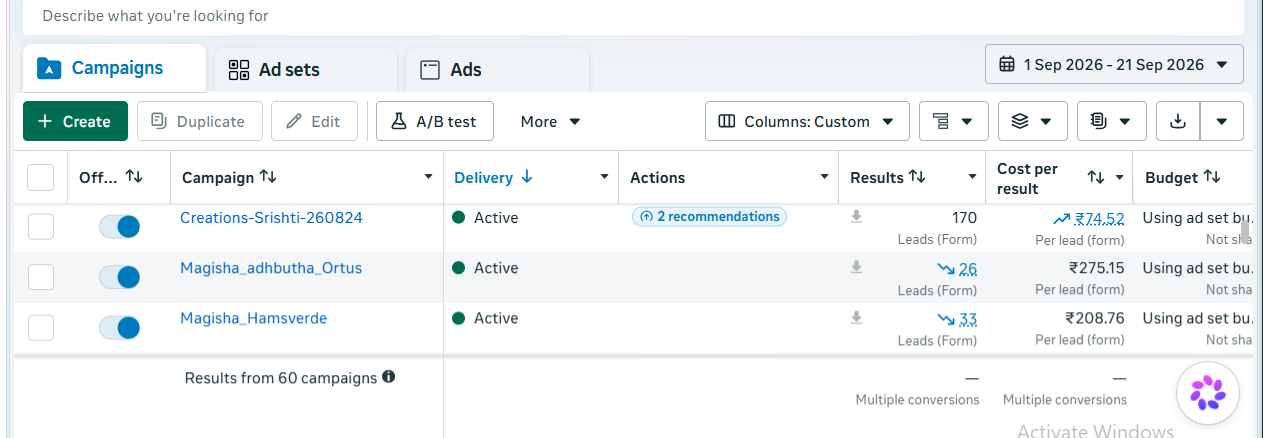
During a recent real estate advertising period, we managed three Meta lead-generation campaigns running between 1 September and 21 September 2026.
Across the three campaigns, Meta Ads Manager recorded:
- Campaign 1: 170 leads at ₹74.52 per lead
- Campaign 2: 26 leads at ₹275.15 per lead
- Campaign 3: 33 leads at ₹208.76 per lead
- Total: 229 Meta Lead Form leads
- Approximate blended cost per lead: ₹108
The interesting part was not simply generating 229 leads. It was seeing how differently three campaigns could perform even when they shared the same broader objective.
This case study breaks down the practical lessons we learned from those campaigns and what other marketers should consider when running Meta Ads for real estate.
The Challenge With Real Estate Lead Generation
Real estate is not a simple impulse-purchase category.
Someone may click an advertisement because a property looks attractive but still have no immediate intention of purchasing. Another person may genuinely be searching for a property but have a budget that does not match the project.
That creates an important distinction between generating a lead and generating a useful sales opportunity.
For this reason, looking only at the number of leads can be misleading.
When evaluating a real estate Meta Ads campaign, we consider several factors beyond the headline lead count:
- Cost per lead
- Project location
- Property price and ticket size
- Audience relevance
- Creative and offer
- Lead form completion rate
- Responses to qualification questions
- Follow-up performance
The Meta Ads dashboard provides valuable acquisition data, but sales teams still need to determine what happens after the form is submitted.
For the results discussed in this article, therefore, “lead” refers specifically to a Meta Lead Form submission. We are not treating every form submission as a confirmed qualified buyer, site visit or sale.
The Campaign Results
Between 1 and 21 September 2026, the three campaigns produced noticeably different results.
Campaign 1: 170 Leads at ₹74.52 CPL
The strongest campaign generated 170 leads at ₹74.52 per lead.
This campaign accounted for most of the total lead volume and achieved the lowest CPL among the three campaigns.
A result like this demonstrates why marketers should avoid judging an entire advertising account based on a single average.
When one campaign is working efficiently, it can contribute a large percentage of the account’s overall lead volume.
At the same time, a low CPL should not automatically trigger aggressive budget increases. Before scaling, marketers should still examine lead relevance and downstream sales feedback.
Campaign 2: 26 Leads at ₹275.15 CPL
The second campaign generated 26 leads at ₹275.15 per lead.
Its CPL was significantly higher than Campaign 1.
This does not automatically mean the campaign was a failure.
Different real estate projects can have very different economics. Location, pricing, property type, competition and the size of the realistic buyer pool can all influence acquisition costs.
This is why comparing campaigns only by CPL can lead to poor decisions.
A ₹75 lead is not necessarily more valuable than a ₹275 lead if the projects and audiences are fundamentally different.
Campaign 3: 33 Leads at ₹208.76 CPL
The third campaign generated 33 leads at ₹208.76 per lead.
Its performance sat between the first and second campaigns.
Again, the important lesson was that there was no universal “good CPL” that could be applied blindly across every project.
Campaign performance needs to be evaluated within the context of the property being advertised.
What the Combined Numbers Tell Us
Across all three campaigns, Meta Ads Manager recorded 229 leads during the 21-day period.
Using the visible lead volume and CPL figures, the combined advertising spend was approximately ₹24,700, resulting in a blended CPL of roughly ₹108.
However, the blended number hides a major difference.
Campaign 1 achieved a CPL below ₹75, while Campaign 2 exceeded ₹275.
That gap is important.
If we had looked only at the account-level average, we would have missed the fact that one campaign was substantially more efficient at generating form submissions than the others.
This is one reason campaign-level analysis is essential in performance marketing.
Lesson 1: Do Not Use One CPL Benchmark for Every Property
One of the biggest mistakes in real estate advertising is expecting every project to generate leads at the same price.
Consider two hypothetical projects.
One may be an affordable plotted development aimed at first-time buyers. Another may be a premium apartment or villa project requiring a much larger investment.
The audience size, financial commitment and purchase journey are different.
Naturally, their advertising economics may also differ.
Instead of asking:
“Is ₹200 CPL expensive?”
A better question is:
“Is ₹200 CPL commercially viable for this particular project and the type of enquiries it is generating?”
That question forces marketers to connect advertising metrics with business outcomes.
Lesson 2: Location Targeting Needs to Match the Project
Real estate is heavily dependent on geography.
A campaign can have excellent creatives and still waste budget if it reaches people who are unlikely to consider the project’s location.
Before launching a campaign, marketers should understand:
- Where the project is located
- Which surrounding areas are relevant
- Major employment hubs nearby
- Transport connectivity
- Schools, hospitals and other landmarks
- Whether the project appeals to end users, investors or both
- Whether buyers commonly come from other cities or countries
The targeting strategy should come from the actual project rather than from a fixed audience template reused for every campaign.
Lesson 3: The Advertisement Must Communicate the Offer Quickly
Real estate advertisements compete with hundreds of other pieces of content in the user’s feed.
The creative therefore needs to communicate the core proposition quickly.
Depending on the project, useful information can include:
- Property type
- Starting price
- Location
- Plot or unit size
- Approval status where applicable
- Major connectivity points
- Key amenities
- A clear next action
The objective is not to put every detail about the project into one advertisement.
The objective is to give the right person enough information to decide whether the project deserves further consideration.
This can also reduce completely irrelevant form submissions because users understand the basic offer before becoming a lead.
Lesson 4: Lead Forms Should Do More Than Collect a Phone Number
A lead form can be extremely short and generate a high volume of submissions.
But maximum volume is not always the best business outcome.
For real estate campaigns, useful qualification questions may include:
- Preferred property size
- Approximate budget range
- Purchase timeline
- Purpose of purchase
- Preferred location
- Whether the prospect wants to schedule a site visit
The exact questions should depend on the project.
There is also a trade-off.
Every additional question creates friction and may reduce the total number of submissions. However, carefully chosen questions can give the sales team more context before contacting a prospect.
The goal is not to create the longest form possible. It is to collect enough information to make the enquiry more actionable.
Lesson 5: Cheap Leads Are Not the Final Objective
Campaign 1 produced leads at ₹74.52 each, which was substantially cheaper than the other two campaigns.
From an advertising dashboard perspective, that is an excellent efficiency signal.
But CPL is still an intermediate metric.
After a lead enters the system, the business should ideally track what happens next:
Ad → Form Submission → Contacted → Relevant Prospect → Site Visit → Booking/Sale
Without this connection, Meta can tell us how efficiently we generated form submissions, but it cannot by itself tell us the full commercial value of those leads.
This distinction becomes increasingly important as campaigns scale.
Lesson 6: Campaigns Should Be Evaluated Separately Before Scaling
When several campaigns are active, it is tempting to make account-wide decisions.
That can be risky.
A better approach is to examine each campaign independently.
For example:
Campaign 1
170 leads at ₹74.52 CPL indicates strong lead-generation efficiency. Before increasing budget substantially, the next question should be whether lead relevance remains acceptable as spend increases.
Campaign 2
26 leads at ₹275.15 CPL deserves investigation. Creative, audience, offer, project positioning and downstream lead quality should be reviewed before deciding whether to optimize, continue or reduce spend.
Campaign 3
33 leads at ₹208.76 CPL sits between the other two. It should be evaluated against its own project economics rather than Campaign 1’s CPL.
This prevents marketers from shutting down a potentially valuable campaign simply because another project happens to generate cheaper leads.
Lesson 7: Sales Feedback Should Influence Advertising Decisions
One of the most useful sources of campaign intelligence is often outside Ads Manager.
It is the sales team.
Marketers should regularly ask:
- Are prospects answering calls?
- Do their budgets match the project?
- Are they genuinely interested in the location?
- Are they asking for more information?
- Are site visits being scheduled?
- Which campaigns are producing the most relevant conversations?
This feedback can reveal problems that are invisible in advertising metrics.
For example, a campaign with a low CPL may generate many low-intent enquiries. A higher-CPL campaign may generate fewer but more relevant prospects.
Without CRM or sales feedback, that distinction can easily be missed.
What We Would Monitor Next
The 229 leads provide a useful acquisition snapshot, but they are not the end of the analysis.
For the next stage, the most valuable metrics would be:
- Contact rate
- Lead-to-qualified-prospect rate
- Site-visit rate
- Cost per site visit
- Booking or sale conversion rate
- Cost per acquisition
- Revenue attributed to each campaign
Connecting these metrics with Meta campaign data would make it possible to optimize toward business outcomes rather than only form submissions.
Practical Checklist for Real Estate Meta Ads
Before launching or scaling a real estate campaign, ask:
- Is the project’s target buyer clearly defined?
- Does the location targeting reflect realistic buyer geography?
- Does the creative communicate price, location and key value quickly?
- Does the lead form collect enough information without creating unnecessary friction?
- Are campaigns being evaluated individually?
- Is CPL being compared with downstream lead quality?
- Is the sales team providing feedback to the marketing team?
- Are leads tracked beyond the initial form submission?
- Is budget being scaled based on evidence rather than just cheap CPL?
- Are different projects being given different performance expectations?
Final Takeaway
The biggest lesson from these campaigns was not simply that Meta Ads generated 229 leads in 21 days.
It was the variation behind that total.
One campaign produced 170 leads at ₹74.52 each, while the other campaigns generated leads at ₹208.76 and ₹275.15.
That difference demonstrates why real estate advertisers should avoid relying on universal CPL benchmarks.
Each project has its own audience, location, pricing, demand and sales process.
Meta Ads can be an effective real estate lead-generation channel, but the dashboard should be treated as the beginning of the analysis rather than the end.
The strongest campaign decisions come from combining advertising metrics with lead qualification and sales outcomes.